Defining the Future of Automotive Audio
- James Alford
- 3月10日
- 読了目安: 6分

As vehicle programs pivot toward centralized and zonal architectures, most OEM audio strategies are still built around legacy assumptions. Amplifiers, speakers and branded options get plenty of attention but the software that determines how those components behave over a vehicle’s lifespan usually does not. The result is an audio stack that looks great on the surface, but is still specified, sourced and governed as if the vehicle were not software defined at all.
This gap is showing up in two places.
Before Start of Production (SOP), OEMs carry more cost and complexity than they need to, because audio remains tightly coupled to hardware on a program by program basis. After SOP, vehicles leave a large share of potential lifecycle value on the table, because the audio platform is not set up to deliver new features, services and experiences at scale. Software defined audio is the missing link between Software-Defined Vehicle (SDV) roadmaps and the parts of the cabin that drivers and passengers experience every day.
Where Legacy Audio Models Break Down
Legacy audio models were designed for distributed Electrical/Electronic Architectures (EEA). Individual ECUs and dedicated amplifiers carried their own logic and tuning. That approach is increasingly at odds with central compute roadmaps, where OEMs can consolidate signal processing and software functions onto a centralized System on a Chip (SoC).
Three key areas stand out:
Hardware centric decision making Audio discussions still begin with channel counts, power ratings, and speaker layouts. Software is treated as an attribute of a specific amplifier or head unit, not as an asset that should travel across programs and generations. That makes it difficult to reuse work or to decouple feature planning from hardware timelines.
Fragmented responsibilities Sound in the vehicle now touches infotainment, ADAS, User Experience (UX), connectivity, and brand teams. In practice, each group tends to optimize its own priorities: safety alerts, voice assistants, navigation prompts, music and media streaming, and third-party apps all compete for space. Without a shared framework, compromises are resolved late and expensively, often by adding more hardware or local patches rather than by reshaping the overall audio platform.
Limited alignment with SDV roadmaps Many OEMs have strategies for central compute, over-the-air (OTA) updates, and software platforms. Audio rarely appears explicitly in those roadmaps. As a result, next generation audio concepts are discussed in parallel to SDV plans instead of being treated as a core SDV use case. That delays architectural decisions and makes it harder to quantify return on investment.
The result is higher pre-SOP engineering spend, more variants to validate, and a proliferation of “one-off” audio solutions that cannot easily benefit from central platform improvements.
Collaboration, Integration, And Invisible Value
Audio exposes another constraint: how OEMs and suppliers talk to each other.
On the OEM side, lack of clarity on table stakes versus premium content makes choices harder than they should be. It is often unclear which capabilities should be standard, which are reserved for higher trims, and which should be treated as optional or post SOP feature deployments. Without that hierarchy, sourcing is dominated by hardware cost and logo strength rather than lifecycle contribution.
On the supplier side, the technical and commercial narratives remain uneven. Many suppliers invest heavily in audio algorithms, tuning tools and lifecycle services. But those investments do not always land with decisionmakers. Without a strong software led narrative, suppliers risk being seen as interchangeable hardware providers even when their real differentiation sits in software, tools, and support models. In that scenario, genuine value becomes invisible in procurement discussions, and the audio roadmap converges toward the lowest perceived cost.
The net effect is that brand defining audio is difficult to reuse and a large portion of the SDV lifecycle value never reaches the audio domain.
What Changes With Software Defined Audio
Software defined audio means treating the whole vehicle audio layer as a programmable, updateable platform that sits alongside other SDV building blocks rather than at the edge of the system.
A software defined approach typically includes:
A core audio software stack that runs on central or zonal compute, abstracting software like DSP implementations whilst still allowing for hardware optimization.
A configuration and asset/rules library that can support multiple OEM brands and trims.
Builtin support for OTA updates, feature toggling, and diagnostics, so that audio can participate in the same lifecycle processes as other SDV domains.
Clear integration points with HMI, ADAS, connectivity, and cloud services, enabling smarter coordination of alerts, speech, and entertainment across the cabin.
This changes both sides of the business case. Before SOP, OEMs can simplify testing and reuse across variants, whilst reducing BoM cost through software-based hardware optimization. After SOP, they gain a route to introduce new modes, personalization features, and content specific experiences without waiting for hardware refreshes.
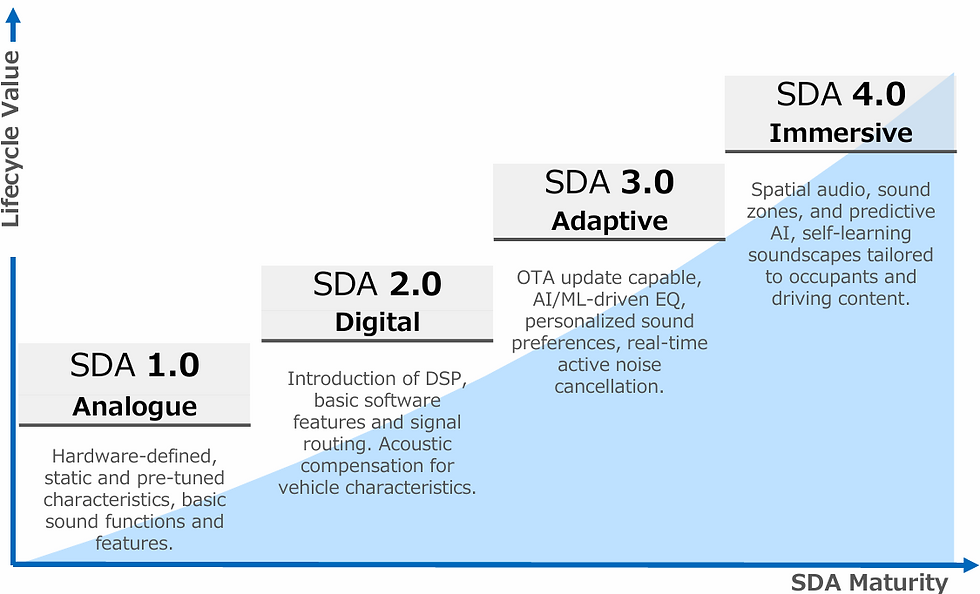
Pre-SOP Cost And Complexity Levers
From a program perspective, several levers appear as soon as audio is designed on software defined principles:
Fewer unique hardware combinations For entry to mid-market segments, the same base hardware can support different trims and brands through software-based enhancements rather than physical change. That reduces the number of amplifier, harness and speaker variants, and lowers the effort required to validate each combination.
Reusable tuning and integration assets A common audio platform allows engineering teams and partners to build libraries of pre-sets, behaviors, and audio policies that can be deployed across multiple nameplates. Instead of building from scratch on each program, teams adapt existing assets to new interior layouts and use cases.
Earlier convergence on requirements With central compute and SDA in mind, UX, ADAS, and audio teams can agree on routing, prioritization, and failsafe rules much earlier in the cycle. That reduces late change requests and integration surprises, which are common cost drivers in traditional audio programs.
These changes do not require a radical break with existing suppliers. They do require that audio is framed as part of the SDV platform from the first architecture discussion, not as an isolated domain tackled once the rest of the system is set.
Audio Into A Lifecycle Asset
Once vehicles are in customer hands, software defined audio opens a different set of options.
Because the audio stack is updateable and connected to vehicle and user data, OEMs can introduce new capabilities over time without touching hardware. Examples include new listening modes, adjustments to how safety alerts and navigation prompts are mixed with media, or additional and enhanced spatial and immersive features.
Personalization becomes more realistic as well. Profiles can carry not only simple tone settings but preferences for how different content types are presented, how aggressively background noise is managed, and how shared the cabin experience should be. Those preferences can travel with the customer across vehicles in the same brand family when accounts and backend systems support it.
From a commercial standpoint, this supports a richer mix of onetime and recurring offers. Some OEMs may prefer to keep audio features bundled with hardware or trim levels. Others will explore bundled options as part of connectivity services, feature unlocks, time limited packages, or partnerships with content providers. In each case, the underlying requirement is the same: the audio platform has to be able to deliver and manage these offers with the same discipline used for other SDV services.
Why A Shared Framework Is Now Necessary
The main challenge is the absence of a common framework that links audio strategy to SDV maturity, brand positioning, and architectural constraints.
To create clarity, OEMs and suppliers need to work to a defined, tiered, SDV aligned audio framework that maps different requirements and customer expectations across entry, mid, and premium/luxury segments. It should clarify where software creates differentiation and distinguish clearly between table stakes functionality, premium experiences, and areas best suited for partner ecosystems. That includes tuning, spatial rendering, personalization, and lifecycle services such as continuous optimization or analytics driven improvements.
Such a framework does not replace differentiation. It would create the common ground needed for OEMs to make deliberate choices about where to compete, where to standardize, and how to allocate investment across the vehicle lifecycle.
Positioning Software Defined Audio Within SDV Roadmaps
As SDV strategies mature, audio will either be pulled along by default architectural decisions or deliberately positioned as a flagship use case. The first path risks locking in legacy patterns under a modern technical surface. The second treats audio as a clear, customer visible proof point that SDV thinking can translate into day today value.
For OEMs, the opportunity is to reframe audio from component choices to an early stage platform decision. For suppliers, it is a chance to articulate software led capabilities in a way that fits SDV planning cycles instead of being squeezed into traditional hardware negotiations.
At SBD Automotive, we’re exploring how we can move the industry conversation from “what amplifier do we buy?” to “what experiences and lifetime value can we unlock?”. To close this gap, we will be launching an initiative to define the software-defined audio framework so if audio impacts your architecture or customer experience discussions, this may be the right moment to formalize how it fits within your wider SDV roadmap. To find out more, click here.

“The OEMs that will win in the software-defined audio era aren’t those that simply spec the best speakers. They’re the ones who realize audio is a new business model, one that that differentiates, renews, and compounds with every software release.”
James Alford
Manager- C-AMS
SBD Automotive