
Why does the OTA repair gap persist despite better software delivery?

Unresolved vehicles need just as much focus as new software releases.
Vehicles still waiting for a fix can tell us more about OTA performance than a release announcement alone. OEMs already track installations, offer scheduling, and roll out updates in stages. The real question is how well these controls help owners complete updates and fix the original problem, especially when they need extra support.
Vehicles still awaiting the update.
Lucid’s August 2026 recall filing illustrates the distinction. Software version 2.10.0, released in July, improved overcurrent protection for exterior-lighting circuits. Telematics showed that 20,719 of 27,185 affected Air vehicles had installed the remedy or a later version. Another 6,466 had not yet installed the update at filing. Owners were advised to park outside and away from structures until the remedy was completed.
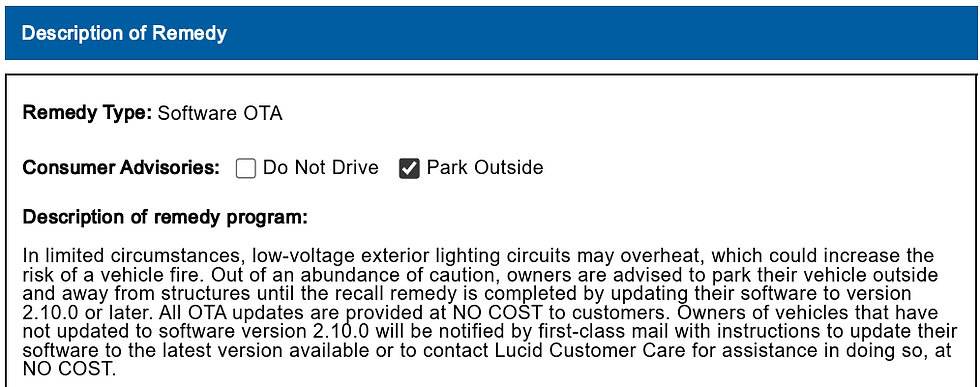
Lucid was tracking how many owners installed the update. These numbers show a snapshot in time, but they don’t explain why some vehicles still haven’t been updated or whether ongoing issues occurred.
Tracking completions helps spot which updates are still missing. To understand why, you need more data to tell whether owners postponed, downloads failed, or installations failed, and to check for network or storage problems. Regular reporting can show if follow-up actions fix these issues. When comparing completion rates, also consider how long the campaign has run, how serious the defect is, and which vehicles are eligible.
Owners need a workable installation window.
Volvo’s US guidance allows owners to schedule or postpone installation and receive completion notifications. Kia’s European guidance explains prerequisites and warns that controller updates can prevent vehicle operation, charging and V2L use for up to 100 minutes. Remote start is unavailable too. During Digital Key system updates, owners retain smart-key access to the doors.
Owners must plan OTA updates around their trips and charging needs. The 100-minute maximum is just a limit; it doesn’t reflect typical installation time or mean the process is slow.
To assess progress, it’s important to see if scheduling and reminders help more owners complete updates, how often installations need to be retried, and if the time and requirements can be reduced. Comparing these results to past performance would show if things were improving.
Checking whether the repair works
Rivian’s September 2026 recall concerned a sequence in which a stability-control notification could overlap the reversing-camera image. The NHTSA Part 573 report recorded the remedy installed on 95% of affected R1 vehicles and 96% of affected R2 vehicles. This shows substantial deployment progress. The defect was remedied through OTA; this does not establish that an earlier OTA caused the defect.
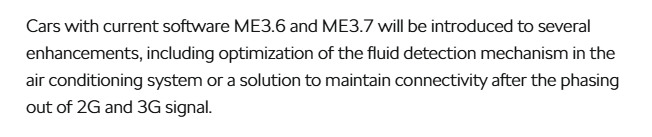
Škoda documents staged deployment for its Enyaq ME3.8 update, providing an existing foundation for managing rollout risk.
Repeat complaints, ongoing diagnostic faults, and repeated repairs can help measure how well the fix works, if they truly reflect the defect. If problems keep happening, it’s important to review all software components and suppliers. There’s no public proof that these OEMs don’t monitor for this. However, warranty or aftersales data might not be easy for the OTA team to access. Linking reliable records would make it easier to judge repair results.
Support for older vehicles
Older software sometimes needs a workshop visit. Volvo says vehicles that aren't updated often may need a workshop visit to receive OTA updates again, and there could be a fee. Some updates must be installed at a workshop. This does not mean owners are charged for recall fixes.
Lucid’s September 2026 Air UX 3.0 announcement shows a hardware limit. Eligible vehicles receive the experience through OTA; MY2022–2023 and some MY2024 Air vehicles require a processor upgrade. The US price is $950, including installation and excluding taxes. This optional feature upgrade is distinct from the earlier safety remedy.

These factors matter when evaluating claims of ongoing improvement. Owners need clear details about which hardware is eligible, what updates are needed, how long support lasts, and any possible costs. They also need to know how much effort and time it takes to use workshop recovery options. The process might be available, but the real test is how convenient remote updates are for owners.
Responsibility for unresolved vehicles
In September 2026, China’s SAMR linked recurring software defects and routine iteration to stronger lifecycle quality management. GB/T 48140-2026, a recommended national standard effective from 1 December, addresses software quality and defect management, including OTA recall processes (Read SAMR).
Consider completion rates, recurring problems, and customer disruption together. Just because there aren’t public metrics doesn’t mean internal processes don’t exist or aren’t working.
Evidence and priorities for assessment
Area | Documented evidence | What remains unclear | Assessment or next step |
Update completion (Lucid Recall) | Installation tracking and completion reporting | Reasons for outstanding updates | Diagnose failures using additional telemetry |
Installation(Volvo & Kia) | Scheduling and prerequisites | Typical duration and owner disruption | Measure retries and completion |
Repair validation(Rivian & Škoda) | High uptake and staged deployment | Post-repair recurrence | Connect diagnostics, complaints and repairs |
Older Vehicle Support (Lucid & Volvo) | Hardware limits and workshop routes | Owner effort and support expectations | Clarify eligibility and recovery |
Lifecycle Quality (China SAMR) | Recommended software quality standard | Campaign-level outcomes | Assess completion and recurrence |
Where OTA proves its value
OEMs already have several ways to manage OTA software delivery. The real value comes from how well they help vehicles that still need updates. Put completion rates in context, link installation success to repair results, and provide clear support for owners of older vehicles. Improving these areas would give owners a more reliable experience.
“OTA earns its value by resolving the owner’s problem reliably. The next step is to understand why some vehicles haven't been updated yet, provide appropriate support, and check whether the fault recurs. Shorter installation windows and clearer support commitments for older vehicles would also help.” Amit Shukla - SBD Automotive Product Owner |  |
How SBD can help
SBD Automotive can help benchmark your position against the wider industry and identify where action is needed most. To explore how these trends impact your strategy, architecture and supplier roadmap, get in touch with SBD Automotive for a deeper discussion. Email info@sbdautomotive.com |


