
In-car AI agents: What works today and what is missing
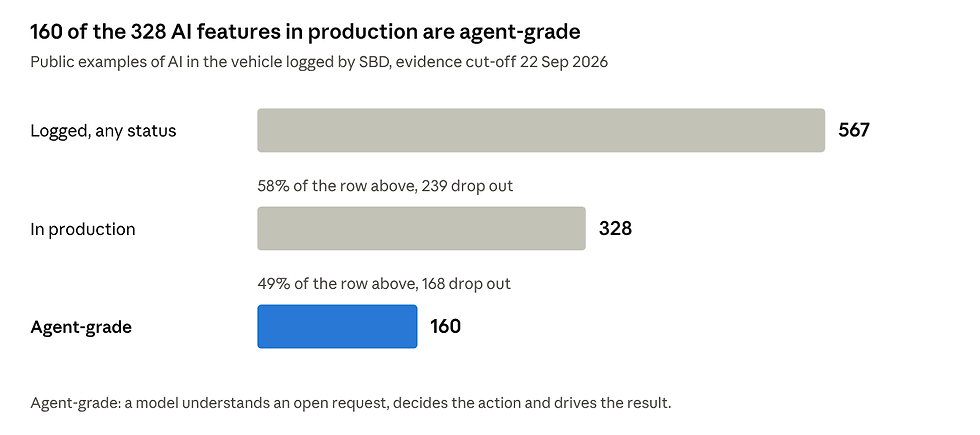
Almost every new cockpit assistant is now sold as an AI agent. SBD found 328 AI features already in customers' cars. Fewer than half meet a basic agent standard, and the capabilities that make an agent personal and trustworthy are close to absent.
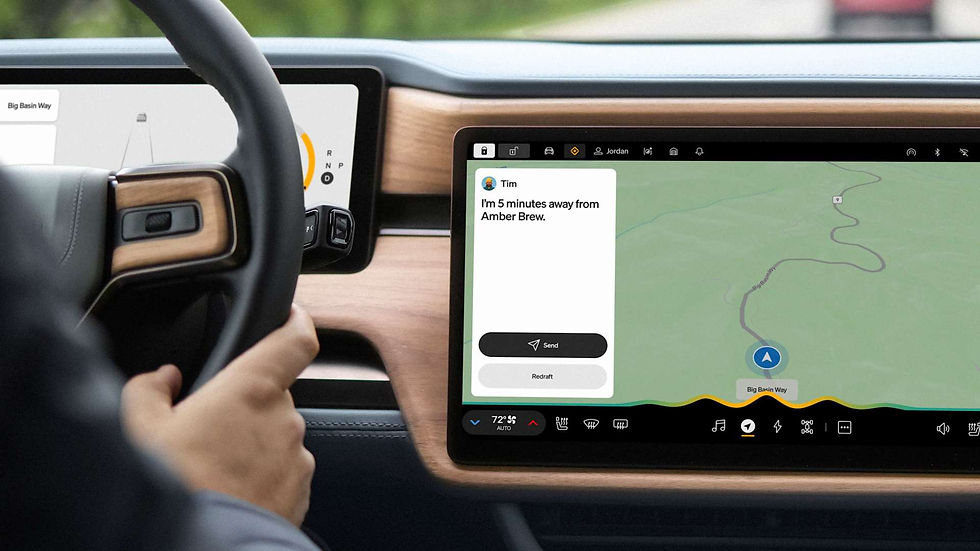
In the past year Gemini arrived in GM, Volvo and Honda vehicles. Grok moved from conversation to vehicle control and errands. Li Auto's assistant already pays for parking by itself. To see what sits behind the label, SBD logged 567 public examples up to 22 September 2026 and mapped each one to 11 agent capabilities and 11 stages of the ownership journey.
Fewer than half of the AI features in production are agents
SBD counts a product as agent-grade when a model decides at runtime what to do and how, and that decision drives the result. Three conditions must all hold. The model understands an open request. It chooses the tool, the route or the answer. Its choice produces the result, and an answer counts as a result. The criteria follow the line Anthropic and LangChain draw between workflows and agents.
Volvo's Gemini integration passes. Drivers speak freely and the model picks the vehicle function. Plug & Charge is fully automatic but fails, because no model sits in the chain.
Memory, authorisation and explanation are still rare
SBD found 45 brands with at least one agent-grade product in production. At 39 of them the driver can make a request in their own words, through what SBD calls an open language entry. Seven ship long-term memory. Hyundai is the only one with authorisation and guardrails, and Li Auto the only one with explainability. No brand has both memory and authorisation.
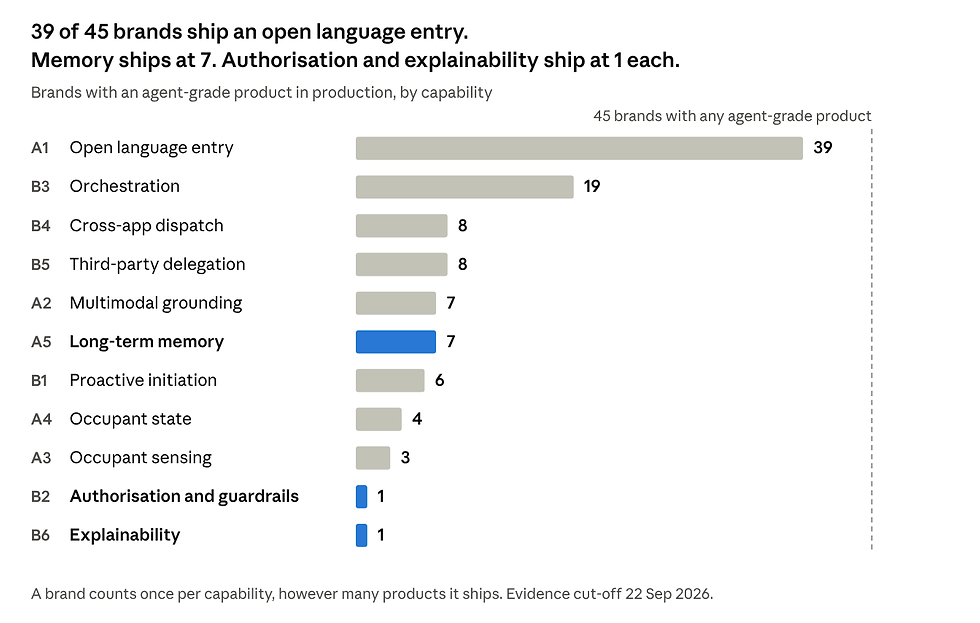
The open language entry can now be bought from suppliers. Of the 45 brands, 21 have exactly one capability, and for 18 of them it is this entry. Across the 160 agent-grade products, 64% stop there: they understand the request and pass it to an existing function.
An OEM can buy a better voice front end and have it in cars within months. The layers that make an agent personal and safe to hand tasks to still have to be built.
Most agents work on the road
SBD's framework has 55 cells where a capability meets a journey stage and an agent should add value. Agents are in production in 39 of them, and 28 of those 39 sit in the stages from driving to exit.
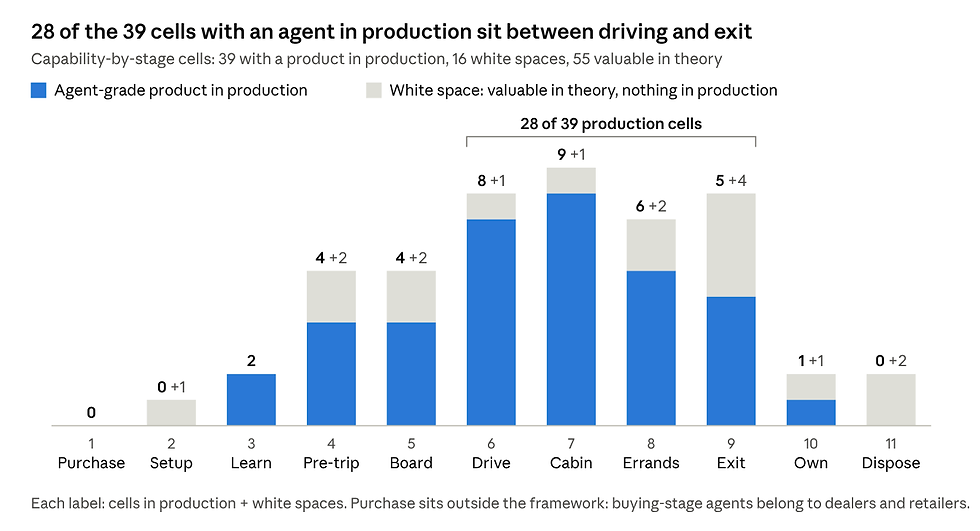
Setup has no agent-grade product. This is the stage where the car would learn who the driver is, what to remember and what the agent may do. At handover, stored memory becomes a liability. The owner should be able to export it and delete it, and SBD found no example of either. The next gains may come from these two ends of the journey.
Six of the 16 white spaces are authorisation. A commute that adapts to how the driver felt the night before would cross four of them.
Navigation and maps are the most common application, used in 58 of 156 production agent cases. So map and place data sit inside the agent stack, next to the model.
Li Auto leads on depth, Rivian on reach
Li Auto tops SBD's ranking of 18 OEMs with 72 out of 100. XPENG (53), Tesla (52), NIO (49) and Rivian (45) follow.
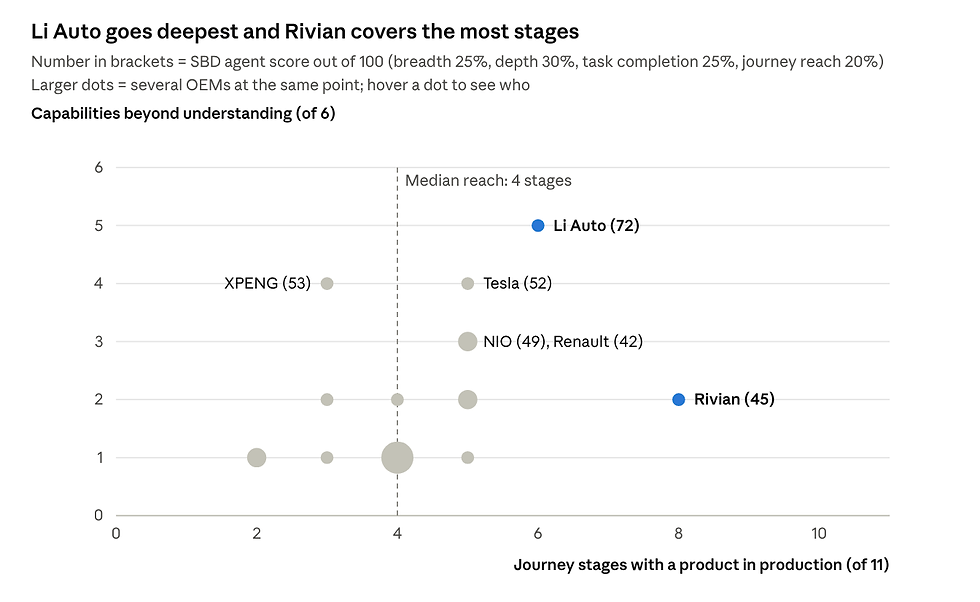
Li Auto has nine capabilities, five of them beyond understanding. Its agent finishes the task in 18 of 22 production instances. Rivian spreads five capabilities across eight stages, the widest reach of any OEM.
Many Western brands follow a third pattern. One general-purpose assistant, often bought in, brings the same few capabilities to several stages. The median OEM covers four of the 11 stages. That kind of reach can be bought. Li Auto's lead comes from depth.
Trust may hold agents back
Large AI models are mostly black boxes, and drivers trust what they understand. Only one OEM has explainability in production. Li Auto's driving model shows a short summary of its reasoning when it turns, changes lanes or handles a traffic light. No car yet lets the driver ask why it did something.
Language models also tend to say yes. CAR-bench (2026), a benchmark for in-car agents, found that agents often break the rules they were given or make up information to satisfy a request. A car needs an agent that can say "I can't do that, and here is why".
Trust is calibrated when it matches what the system can actually do (Lee and See, 2004). In-car agents are improving fast and automated driving more slowly. A driver who sees the assistant handle more and more tasks well may carry that trust over to the car's Level 2 driving functions. In China the two are already linked: at Xiaomi, Li Auto, XPENG and Leapmotor, voice reaches driving functions in production cars.
Explainability and occupant sensing both need the vehicle's own data and HMI, and only the OEM has those. Together with orchestration, they are where OEMs have the most room to stand out.
What OEMs could do
Roadmap question | Possible response |
What must be built in-house? | The orchestration layer. It turns vehicle functions into tools the agent can call and connects them through protocols such as MCP and A2A. Models can be bought, and compute is fixed early in the platform. Orchestration holds the OEM's own knowledge of the vehicle. |
Where should the next budget go? | Memory and authorisation, built as one layer that keeps working through OTA updates, model changes and a change of owner |
Which stages are under-served? | Setup, where identity and permissions are agreed, and handover, where they are exported and revoked |
How does the agent earn trust? | Explain the input: what the car saw and which rule it applied. Refuse clearly. A second model that explains a black-box decision after the fact may give an account that sounds right but is wrong. |
How is trust in Level 2 kept calibrated? | Have the agent say what the driving functions cannot do, and test for over-trust before the agent can control them |
"An agent can perform well in most cases, but if drivers don't understand why it made a decision, they won't give it their full trust."
Andy Qiu, Senior Manager at SBD Automotive |  |
How SBD can help
SBD's In-Vehicle AI Agent study tracks 567 examples across 11 capabilities and 11 journey stages, and ranks 18 OEMs. It also maps the five layers an agent depends on and identifies orchestration as the one OEMs need to build themselves. SBD works with OEMs and suppliers to benchmark agent roadmaps, choose which white spaces to enter and design the trust and authorisation layer. Contact info@sbdautomotive.com.
The open question
Which layer will each OEM choose to own: the memory of who the driver is, the rules for what the agent may do, or the explanation of why it acted?
Evidence cut-off 22 September 2026. Figures from the evidence base behind SBD's AI Agent Research v39, classified from public sources.
Sources
Anthropic, Building effective agents, December 2024
LangChain, What is an AI agent?
Kirmayr, Stappen and André, CAR-bench, arXiv, January 2026
Lee and See, "Trust in Automation: Designing for Appropriate Reliance", Human Factors 46(1), 2004
Rivian, Rivian Assistant and Google Calendar, May 2026 (image)
GM, GM brings Google Gemini to millions of vehicles on the road, April 2026
Volvo Cars, Volvo Cars and Google roll out Gemini to Volvo cars, April 2026
Honda, Honda adds Google Gemini to vehicles with Google built-in, July 2026
Tesla, Connectors for Grok in Tesla vehicles, September 2026
Li Auto, OTA 8.0.0 release notes
Electronic Times, 42dot unveils Gleo AI, May 2026


