
What novel AI use cases would the user most likely value? Insights from testing in China

Among the AI applications most likely to become part of everyday vehicle use are those that reduce the effort of a recurring task, however, their value depends on reliable execution, appropriate timing and user control.
This topic is also becoming increasingly relevant in Europe. At the Paris Motor Show, XPENG combined its European G9L launch with public demonstrations of its latest driver-assistance system on local roads. As Chinese manufacturers extend their AI capabilities into European markets, evaluation needs to establish how consistently these capabilities work across different languages, services and operating conditions.
SBD’s recent UX evaluations in China, including the Li Auto L9 Livis and XPENG GX, examine how AI features perform beyond the initial demonstration. Four categories help distinguish the potential benefits: voice, proactiveness, curation and orchestration. Each addresses a different aspect of the user’s interaction with the vehicle and its connected services.
Voice: extending access to vehicle functions
External voice control provides an alternative to physical controls and smartphone apps when users are outside the vehicle.
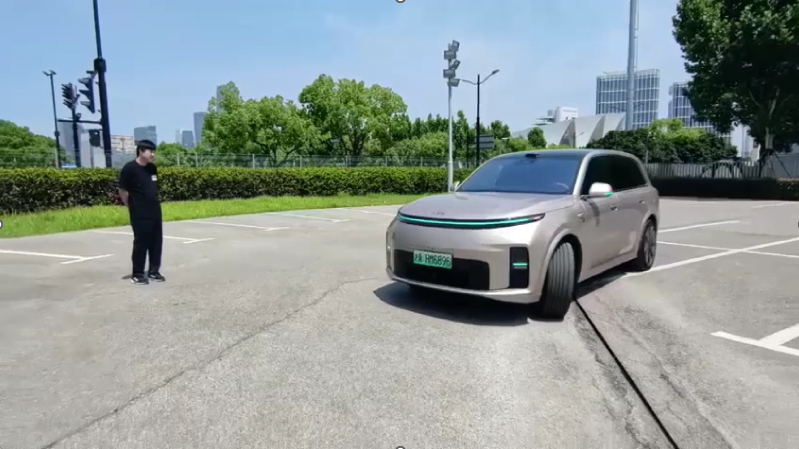
In our Li Auto testing, users could ask the vehicle to park in or move out through its exterior microphones or connected AI glasses. Both methods worked successfully, with commands supporting positioning preferences and exit direction. Limitations included preparation time and the inability to select a specific parking space through exterior voice commands. The practical benefit is clearest in restricted spaces, where moving the vehicle before entering improves access.
NIO’s ET9 also supports exterior voice interaction including door, window and frunk open/close and HVAC on/off. During interaction, NOMI Mate turns towards the person speaking outside, and the front and rear lights show a ‘breathing’ pattern. This combines functional access with a visible acknowledgement that the assistant is responding.
For these interactions, the relevant measures include activation time, command coverage, feedback and task completion. Novelty may encourage initial use, but repeated use requires predictable behaviour.
Proactiveness: responding to context
Proactive assistance can reduce the need to recognise a task, locate a function and initiate it manually.
Li Auto’s parking-payment integration illustrates this approach. Once the number plate is linked through Alipay, supported car parks can send a payment prompt to the central display, providing a one-tap payment route. The suggestion relates to a specific task at a relevant point in the journey.
Automatic comfort adjustments have a less definite target due to variances in passenger preferences. XPENG’s AI Dimming Privacy Glass responds to external lighting and also provides physical and screen-based controls. Our evaluation found that small percentage adjustments produced limited visible differences, making fine adjustment difficult to judge.

The assessment therefore needs to establish whether automatic behaviour matches passenger preferences and reduces intervention. Clear adjustment controls remain important when the system’s choice is unsuitable, and the value depends on whether automatic dimming improves passenger comfort and reduces the need for manual adjustment.
Curation: adapting information and content
Curation can support personal expression or reduce the effort required to consume information.
Li Auto’s “Artistic Frame” generates wallpapers from user-supplied images. Its “Li Auto Dialogue” feature converts long-form news articles into a conversation between two speakers, making the material accessible in an audio format during a journey. Wallpaper generation offers personalisation, while article-to-audio conversion has the potential to change consumption habits, making material accessible during time that would otherwise be unsuitable for reading.

NIO provides an example that continues beyond the journey. Users can capture spoken thoughts through NOMI in the car, then access summarised se notes on NIO Phone. Ideas can be recorded when they occur and condensed for later review, reducing effort at both stages.
These examples highlight that the value of curation lies in making information useful under different attention constraints. An article may become accessible as audio during a journey, while a spoken note may become easier to review as a summary afterwards. The benefit depends on what the system preserves and omits: users need enough substance to understand or act without returning to the original.
Orchestration: bringing the steps of a task together
Orchestration connects functions and services that users would otherwise manage separately.
Li Auto’s QR-code parking payment combines voice interaction, the vehicle camera and an Alipay mini programme. At a payment point, users can ask the assistant to pay, allowing the camera to scan the code and the payment process to continue within the vehicle interface. This reduces the need to retrieve a phone, open an app and scan the code manually.

The benefit depends on the complete sequence working correctly. Recognition, service access, payment confirmation and completion feedback must remain consistent, with a clear indication of any failure.
Our Li Auto evaluation identified occasional interactions in which the assistant confirmed an action without completing it correctly. Its processing window could also obscure navigation information. These issues introduce checking and correction into an interaction intended to remove work.
From capability to sustained use
Which of these applications will users continue to value after the novelty has faded?
The strongest candidates appear to combine a clear purpose, low interaction effort and an outcome the user can readily understand. Parking assistance, integrated payment and summarised notes each address a recognisable need. Personalised content and proactive comfort settings may also provide value, with greater dependence on individual preferences.
"Reliability is a common requirement across all four categories. Hands-on testing exposes the waiting, interruptions, incomplete actions and recovery steps that determine how much effort a feature actually saves. Our evaluations in China demonstrate the importance of assessing these details alongside the breadth of AI functionality” Adam Jefferson - Senior UX Expert at SBD Automotive |  |
How SBD can help
If you or your team would like to understand how the highlighted analysis could impact your strategy, we invite you to get in touch. Email info@sbdautomotive.com to connect with one of our experts and discuss your specific requirements. |


