
Can smartphones replace physical car keys?

A smartphone can already perform most of a traditional key fob's functions. That does not mean every customer can leave the fob at home. Digital Key still falls short of the reliability, compatibility and recovery standards needed for universal replacement. Technical feasibility is largely established; delivering a dependable primary key across devices, vehicles and markets is the harder task.
In 2026, Digital Key shifts from an optional extra to a standard feature for vehicle access. You can now lock, unlock, and start vehicles from a range of OEM brands, including BMW, Mercedes-Benz, Audi, Cadillac, Hyundai, Kia, Genesis, Volvo, Polestar, Porsche, Toyota, Tesla, and others. The fact that so many vehicles support the feature proves that the technology works. However, reliability, compatibility, and data recovery still vary by vehicle, device, and operating system.
For many customers, the phone can now perform most of a conventional key fob's functions. The industry currently doesn't offer a more consistent experience for a universal replacement.
What the wireless hardware changes
The Digital Key focuses on Bluetooth Low Energy (BLE), ultra-wideband (UWB), and near-field communication (NFC). BLE supports communication and passive access; UWB provides accurate ranging to help stop relay attacks; and NFC offers tap-based access when passive operation is not possible. The three technologies deal with different aspects of the access problem.
NFC also provides limited access when a compatible phone's main battery is empty. In case of vehicle failure, most OEM brands keep a mechanical key or another method that doesn't depend on the phone. The solution for a discharged phone is not necessarily the same as the solution for a vehicle fault.
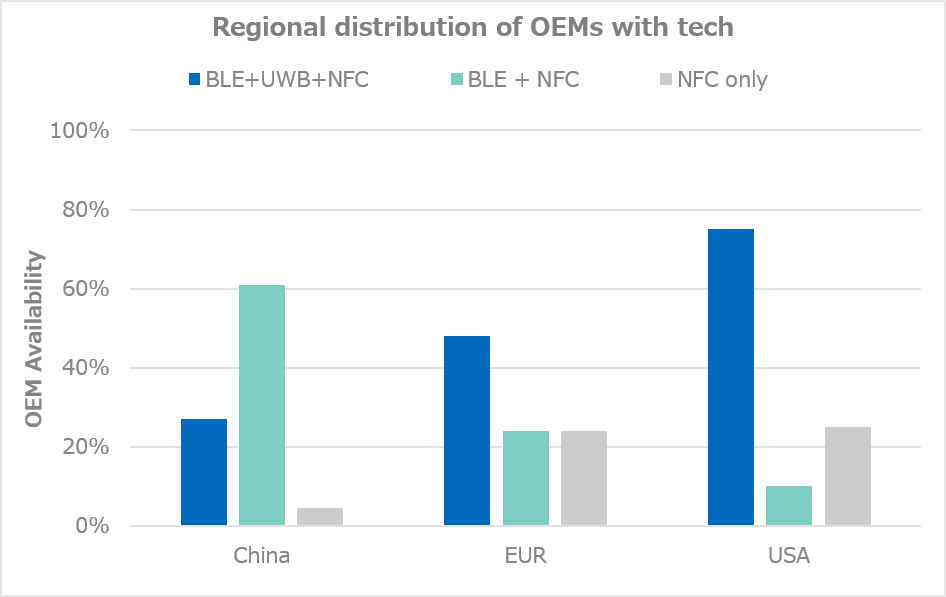
BLE–UWB–NFC systems provide the best all-round experience, but they add extra packaging, validation, hardware complexity, and cost; they are still more common in luxury vehicles and more upscale models. OEM brands pursuing lower-cost setups are also exploring other ranging technologies, such as Bluetooth Channel Sounding and NearLink.
A different hardware setup doesn't have to create a confusing product; OEM brands can keep the activation process simple, explain the fallback procedure, and securely handle credentials. Customers should be made aware of how access will function with their vehicle and phone.
The US market is moving beyond feature availability
In the United States, Digital Key is being incorporated into vehicles rather than being available only as a premium standalone feature, and its use now spans both premium and mass-market brands; since the feature is becoming more widespread, the quality of its implementation can be used as a basis for comparison.
The available options include wallet integration. OEM brands can store keys in Apple Wallet, Google Wallet, Samsung Wallet, or their proprietary app. Arrangements with smartphone providers provide secure storage, standardised interfaces, and interoperability. These arrangements also mean automotive OEM brands have less control over certain APIs, interface decisions and customer data.
Most brands now support iOS and Android, but for a buyer, this still describes compatibility incompletely. You must consider not only the vehicle model but also the device generation, operating system version, and wireless hardware. One vehicle-phone combination might enable passive UWB entry, while another might require an NFC tap or an app interaction. In both cases, they may be advertised as supporting Digital Key.
The study found that 14 brands offered key sharing via a dedicated app, making smartphone apps the most common sharing channel. A small number of these also allowed sharing through the head unit or via the OEM's official website. Sharing should therefore be treated as a real process rather than just a listed feature.
To make the Digital Key the customer's main key, it would be helpful to have widely known wallet apps and simple setup procedures. Just as important are broad device compatibility and offline functionality. When a phone is lost or replaced, the recovery process should be clear and, where appropriate, include NFC, an NFC card, or some other independent backup option.
Digital credentials can also manage fleets, handle subscriptions, manage rentals, provide concierge services, carry out vehicle servicing, and support shared mobility. Basic access to the vehicle is likely to be included, with monetisation focused on these extra services. The business potential goes well beyond simply opening the door; the commercial model must reflect this difference.
Security through changes of ownership
In Europe and the United States, OEM brands have generally adopted the Car Connectivity Consortium (CCC) system and are improving compatibility between Apple and Android ecosystems. It has become the de facto standard in these regions, with more sophisticated systems combining BLE and UWB to enable secure passive access and support both major smartphone platforms.
Europe places particular emphasis on security because of the risk of electronic theft. Alignment with UNECE R155 and end-to-end cryptographic auditing, from cloud services to vehicle ECUs, are identified as industry best practices.
Meeting lifecycle requirements is especially important in the context of a vehicle sale. The previous owner's credentials must be deleted, and the new owner must have control over access. It is also important to securely offboard and revoke access when a vehicle is stolen, reset, or otherwise transferred. Give equal attention to unlocking and starting the vehicle.
Owners must have clear control over permissions, which requires auditable revocation, access logs, data-minimisation controls, and the ability to grant third parties time-limited access. Certification and security remain central to European adoption, alongside the convenience of passive entry.
China has several routes to Digital Key adoption
China has one of the highest Digital Key penetration rates in the world and is well ahead of both the United States and Europe. In the domestic electric vehicle market, Phone-as-a-key is increasingly seen as a basic requirement. This widespread adoption is seen within several standards ecosystems.
ICCOA unites Chinese smartphone brands and automotive OEM brands, while ICCE includes industrial companies, institutions, and research organisations. Both organisations are alongside CCC. In 2026, the ICCE published a Bluetooth Digital Key standard which included support for Bluetooth Channel Sounding.
Premium models are increasingly using hybrid BLE–UWB–NFC systems, while more economical options are being explored for wider market segments. At the same time, Chinese automotive OEM brands are also increasing their use of the CCC as they prepare their vehicles for sale in international markets. According to the Q3 2026 study, CCC adoption was approximately 20% among the 44 brands examined in China. This figure reflects the sample of brands, not vehicle sales share or compatibility across all models.
Domestic standards can speed integration with Chinese phones and digital services, while export versions must also be compatible with global devices and CCC-based ecosystems. OEM brands serving both markets must consider these requirements when designing their credential and security architecture.
One practical approach is to maintain a common global framework for credentials and security, supported by regional ecosystems through software integrations. For example, a vehicle could use CCC-compliant credential management globally while integrating with ICCOA-supported smartphone platforms in China and Apple or Google Wallet in Europe and North America. This is an architectural proposal, rather than evidence that every such combination is already interoperable.
Making replacement a measurable objective
Compatibility across the full system
The CCC specifications can offer a common basis for authentication, secure distance measurement and cross-platform use, with regional layers supporting ecosystems such as ICCOA and ICCE. End-to-end testing should include vehicles, smartphones, operating systems, and wallets, and it should also check backwards compatibility between different versions of the specification.
Release 4 of CCC aims to deliver more consistent behaviour across devices, introduce server-based ownership, and provide credentials from OEMs, fleet operators, and service providers. Interoperability testing and certification preparation are still ongoing. Vehicles that currently exist should therefore be seen as forming the basis upon which to migrate, not as confirming deployments of Release 4.
The simplest requirement for the customer is to state whether the vehicle has NFC access, passive entry, low-battery operation, the ability to share it across platforms, and an independent emergency fallback option. Providing this information would make the Digital Key label much more useful.
Reliability beyond initial activation
A Digital Key designed to replace the fob should be able to operate offline and keep the credentials safe in secure hardware. By storing credentials in a hardware trust anchor, the vehicle can unlock and start without a live server connection. However, reliable recovery is still necessary if the phone is lost, replaced or runs out of power.
Owners must be able to view, share, limit, and cancel credentials, and remove all keys when ownership is transferred. OEM Brands can evaluate performance by looking at the number of failed entry attempts, activation results, revocation performance, and the number of support cases. It is also important to monitor continued dependence on the physical fob, as this shows how far the product has come toward achieving its aim of being replaced.
The remaining test
The most advanced systems currently incorporate BLE, UWB, and NFC; are compatible with both iOS and Android; offer secure sharing; and include a phone-independent backup access method; they can be used as the main vehicle key. The next step is to ensure this experience is consistent across all devices, models, and markets, even when connectivity is lost or hardware capabilities vary.
People need to know what features their system offers and how to regain access if something changes. A longer feature list doesn't reduce uncertainty about losing a phone, needing a replacement handset, or transferring ownership. A physical fob option will only be available if it works reliably and includes clear recovery instructions.
“Modern automotive digital keys combine Bluetooth Low Energy, Near-Field Communication, and Ultra-Wideband (UWB) within Car Connectivity Consortium standards to turn smartphones into secure, hands-free entry systems. Current adoption remains largely concentrated in premium vehicles because multi-anchor UWB hardware is costly, and it uses Time-of-Flight distance measurement to block signal-relay theft. Over the upcoming years, cheaper integrated chipsets might bring hands-free entry to mass-market models, gradually replacing physical fobs. This setup will unlock software features like dynamic access sharing and automated valet services, while security evolves toward cloud-managed key rotation, biometric checks, and post-quantum encryption to counter advanced wireless threats.” Amit Shukla - SBD Automotive Product Owner |  |
How SBD can help
SBD Automotive can help benchmark your position against the wider industry and identify where action is needed most. To explore how these trends impact your strategy, architecture and supplier roadmap, get in touch with SBD Automotive for a deeper discussion. Email info@sbdautomotive.com |


