
Are EV owners planning to buy a hybrid next?
Growing interest in hybrids makes EV owners’ next choice worth a closer look.
Buying an EV for the first time involves some uncertainty. After a year or two, owners know a great deal more about the car and the life around it. They know their home charging options, how often they need a public charger, and which journeys still take a little thought. That makes understanding their next vehicle purchase quite interesting.
The 2026 edition of the HERE-SBD EV Index paints a positive picture overall. Globally, 64% of surveyed EV owners say they are likely to buy another EV. At the same time, the share most likely to purchase a plug-in hybrid, hybrid, or extended-range electric vehicle next has risen from 23% to 28% globally, reaching as high as 39% in Italy. Those figures are sometimes tempting to read as a verdict of the BEV, but they tell a more interesting story about how people actually use cars.
An owner can be pleased with electric driving and still want a different balance of capabilities next time. A household with an ICE car parked alongside a BEV has already found one way of getting that balance. Others need a single car that will cover both the everyday commute and the occasional difficult trip. Total cost of ownership is also critical: the purchase price, charging costs, and running expenses can change the appeal of each option. The distinction is important when we talk about loyalty, because the next vehicle may be asked to do a different job from the last one.
It would be easy to turn the rise in hybrid interest into a story about EV disillusionment. That would overlook the large majority who would buy another EV, as well as the practical appeal of an alternative powertrain to someone who still needs that enhanced flexibility. Equally, the favorable ownership figures should not distract from the journeys some drivers still avoid. Both sides of the experience deserve attention.
“Most EV owners in our survey would buy another one, which is encouraging. But when EV owners start looking at hybrids as their next vehicle, we need to understand why electric vehicles don’t fulfill all of their mobility requirements.”
Robert Fisher, Senior Consulting Manager, SBD Automotive
Ownership is better than many drivers expect
Concerns about range and charging can look different after a few months of driving an EV. Owners learn what the car can do on familiar routes and settle into a charging routine. For someone who charges at home, the public network may be rarely considered in a typical week. That experience can be much easier than the one they imagined before buying.
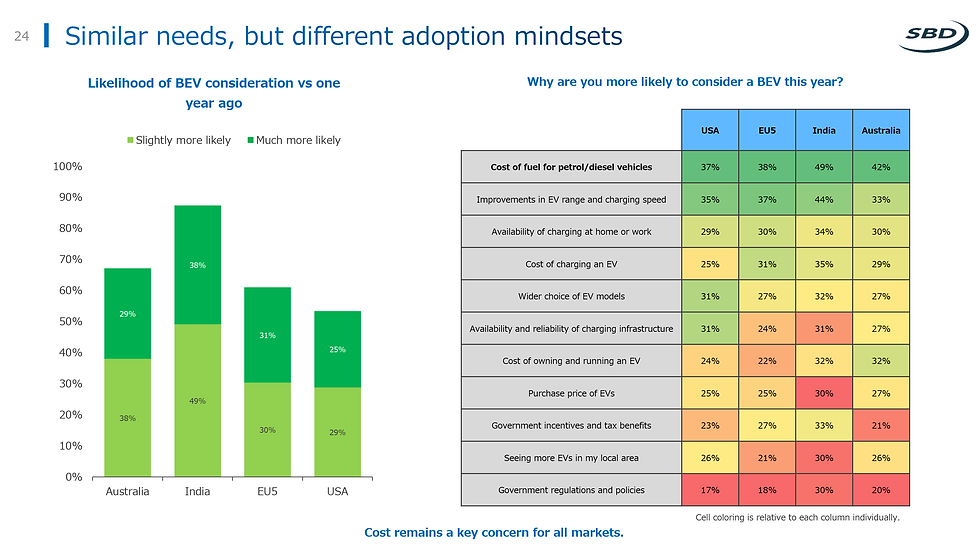
Among owners surveyed for the HERE-SBD EV Index, 68% said charging had been better than expected and 67% said the same about driving range. EV owners rated local public charging coverage more positively than non-EV owners in every surveyed market. It would be reasonable to expect direct experience to change some perceptions, although these figures cannot tell us how much is learned after purchase and how much reflects the conditions that encouraged someone to buy the EV the first place.
These responses are important because discussion of EV adoption often begins with the anxieties of people who have not yet owned one. The owners’ account is generally more encouraging. A sizeable share have discovered that charging and range fit their lives better than they thought they would. The car does not need to be perfect for that to be true.
There is also a limit to what “better than expected” tells us. If expectations were low, an improvement on them can still leave room for frustration. A car can serve its owner well through the working week while a holiday trip takes careful planning. A driver who rarely thinks about charging near home may have a poor experience when travelling somewhere unfamiliar. Those infrequent journeys can loom large in a purchase decision because the next car needs to handle them too.
That helps explain why a good ownership rating and interest in another powertrain need not conflict. People can like what their BEV does well without overlooking the occasions when using it is inconvenient. The industry should take the positive experience seriously, and be equally curious about where it stops being straightforward.
What owners might choose next
The 64% of surveyed owners likely to buy another EV conceals considerable variation around the world. The five-percentage-point rise in hybrid consideration does not tell us how many people will ultimately change powertrain. Consideration is a measure of what owners are open to, not a record of purchases. Even so, it is worth examining precisely because these drivers already know what electric ownership involves.
A plug-in hybrid may appeal to someone who likes driving electrically but wants greater freedom on occasional long trips. If it is charged and used accordingly, it can allow many journeys to remain electric. A conventional hybrid or extended-range vehicle presents a different proposition, so these options should not be treated as interchangeable. What they share is the ability to address a practical concern without requiring an owner to reject everything they like about a BEV.
Nor should we assume the current car caused the change in preference. A new job might involve more long-distance driving. A move could remove access to home charging. The next purchase may be intended to replace a different car in the household. Cost can change the calculation too, particularly when the buyer compares the price of the next car with expected energy, servicing, and other running expenses. These are possible explanations, not findings established by the Index. Hybrid interest alone is a poor measure of whether the BEV disappointed its owner.
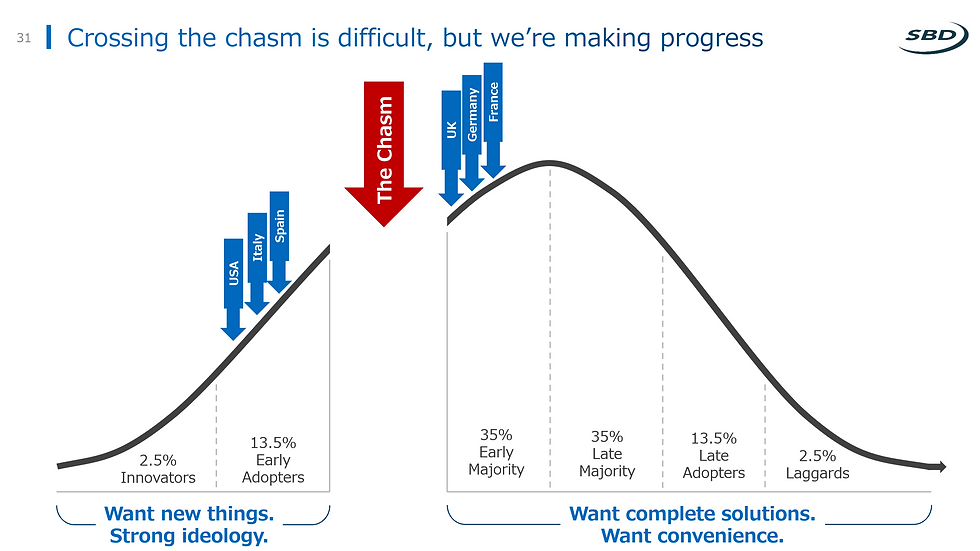
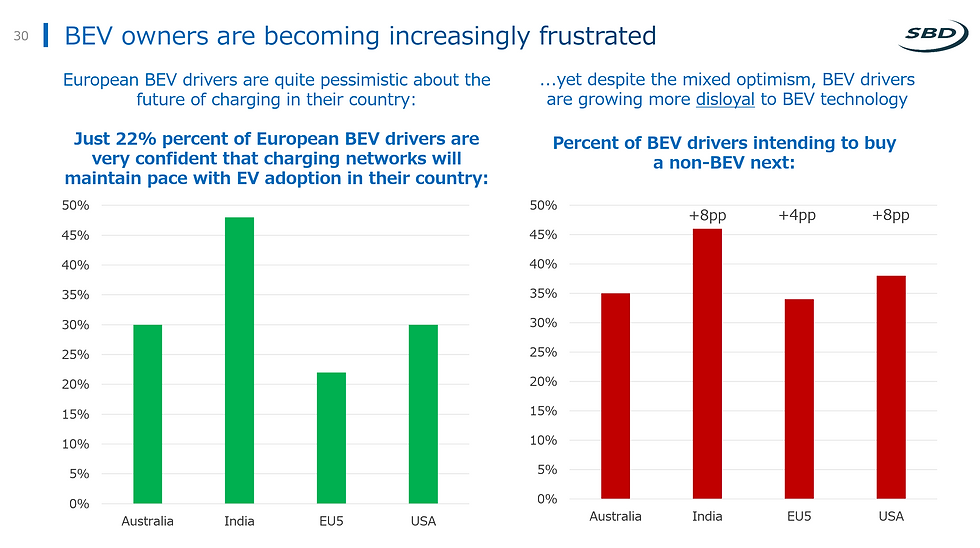
There are substantial differences between markets. Surveyed EV repurchase intent is 87% in the UK and 78% in Germany, compared with just 48% in Italy. You read that right: the majority of Italian BEV owners are not expecting to buy a BEV as their next car. Italy and Spain also show comparatively high hybrid interest among EV owners, alongside weaker average charging power. The contrast is hard to dismiss, although it does not establish that charging power caused the difference in purchase intent.
The Italian result deserves particular attention. A national repurchase figure this low should prompt automakers to look beyond the specifications of the vehicle itself. Availability and quality of charging, the trips owners actually make, and the total cost of owning the vehicles they can choose from all belong in that discussion. The survey does not isolate the influence of each. It does show, however, that retaining an EV customer is a markedly different prospect across the markets surveyed.
I would be cautious about calling every hybrid-curious owner a lost EV sale. I would be just as cautious about waving away the increase as harmless. A consumer who keeps a hybrid on the shortlist is telling us that the choice remains open after living with a BEV. There is something valuable in understanding why.
The other car in the household
A BEV does not have to cover every journey if there is another car at home. A household may use its EV happily for commuting and local trips while keeping an ICE vehicle for road trips or less predictable travel. The combination can suit them very well. It would be a mistake to infer from the presence of the ICE car that the BEV has failed.
Think about the role each vehicle is asked to play. If most driving is local, the BEV may handle the great majority of the household’s journeys. On the occasions when timing is tight or charging on the route feels uncertain, the ICE car is available. The household enjoys electric driving without having to settle every argument about whether a BEV could manage its most demanding trip. Keeping two cars may offer flexibility, but it also means paying to own and maintain both. That trade-off will look different for a household choosing its only vehicle.
The Index reports that 65% of surveyed EV owners replaced their only car and became EV-only households. They cannot choose another vehicle if a planned charging stop feels uncertain. Public charging reliability, long-distance coverage, and route planning may therefore carry a different weight for them. The figure does not tell us how household arrangements affect repurchase intent, but it makes clear that an EV owner is not always someone with an ICE fallback.
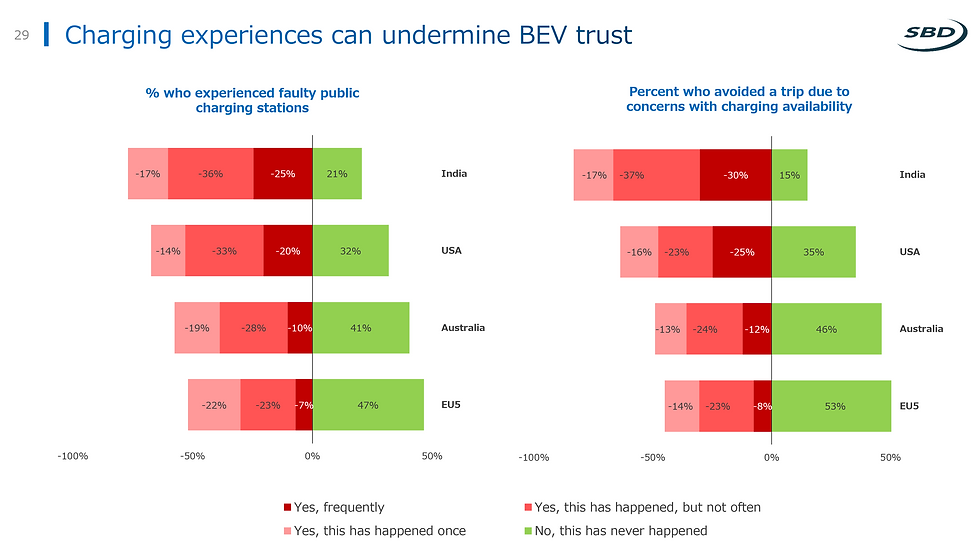
Among all surveyed EV owners, 54% said they had avoided a trip because they were worried about finding a charger. Another 59% reported encountering broken public chargers and being unable to charge. These experiences should not be assigned to one type of household or used to explain a particular purchasing choice. They do illustrate the sort of inconvenience an ICE backup can help a household avoid. The car in the driveway may be most important on the day it is rarely needed.
For an EV-only household, a decision to avoid a trip has a different practical effect. The journey might be postponed, rerouted, or made with another form of transport. Even if such occasions are uncommon, their consequences can be awkward enough to influence the next vehicle choice. A household considering a hybrid in place of its only BEV may be buying flexibility in one car. Another household could buy a second BEV and continue to use its ICE vehicle for the difficult trips. The powertrain label by itself misses the role of the car.
This is why the two households may reach different decisions about their next car. One can be happy with a BEV because an ICE vehicle is available for the trips where charging feels uncertain. The other has to decide whether a BEV can handle those trips as its only vehicle. Both may like electric driving, but they are asking different things of the car.
Charging shapes the ownership experience
The car is only part of what an EV owner lives with. On longer journeys, charger availability, payment, route guidance, and the time spent at a stop can have a strong bearing on how convenient it feels to use. Home charging depends on circumstances that vary widely between households. It also affects what owners pay to run the vehicle: someone who mostly charges at home faces a different cost calculation from someone who relies on public charging.
Automakers do not control every charge point or payment service. The customer still experiences the journey through the vehicle. A route recommendation that leads to an unavailable charger, an unclear price, or a payment attempt that fails reflects on the whole experience. A driver may know that the charge-point operator is responsible, but that distinction offers little comfort when the family is waiting in the car. Dependability is built across several services that have to work together.
There are useful areas for automakers to focus on with their partners: range estimates and route plans that reflect the vehicle’s actual performance, reliable charger-status information, clear prices, and payment that works without fuss. The Index finds that high-speed charging remains the most important charging feature. Standardized connectors and automatic payment also rank highly. Nearby amenities and secure parking matter during a stop, especially when charging takes longer than expected.
It is tempting to answer every concern about public charging with a count of new charge points. More locations and more available power clearly have a role. Yet a charger that appears in a route plan but cannot be used does not give the driver confidence. Nor does a fast charger necessarily make a journey easy if its price is unclear or access requires another app and account. The price of charging also matters to the total cost of ownership. Owners judge the trip they made and what it cost them, not the size of the network on a map.
This is one reason the quality of information matters. Good route planning can give a driver a sensible alternative when a charger is occupied or out of service. Honest estimates make it easier to decide whether to stop now or continue. Payments that work first time avoid turning an ordinary break into a problem to solve. None of this eliminates the need to build charging capacity. It helps people use the capacity already there with more confidence.
Automakers have a commercial interest in that experience even where they cannot fix every fault themselves. If charging is routinely awkward, an owner may start comparing their next BEV against the convenience of a hybrid. If the difficult trip becomes more predictable, the backup car may spend more time at home. Those are plausible responses rather than outcomes demonstrated by the survey, but they are practical reasons to take the details of charging seriously.
What the next purchase tells us
Repurchase intent is a valuable finding in its own right. Globally, 64% of surveyed EV owners say they are likely to buy another EV. The owners who keep a hybrid under consideration do not cancel out that result. They are weighing the next car against the journeys and circumstances they expect it to cover, as well as what it will cost to buy and run.
The figures also show where ownership has consequences beyond a satisfaction rating. Avoiding a trip because of charging concerns is a change in behaviour, reported by 54% of surveyed EV owners. Another 59% reported being unable to charge at a broken public charger, even though many owners say charging has exceeded expectations overall. A generally good experience can include a few bad moments that are hard to forget.
Those moments will not carry the same weight for everyone. A familiar commute with home charging is different from a long drive through a less familiar network. A BEV with an ICE vehicle available at home plays a different role from the only car in the household, and the costs of keeping two vehicles are different too. An owner may be pleased with the BEV in either case, while looking for something different from the next vehicle.
The next car has more to prove
Most surveyed EV owners say they are likely to buy another EV, and many found charging and range better than expected. That is a meaningful endorsement from people who have lived with the cars, and this deserves to be heard alongside the increase in hybrid interest.
A BEV can work well without covering every journey a household makes. An ICE car may take the occasional road trip, or a buyer replacing their only car may decide that a hybrid offers more flexibility. The costs of buying and running the next car can weigh just as heavily as those occasional trips. Neither choice, on its own, tells us how the owner feels about the BEV. The variation between markets makes broad assumptions even less useful.
The practical opportunity for the industry is to tackle both sides of that decision. Making charging more dependable will help with the trips that still cause hesitation. Buyers also need to see a convincing total cost of ownership, including what they will pay for the vehicle and for the energy they use. Automakers cannot resolve every issue in the public network, but the experience and costs their customers face are too important to leave out of the conversation.
For the full market comparisons and consumer findings, visit the HERE-SBD EV Index 2026 website to interact with the data and download the full report.
“If people are happy with their EV but still feel the need for a combustion vehicle, that’s worth paying attention to. It tells us that drivers are feeling friction in the electric mobility lifestyle, and improvements are needed.” Robert Fisher, SBD Automotive – Senior Consulting Manager |  |


