
What does a successful EV digital-feature strategy look like in 2026?
2026 EV digital ecosystems seem to follow the same trend that has been continuing for quite some time now in the world's largest and most competitive EV markets: China, Europe, and the USA. However, a more in-depth look highlights key differences and automotive OEMs' strategic approaches that may better reflect different approaches to customer bases’ needs and expectations, and can be important indicators for companies trying to approach a different international market. So, what does a successful EV-specific digital strategy look like in 2026?
Three are the key macro areas that substantially distinguish a digital ecosystem (EV-specific for the first two) and can make or break a brand strategy in different parts of the world. The first is charging. The second is trip planning. And finally, there is entertainment.
EV charging and ownership experience
The HERE-SBD EV Index 2026 identifies a specific set of EV charging-related factors and characteristics as the key barriers to EV adoption. These have consistently remained very similar over the past few years.
When it comes to EVs’ digital ecosystem, probably the most important powertrain-specific function that OEMs need to deliver to improve the ownership experience and potentially the EV adoption is charging seamlessness and ease.
2026 Automotive brand penetration of charging experience features and services by regional segment
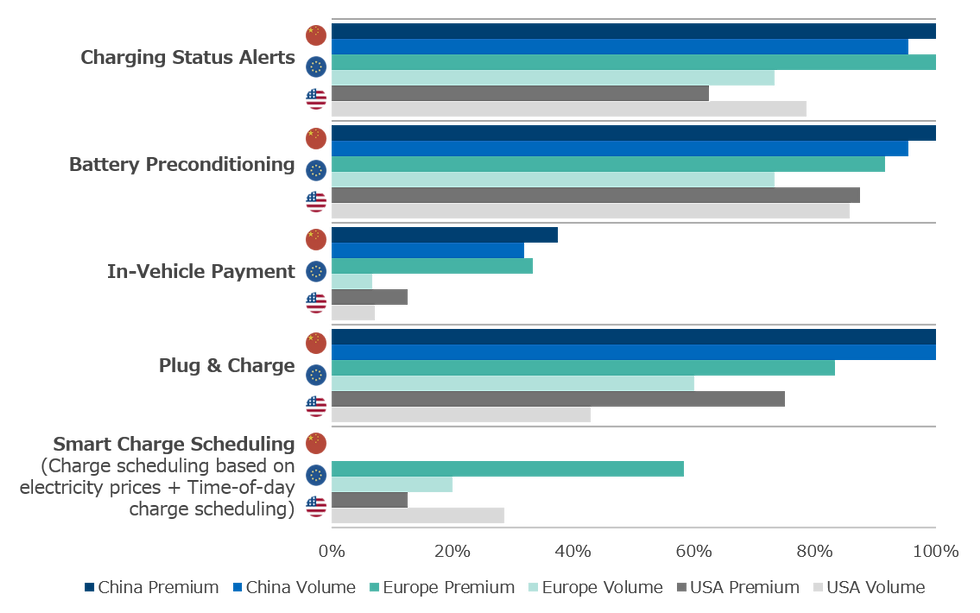
The chart shows the share of brands offering key charging-related digital services in the three regions covered, in both premium and volume segments. Across this and the following charts, penetration refers to brands with a feature recorded as available through an app or in the vehicle. Higher availability shows the breadth of each brand’s digital offering, while usability, reliability and integration will determine consumer reception and how effectively those features improve the ownership experience in the long run.
Chinese automakers look generally ahead of the competition in the availability of these selected features. Interestingly, differently from Europe and the USA, in the Chinese market there is also almost no difference between premium and volume segments. The other key difference is the absence of specific smart charge scheduling features in the Chinese sample. Lower energy prices in China may reduce the potential savings from smart charge scheduling, making it a less compelling part of the charging offer in the region.
In Europe instead, the difference between premium and volume brands is probably the most evident across the three regions. The feature coverage, however, is better than that of the USA overall. The lower penetration of these key services in the USA suggests a more selective charging offer, potentially reflecting different customer needs and OEM priorities. This sits alongside the uncertainty within the EV market discussed in the previous article “The EV market in 2026: What has changed so far?”. Here too, there is a marked difference between premium and volume brands.
The overall less comprehensive offering of charging-related features by American and European OEMs, especially in the volume segments, could weaken their competitiveness against the increasing pressure from Chinese manufacturers.
Trip-Planning Ecosystems
When looking at EV-specific trip-planning features, which closely relate to the charging ecosystem, the overall trend is very similar to the one observed for charging features earlier, with just a few exceptions.
2026 Automotive brand penetration of trip planning features and services by regional segment
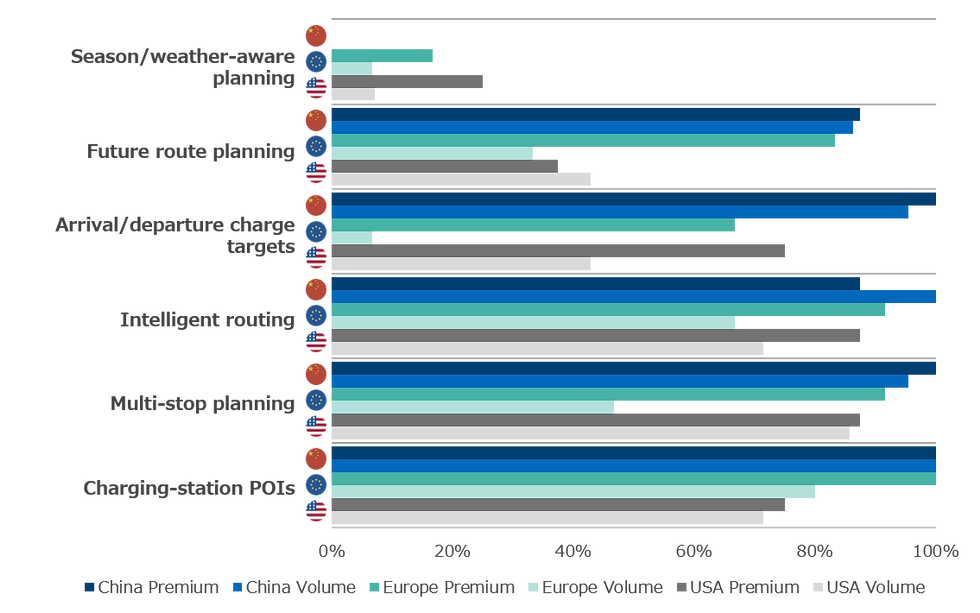
Across the board, China again dominates with its domestic OEMs easily achieving the highest adoption rate for this category’s features. The one exception is the Season or Weather-aware planning that is currently not recorded among the Chinese brands covered. It must also be mentioned, however, that it is currently an extremely rare feature also across the other two markets. Only premium brands in the USA record a relatively higher adoption rate.
Once more also, across the USA, but especially Europe, there is a noticeable difference in the feature availability for premium brands compared to volume ones. While in China, the feature penetration is generally very close between the two segments, with Intelligent Routing even reaching a higher penetration in the volume segment, in Europe the difference is generally really significant. It varies, in fact, between 20 and 60 percentage points (with the exception of Season and Weather-Aware Planning, that has a very low adoption overall but still confirms the trend anyway). In the USA the situation looks more balanced, with higher adoption of Future Route Planning for volume vehicles and overall offering of Multi-Stop Planning and Charging Station POIs close in both market segments.
A step further: In-vehicle Entertainment
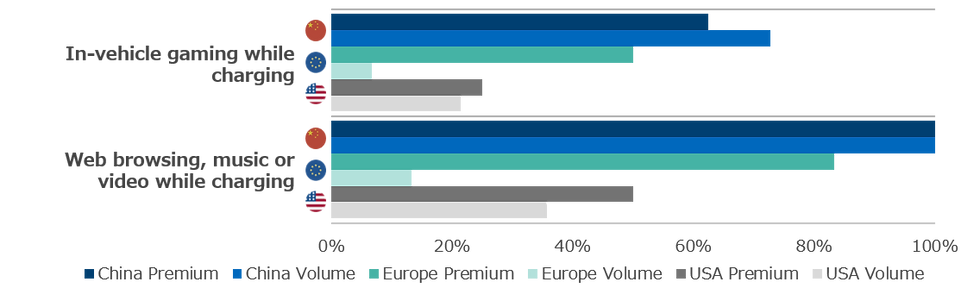
Last but not least, two key features for in-vehicle entertainment show once more the same trend. China leads with equal adoption for volume and premium brands for web browsing, music and video, and volume ones even getting In-Vehicle Gaming slightly more often than their premium counterparts. Europe follows, but only with premium brands, because the volume ones get the lowest adoption percentage of every segment in the covered markets. The USA is placed somewhat in the middle, with again a more balanced difference between premium and volume offering.
2026 Automotive brand penetration of in-vehicle entertainment features and services by regional segment
China’s example and the need for localisation
The customer perception is likely more nuanced than the feature availability highlighted by the data. A Hyundai representative at a Shanghai UX development centre explained that the one major hardware difference between cars sold in China compared to those in the rest of the world is the addition of a passenger screen or a larger central infotainment screen. This is evident in the recently-introduced IONIQ V saloon, developed exclusively for the Chinese market. But, the trend is expected to be extended to the rest of the lineup.
This small anecdote illustrates one OEM’s approach to localising its strategy to satisfy local customers' expectations. Differences in feature availability highlight distinct regional approaches to digital services, potentially reflecting different customer priorities in Europe, China and the USA. The broad availability of these features among Chinese brands suggests that this digital experience is becoming part of the standard offering, likely shaping what customers expect from their next vehicle. The same gradual shift could develop in Europe and eventually the USA, potentially challenging the current strategic approach of American and European domestic manufacturers.
So, to go back to the initial question, in 2026 it seems like one important factor of a successful EV-specific digital strategy needs to be the careful localisation to cater to domestic customers' expectations. The strategic priority then becomes integrating a competitive ecosystem of digital features into a seamless ownership experience. There should be a clear plan for short- to mid-term developments, taking into consideration what successful newcomers in the space are doing both in terms of digital offering and affordability, and how, in the case of China, they gradually gained their domestic market share.
Our EV Digital Services and Features Guide looked at these questions and a lot more to draw a clear picture of the trends and dynamics shaping this space in the EV market. Make sure to check the report linked to gain an in-depth understanding of how it is developing.
"Are Chinese EVs successful because they offer more digital features? How are they addressing the needs of domestic and international customers? And what can other international automakers do to compete more evenly against these newcomers? We tried to find the right answers." Riccardo Del Bello, SBD Automotive Research Analyst |  |


