
Are you getting the most out of AI in your product decisions?

Every automaker we talk to is squarely in the midst of an AI-first transformation, and the promises are hard to resist: ‘China speed’ development, AI-defined vehicles, over-the-air updates for everything, and machine-speed detection and triage of cybersecurity threats. AI adoption is also growing fast inside product planning teams, yet few can say it has made decisions faster or better. So, what is getting in the way?
When we sit down with automotive leaders and their partners, the conversation keeps coming back to accelerating confident decisions: how decisions get made, and which evidence and insights shape the options across the enterprise. Processes built for hardware programs that run for years struggle to keep up with software that changes every few weeks. Increasingly, the bottleneck is approval, not engineering. Across a global multinational, decision delays and slow approvals add up and eat into the value AI was supposed to deliver.
Sound familiar? “We never agreed on the targeted outcomes.” “Where’s the source?” “AI gave us too many options to choose.” “This still has to go through our legacy program management process.” “Another AI hackathon, people!”
None of these frustrations are new. The tools have changed beyond recognition, but most problems still trace back to data application and organizational culture rather than technology. Thankfully, six actionable remedies keep coming up:
1 - Start with the outcome, not the tool
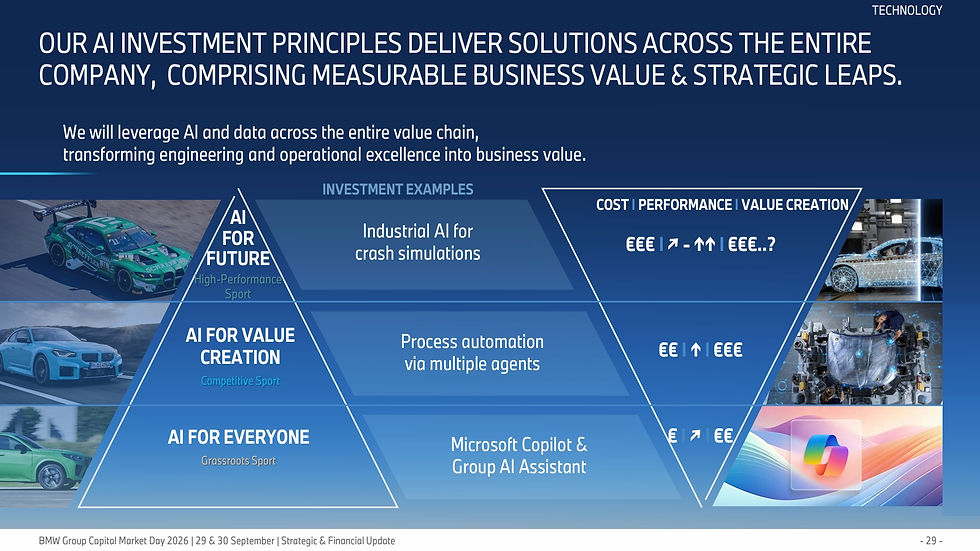
Leaders are finally asking less about how much AI their teams use and more about what it should deliver. Used well, with validated outputs, AI cuts the precious time spent on evidence gathering; used carelessly, it adds noise and rework. Tie AI to the specific outcomes your enterprise cares most about: product appeal, cost and risk, time to market, and lifetime value. Choose one decision this month and track how long it takes today; without that baseline, no gain can be shown later.
2 - Make decisions a repeatable workflow, not a meeting
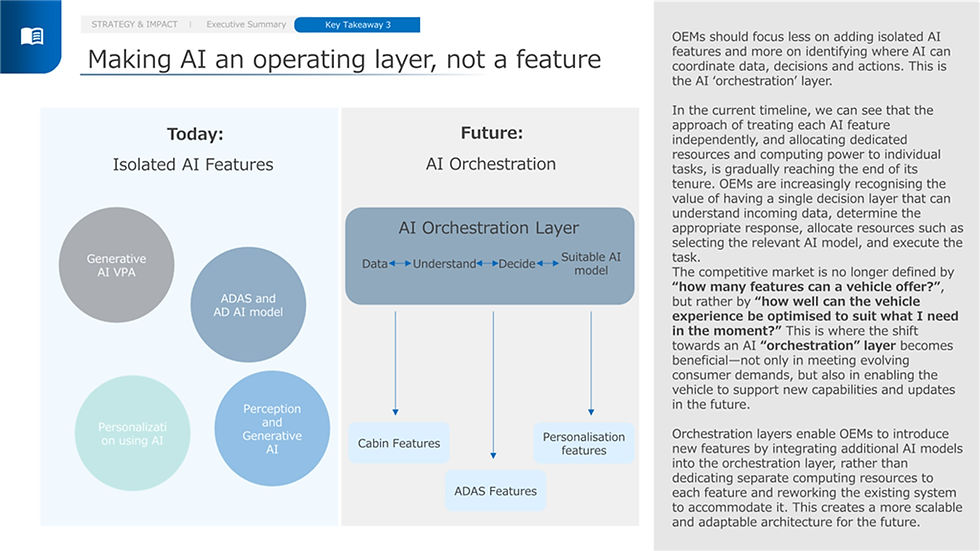
Every new ADAS system, infotainment feature or connected service results from a long chain of research, definition, meetings, politics, and heated debate. And once a decision is prioritized, it tends to bounce ‘hub-and-spoke’ through a program lead or, worse yet, through parallel teams duplicating work.
When ownership of a decision (or AI’s role in it) is unclear, the issue escalates by default. Approvals stack up gate by gate, and outcomes end up buried in slides or email threads. Try mapping one recurring decision end to end: who decides, with what evidence, at which point, and how long it waits between “evidence ready” and “decision made.” Then use AI and validated insights as decision support, for example an agentic workflow that pulls evidence through Model Context Protocol (MCP) connectors from the systems where it already lives.
3 - Go horizontal, not one-off
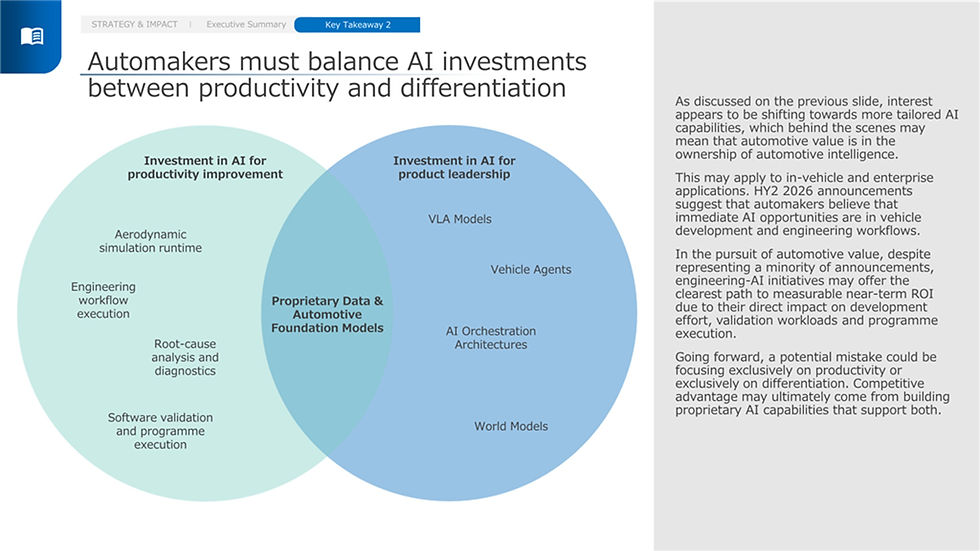
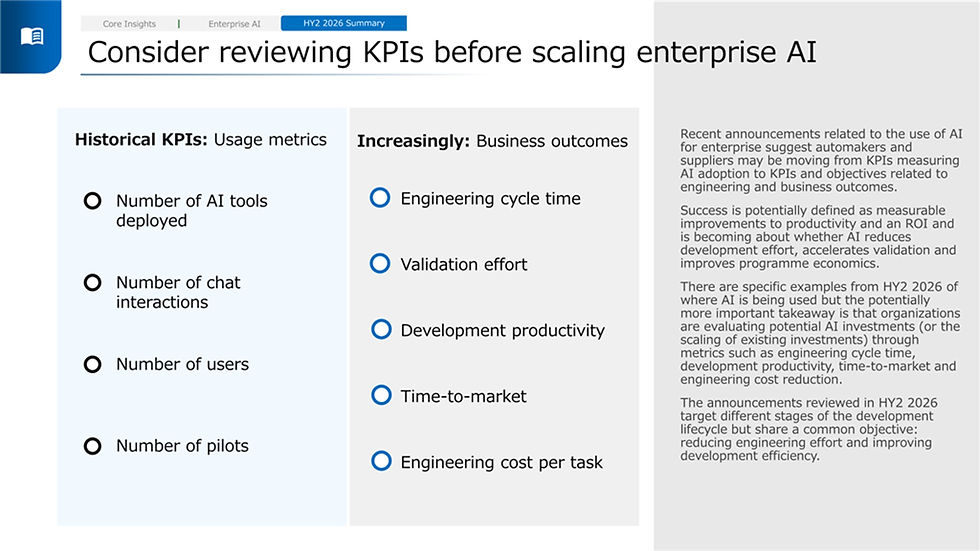
Plenty of AI efforts still start as isolated pilots that never scale, judged by tools deployed, logins, and pilots launched. Recent automaker and supplier announcements point to higher-order outcomes instead: cycle time, validation effort, development productivity, time to market, and engineering cost per task. Each needs a baseline and a standing set of evals (repeatable tests) that show whether the AI still gets the hard cases right. Before you scale, rethink your KPIs and back capabilities that several functions and programs can reuse, such as a shared retrieval layer, common tool connectors and evals, rather than one chatbot per team.
4 - Make every answer traceable
Few things are worse than a major program decision resting on unsourced data or a model hallucination. Decisions stall the moment someone in the room asks, “Where did this number come from?” Retrieval-augmented generation (RAG) grounds answers in your own documents, but an answer is only as good as the passages retrieved.
Make citations the default, check that each cited passage really says what is claimed, and keep a clear line between general AI output, validated research, and your own first-party data. If the evidence is visible and ‘always on’, the decision team can approve it once instead of revisiting it at every gate.
5 - Agree on a shared language and remember your ‘why?’
Ask three teams to define the same connected feature and you are likely to get many more than three separate answers. A data ontology formally models a domain’s concepts and relationships across people, experiences, features, and enablers, giving data a shared meaning that people and machines can both reason over. Without one, consumer, competitor, technical and commercial information is hard to combine, definitions often conflict, and in-house and partner datasets won’t match.
Keep what the ontology says could exist apart from what the evidence shows does exist and start with the few dozen terms one decision needs. Loaded into a knowledge graph, the ontology also lets an AI agent follow relationships instead of guessing them from text. The hard part? Letting it evolve over time without breaking what came before it.

6 - Ensure experts in the loop
Not to sound self-serving, but expertise matters more than ever. While AI can draft, summarize, and possibly recommend, it cannot be held accountable. At its best, this is a three-legged team effort: AI widens the options and assembles data; experts validate data and reasoning, rank options, and pressure-test them in context against real-world experience and agreed criteria; and finally, the accountable decision owner weighs the validated evidence, makes the call and owns the outcome.
Context is just as critical. Real decisions turn on company goals, brand positioning, supplier constraints, competition, and platform timing, much of which never reaches an external agent or dataset. AI requires experts to confidently supply that context and memorialize why a choice was made in the first place, so the same debate doesn’t resurface on the next program.
“Automotive product planning has embraced AI, yet decisions aren’t getting faster or better because teams struggle to verify sources, reconcile conflicting evidence and trust recommendations. The teams pulling ahead start with the outcome, treat decisions as a repeatable workflow and connect consumer, competitor, technical and commercial insight through a shared language. With every traceable answer and experts in the loop, leaders can finally make the call with confidence.” Jeffrey Hannah - Chief Commercial Officer at SBD Automotive |  |
How SBD can help
What is stopping your team from getting the most out of AI in product decisions? SBD Automotive is working with clients and partners to make product decisions faster and with greater confidence. We are actively tackling the pains, gains, and opportunities of applying AI to product planning and look forward to sharing how AI, validated data and expertise can work together to accelerate the choices that matter most. Let’s talk! Email info@sbdautomotive.com.


