
V2G: The game-changing technology that we’re not ready for...
Updated: Aug 28
Vehicle-to-grid technology is reaching the road, but commercial progress still relies on local energy rules, infrastructure and partners. For automakers, choosing where to launch V2G services is the most important decision.
In an earlier SBD Automotive insight, I examined why automakers are moving into energy services. Electric vehicles spend most of their lives parked, giving OEMs and their partners a sizeable pool of flexible battery capacity. Used well, that capacity can lower charging costs, support the grid, and add value to EV ownership.
The opportunity is becoming easier to see. The route to scale remains uneven. A V2G-capable vehicle may be technically identical in two countries, yet face very different commercial prospects in each. In one, it can join a flexibility program and earn revenue for its owner. In the other, unclear export rules, unavailable hardware or a fragmented partner network may confine the same vehicle to a trial.
Recent SBD Automotive research maps a long chain of dependencies around V2G: grid codes, market access, smart meters, bidirectional chargers, communication standards, data governance, aggregators, energy retailers and customer acceptance. Vehicle readiness is one part of that chain, while commercial deployment depends on the rest of it holding together.
V2G has moved beyond the vehicle
Early V2G programs had to prove that energy could move safely from a vehicle battery back into a home, building or grid. That work drove advances in bidirectional power electronics, battery management, charger design and communication between vehicles and external systems. The industry still has technical gaps to close, particularly around interoperability, certification and battery warranties, but the concept has been demonstrated many times. In fact, many automakers currently have V2G-capable vehicles on their showroom floors.
Scaling the proposition is harder because the vehicle sits inside an energy system designed around stationary assets and national or regional rules. Exporting a few kilowatt-hours can involve the distribution network, an energy supplier, a flexibility platform, a meter operator and a market intermediary. Each party needs a defined role, a reliable data exchange and an economic reason to participate.
This helps explain why EV adoption alone is a poor proxy for V2G readiness. A country can have a large electric fleet but limited access to flexibility markets. Another can have sophisticated energy trading and active aggregators, but too few compatible vehicles or chargers. Market readiness occurs when the necessary conditions align.
Five conditions that shape market readiness
1. Clear rules for connection and export
A commercial service needs a predictable way to connect bidirectional assets and export energy. Grid codes must recognize EVs as controllable resources, while connection procedures need to be proportionate to the small, distributed systems being installed. Where approvals are slow, inconsistent or designed for large generators, the cost and effort can overwhelm the customer benefit.
Clear responsibility also matters. OEMs need to know who certifies the installation, who responds when the grid constrains export and how a vehicle’s mobility needs take priority. Stable rules give charger manufacturers, energy companies and automakers confidence to invest beyond a pilot. Complex regulatory environments, such as the 30+ countries in Europe or 50 states in the USA can make the situation seem insurmountable to an automaker or really any player in the bidirectional ecosystem.
2. Access to worthwhile revenue
V1G and V2G need a meaningful value motivation. Cheap electricity alone does little to reward a driver for changing when a vehicle charges or for exporting power from its battery. This weakens the cost-optimization case in markets such as China and parts of the United States, where average prices are relatively low or retail tariffs flatten the underlying variation in wholesale costs. The relevant measure is not simply the average electricity price, but the difference between low- and high-value periods and whether customers can access it.
Time-of-use and dynamic tariffs translate grid conditions into a customer incentive. They encourage V1G systems to move charging away from peaks and towards periods of lower demand or abundant renewable generation. V2G can go further by exporting during high-value periods. Simple price arbitrage may still be insufficient to fund a full V2G proposition, so stronger cases combine it with frequency response, local congestion management, demand response and support for on-site solar generation.
The value available from flexibility is also likely to change as the market develops. Grid-scale batteries, managed charging and bidirectional-capable vehicles all respond to the same periods of surplus and scarcity. As more of these resources enter service, they should ease the constraints that created high prices and flexibility payments in the first place. Participation can still reduce system costs, but each additional distributed energy resource (DER) may capture less revenue as price spreads narrow and competition for grid services increases.
3. Aggregators that can manage the complexity
Individual cars are too small and unpredictable to trade efficiently. Aggregators and virtual power plant operators turn them into a dependable resource by coordinating charging, forecasting availability and bidding combined capacity into energy markets. They can also shield customers and OEMs from much of the operational complexity.
The maturity of this layer varies widely. Some markets already have active flexibility providers, established utility relationships and retail tariffs designed around controllable demand. Elsewhere, the commercial roles are unsettled. Automakers entering those markets may have to assemble the service themselves or wait for the ecosystem to mature.
4. Interoperability across the service
V2G depends on many systems exchanging instructions and data: the vehicle, charger, OEM cloud, home or building energy manager, aggregator, meter and grid operator. Standards such as ISO 15118 and OCPP provide important building blocks, but support for a standard does not guarantee that every combination works in a live service.
Projects often rely on pre-approved pairings of vehicles, chargers, software platforms, and electric utilities. That approach is workable for an early launch, although it limits customer choice and raises the cost of expanding into another market. Certificate management, secure identity, and permissioned data access add further dependencies. Scale improves when these interfaces become repeatable rather than bespoke.
5. Hardware and customer conditions that support adoption
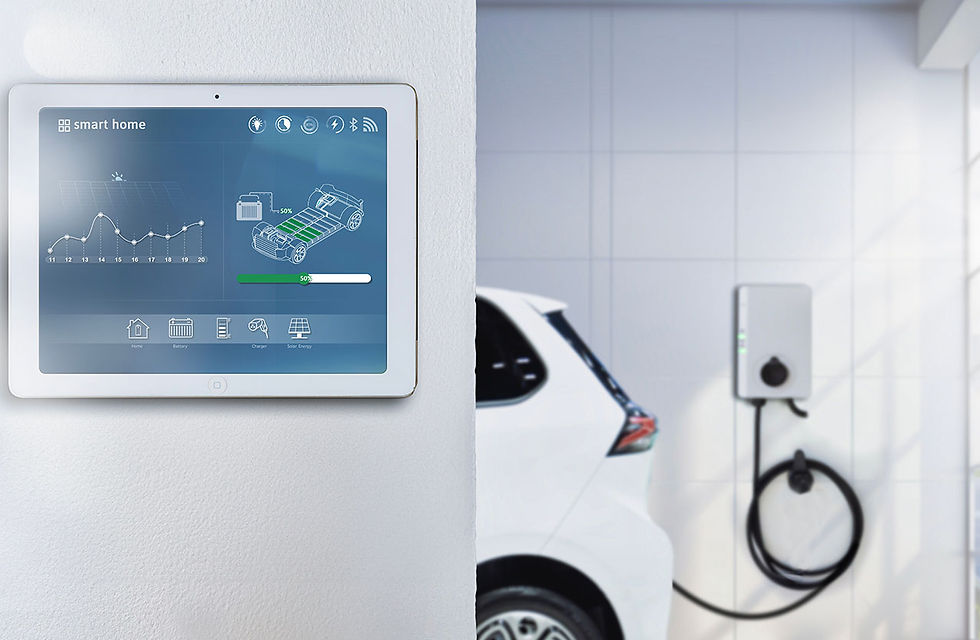
A compatible vehicle cannot provide V2G without a bidirectional charger, suitable electrical installation and, in many cases, a smart meter. Hardware availability, installation cost, housing type, and access to off-street parking therefore shape the addressable market. The practical starting point may be a fleet depot in one country and owner-occupied homes in another.
The offer must also fit around the driver. Customers need confidence that the car will be ready when required, that participation will not create an unexpected bill and that battery health is protected. Clear controls for departure time and minimum state of charge help, as do warranty terms that account for energy services. Revenue alone will not compensate for a proposition that feels difficult or risky.
V2H offers a simpler route to customer value
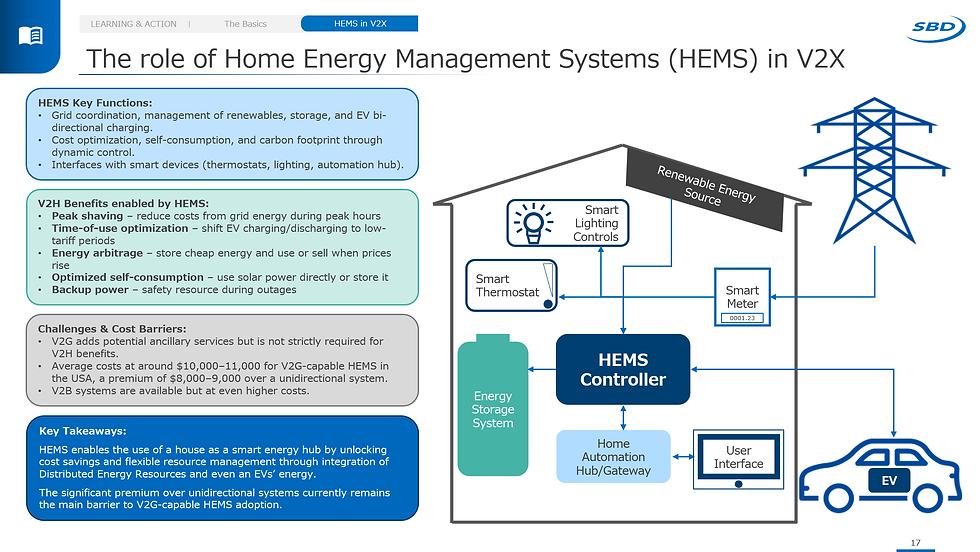
Vehicle-to-home avoids much of the coordination required for a grid service. In its simplest form, the vehicle supplies a home or building behind the meter. The technical relationship is therefore between the OEM and the manufacturers of the bidirectional charger and transfer equipment, rather than a wider group of grid operators, energy suppliers, aggregators, and market platforms. Electrical certification, installation rules and safe isolation from the grid still matter, but the commercial proposition does not depend on access to an energy market.
That makes electric supply resilience a real source of end user value. A suitably equipped EV can keep selected household circuits running during an outage, giving customers an alternative to a dedicated stationary battery. The benefit is particularly relevant in markets where storms, wildfires or network constraints cause frequent interruptions. It’s also easier to explain to an end customer than income from grid services: the vehicle provides power when the home needs it.
For prosumers (consumers that produce electricity with solar panels), V2H can increase the share of rooftop solar used on site. Solar generation can charge the vehicle during the day, with the stored energy supplying the home later instead of being exported at a relatively low rate and bought back at a higher retail price. As one example, Germany’s recent policy direction reinforces this logic. Measures to improve the market integration and controllability of photovoltaic systems reduce the reward for feeding power into the grid during periods of oversupply, while government proposals have explicitly sought to limit peak injection and encourage self-consumption and storage. An EV that can serve the home offers another way to absorb surplus solar without placing it immediately on the grid.
Taking another example from Germany, its treatment of plug-in balcony solar shows how a deliberately simple regime can unlock useful behind-the-meter value at small scale. Since the 2024 Solar Package I reforms, qualifying systems can use an inverter rated up to 800 VA and modules totaling up to 2 kW. Owners still register the system in the Federal Network Agency’s Market Data Register, but no longer need to notify the local grid operator separately. Any output not consumed in the home can flow into the grid, although operators who use the simplified route typically forgo payment for that surplus. Eight hundred watts is modest compared to the capacity of a vehicle battery, yet it can offset a meaningful share of a household’s daytime baseload with little administrative or installation effort. The example suggests that simple, low-power arrangements can deliver practical consumer value well before a fully coordinated market is in place. While this concept doesn’t apply directly to V2G, a similar arrangement for vehicles could, in theory, create new low-effort options for drivers and automakers alike.
One technology, several paths, and one commercial bright spot
Regional activity shows how the same technology can follow very different paths. Across Europe, V2G and V2H capability is growing, supported by flexibility markets, interoperability initiatives and OEM-energy partnerships. Progress remains fragmented, however, because grid rules, tax treatment, metering and access to local services still vary by country. The UK is the clearest exception and arguably the strongest current example of residential V2G moving beyond the pilot stage.
The UK shows what commercial V2G can look like
The United Kingdom brings together several of the conditions discussed above. Half-hourly wholesale prices and smart tariffs create a visible spread between low- and high-price periods. Aggregators can optimize many vehicles as a portfolio, while established processes allow small assets to export and participate in flexibility. The National Energy System Operator provides a single system-level view across Great Britain, which helps align national balancing needs even though local connections and constraints remain the responsibility of regional distribution network operators.
Commercial propositions now connect these pieces for customers. Perhaps the most prominent example is Octopus Energy’s Power Pack program that schedules compatible vehicles to charge when electricity is cheaper and export when the system values the energy more highly, translating that flexibility into free home charging within the tariff’s conditions. A bundle with BYD went further by packaging a V2G-capable vehicle, bidirectional charger and energy service together. This turns V2G from a technical demonstration into a product that can be compared, priced, and delivered.
The UK is not frictionless. Customers still need an eligible vehicle and charger, a smart meter and approval from their local distribution network operator under the relevant connection process. The range of compatible combinations remains narrow and the hardware premium can erode the financial return. Even so, the UK demonstrates the main argument of this insight in a positive light. When price signals, regulation, market access, aggregation, and customer packaging line up, V2G can become a real commercial option rather than just another pilot.
In the United States, vehicle-to-home has gained greater commercial visibility. Detached homes, rural locations, and concern about power outages create a clear reason to buy backup capability. Utility-linked V2G programs are developing, but regulation and program design differ by state and utility territory. Because of this, it’s becoming common to see automakers launch new bidirectional-capable vehicles in the market alongside a local utility’s V2G offer, such as with GM vehicles and the electric utility PG&E.
China has a growing range of V2G-capable models and is moving from scattered demonstrations towards coordinated, larger-scale deployment. In 2025, the government selected nine cities and 30 projects for its first national batch of large-scale vehicle-grid interaction pilots. These cover passenger cars, buses, heavy trucks, battery-swapping stations, residential charging and industrial sites. V2G requires standards, grid rules, market access, infrastructure, and data exchange to develop in step. China’s centralized policy system can align these elements through national targets and coordinated implementation more readily than fragmented markets can. That gives the country a structural advantage in enabling the technology, although low and regulated retail prices may still weaken the financial incentive for individual drivers to participate.
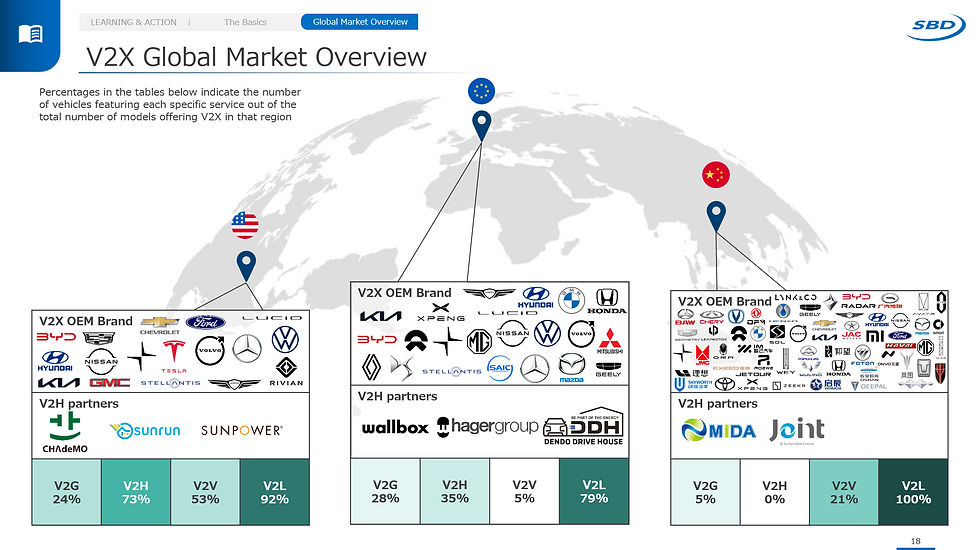
These examples do not produce a simple league table. They show that readiness is use-case specific. A market may be well suited to home backup, fleet demand response, or frequency services without being ready for every form of V2G. OEMs need to determine whether or not the local conditions support a defined customer and grid need.
What this means for automakers
A global technology roadmap still makes sense, but a global service template is less feasible. Automakers will need to combine common vehicle and cloud capabilities with market-specific partnerships, tariffs, hardware packages, and customer journeys.
That calls for detailed market research and selection. EV volume is relevant, but it should be considered alongside the value of accessible grid services, aggregator maturity, connection processes, hardware economics, and the number of customers with suitable charging arrangements. A smaller EV market with aligned rules and partners may offer a better launch platform than a larger one with unresolved barriers.
OEMs should also decide which role they want to play. Some will provide vehicle capability and secure data access while energy partners operate the service. Others may manage the customer relationship, control charging through their own backend or aggregate vehicles directly. The right position depends on regulatory permissions, internal capability and how much of the revenue and customer experience the automaker wants to own.
Finally, pilots should be designed around a path to repeatability. A demonstration built from one-off integrations can prove technical feasibility without reducing the cost of the next deployment. Programs that standardize onboarding, compatibility testing, permissions, settlement, and customer support have more strategic value, even when their initial scale is modest.
From technical capability to a commercial offer
V2G has accumulated a long record of successful trials and pilot programs. To scale up from this, automakers and their partners will need services that customers can understand, purchase, and benefit from. Reaching that point requires more than adding a bidirectional charging function to an EV.
Market readiness gives automakers a practical way to focus their effort. It directs investment towards places where rules permit participation, revenue is tangible, partners can operate the service, and customers have a clear reason to enroll. It also shows where groundwork is still needed before a launch can move beyond a pilot.
Automakers have started to treat the car as a valuable part of the energy system. The next steps are to determine where to launch services and with which partners.
“V2G is often presented as a vehicle technology, but the vehicle may now be the easiest part of the equation. Without the right tariffs, grid rules, hardware and commercial partners, bidirectional capability has little value beyond the specification sheet.” Robert Fisher, SBD Automotive – Senior Consulting Manager |  |
How SBD can help
If you or your team would like to understand how the highlighted technologies, partnerships and market dynamics could impact your strategy, we invite you to get in touch. Email info@sbdautomotive.com to connect with one of our experts and discuss your specific requirements. |


