
The next connected vehicle revolution may have two wheels
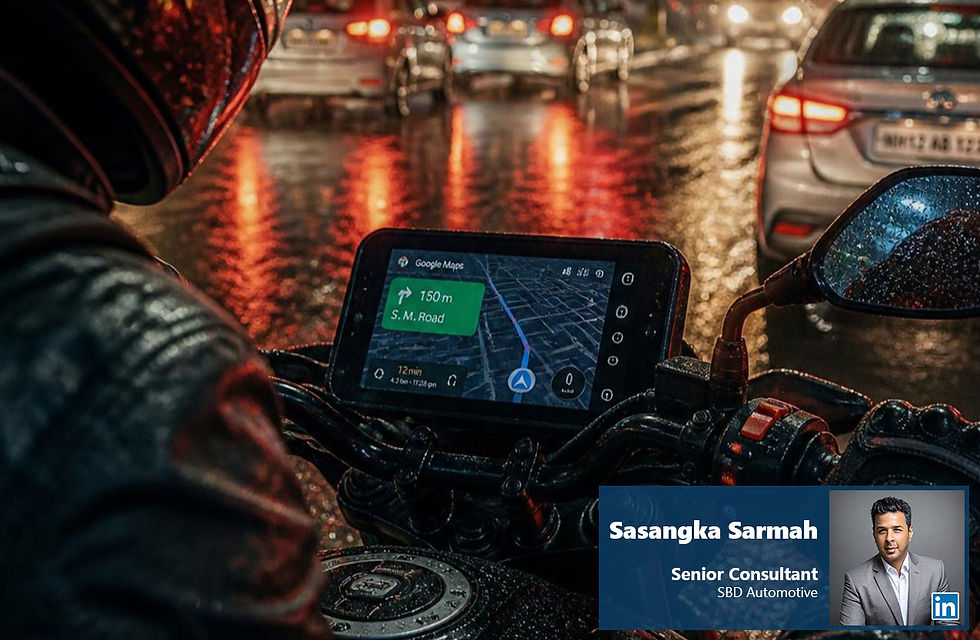
Navigation on a motorcycle is hardly new, riders have been mounting smartphones to handlebars for years.
But what is changing is where navigation is appearing and who gets access to it.
Bajaj's latest Pulsar updates bring a 5-inch colour TFT display with Google Maps mirroring to the top variants of motorcycles such as the Pulsar N160 SS, Pulsar 150 and Pulsar 125. At first glance, this could look like another feature in the ongoing two-wheeler technology race. But there is a much bigger story here.
Connected motorcycle technology is moving from premium motorcycles and electric scooters into the mainstream commuter segment. In India, that has implications far beyond convenience.
The interesting part isn't the TFT but how Bajaj gets Google Maps onto it
Bajaj isn't putting a full version of Google Maps directly into the motorcycle's instrument cluster. Instead, the Pulsar uses the rider's smartphone as the intelligence and connectivity layer, with the motorcycle effectively becoming the display and interaction interface.
The rider initially authenticates the motorcycle through the Bajaj Ride Connect app, using the motorcycle VIN and OTP verification. The smartphone then establishes a Bluetooth connection with the motorcycle.
Post that the Bluetooth handles the initial pairing, controls, telemetry and other connected functions.
But Bluetooth isn't suitable for streaming a full visual map. That's where Wi-Fi comes in.
The smartphone establishes a higher-bandwidth local Wi-Fi connection with the motorcycle's console, allowing the visual navigation interface to be projected onto the 5-inch TFT.
Once the rider enters a destination and starts navigation, the system initially provides turn-by-turn guidance. A long press of the handlebar control then switches the TFT into full-screen mirroring mode, allowing the visual map from the phone to appear on the motorcycle's display.
You may ask that what is new as there are comparable solution from other OEMs that already exist in the market. This is where it gets interesting.
Mirroring / Framebuffer
Most solution from other OEM relies on standard OS-level screen capture (similar to a live screen-recorder or basic Miracast). The bike's console literally mirrors whatever pixels light up the phone’s physical glass. The moment the phone locks or times out to save battery, the display pipeline shuts off, terminating the visual feed and dropping the cluster back to basic arrow navigation.
Decoupled Virtual Display
Bajaj has done something much smarter by engineering a sandboxed virtual-display pipeline . Instead of recording the phone's main screen, the Bajaj’s solution creates a second, invisible screen inside the phone's brain (GPU), specifically reserved for the motorcycle. The phone processes the Google Maps navigation on this hidden, secondary display and streams only that to the bike, completely separate from what the phone's main screen is doing. Since both these two "screens" (the phone’s and the bike’s) are completely independent, a rider can lock his phone, switch apps, or put it in his pocket, and the bike’s display keeps showing the full map without missing a turn.
Why not simply put Google Maps inside the motorcycle?
This is where the economics become interesting.
A genuinely standalone navigation system would require considerably more hardware and software infrastructure: an operating environment capable of running navigation, connectivity, positioning, map services as well as cellular connective. In the electric two-wheeler world, we already have example of Ola and Ather who have implemented such integrated connected platform.
Bajaj’s instead has taken a cost effective approach by opting for a sophisticated screen mirroring. While Bajaj’s solution may not be as technologically ambitious as running a complete native navigation platform onboard, it is more commercially rational architecture.
The key innovation is therefore not native navigation. It is cost-effective clever projection.
This matters because the commuter motorcycle is also a workplace
India's gig and platform economy is expanding rapidly, with millions of workers now relying on platforms across food delivery, e-commerce, quick commerce and other services.
Estimates from NITI Aayog shows that in India there were around 7.7 million workers in the gig economy in 2020-21 which is estimated to grow to 23.5 million by 2029-30. This is where the Pulsar story becomes much more significant in India as much of that work happens on two-wheeler.
From a rider’s perspective, this is how a typical day looks like
Finding an address
Navigating unfamiliar streets
Moving between restaurants, dark stores and customers
Checking the next delivery
Monitoring arrival times
Re-routing around traffic
Switching between navigation and communication
The smartphone has traditionally been the interface for all of this.
But holding or repeatedly looking at a smartphone while riding is hardly an ideal user experience.
Putting navigation directly into the rider's natural field of view changes the interaction model.
The democratization of connected motorcycle technology could be more important than the technology itself
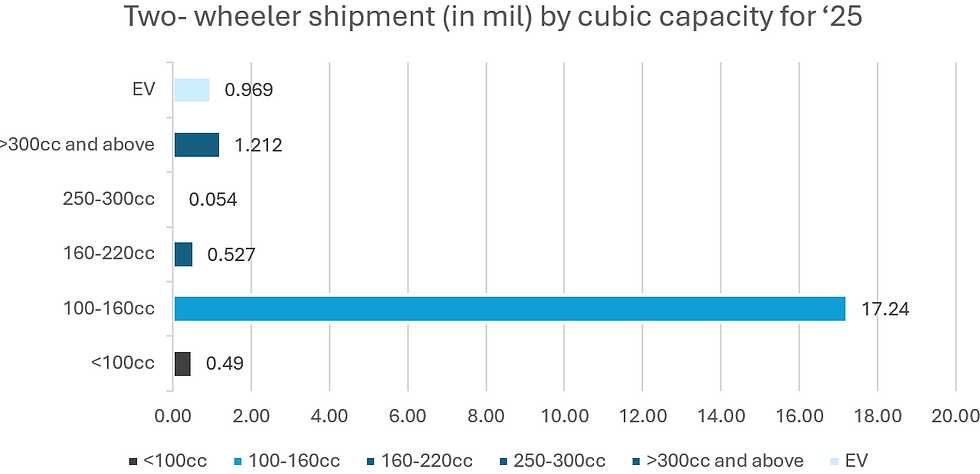
Traditionally large TFT screens, smartphone integration, navigation and connected services have been associated with two-wheeler in the premium segment.
But the real opportunity in India is the enormous volume sitting underneath the premium segments. For reference, the Executive Commuter segment represented by two-wheelers having engine capacity between 100-160cc represent 84% of the market with annual shipment of 17.2 million in 2025
This is why Bajaj's decision to introduce a full-colour TFT and map mirroring into the Pulsar family (Pulsar 125, Pulsar 150 and Pulsar 160) deserves attention. While the technology itself isn't revolutionary, the democratization of the technology is.
What this means for motorcycle OEMs
Ather and Ola have already demonstrated much deeper integration of software and navigation into electric two-wheelers. In the Premium segment, Royal Enfield’s Tripper Navigation is another widely recognized platform.
What Bajaj has done differently is bring a relatively sophisticated connected HMI into a high-volume, mainstream motorcycle segment using a pragmatic low-cost smartphone-plus-Wi-Fi architecture.
That matters in India. Because the next major wave of motorcycle software may not be driven by people buying motorcycles as lifestyle products. It will be driven by people who use motorcycles to make a living.
For millions of gig workers, better navigation isn't simply about convenience. It can mean fewer interactions with a phone, less friction between deliveries, better awareness of the route and potentially more productive time on the road.
That is when a motorcycle software becomes less of a feature and more of an enabler.
"Connected features should never exist simply to add another tick to a specification sheet. They need to solve a real problem for the person riding the vehicle. The real achievement with the Pulsar’s navigation is not putting maps on a TFT screen. Rather it is about giving a rider one less reason to reach for their phone while riding. That is when connected technology moves from a brochure feature to something that genuinely changes the riding experience” Sasangka Sarmah, SBD Automotive – Senior Consultant |  |
How SBD can help
If you or your team would like to understand how the highlighted technologies, partnerships and market dynamics could impact your strategy, we invite you to get in touch. Email info@sbdautomotive.com to connect with one of our experts and discuss your specific requirements. |


