
Questions and learnings from the announced Volkswagen reorganization

Volkswagen’s Future Plan 2030 signals a hard reset of the traditional European volume-car business model, with deep cuts in capacity, workforce and complexity to regain cost competitiveness and strategic focus. Other European OEMs will be forced to confront similar structural questions, especially under mounting Chinese competition and a more volatile geopolitical and regulatory environment.
The announcement can be summarised in the following:
VW’s plan targets a roughly 50,000 workforce reduction on top of earlier announcements (total of 100,000 workforce reduction)
Acknowledging more than 500,000 units of excess capacity in its European plants and putting sites such as Emden, Zwickau, Hanover and Neckarsulm under review for alternative uses.
Halve its model portfolio by 2035 and cut offering complexity by around 75%.
Raising the group operating margin to 9% by 2030 through a tighter focus on core automotive activities and a streamlined investment portfolio.
Strengthening its China and North America businesses
These decisions to tighten cost base and simplify its portfolio will have knock‑on effects on innovation capacity, brand perception, and the core capabilities needed to compete in a harsher global environment. Furthermore, they will raise questions about their execution and constraints, including:
Core competency | Tactical implication | Future questions for OEM | Potential answers / signals |
Complexity | Simplified model and variant portfolio reduce near‑term engineering workload and product complexity, freeing R&D capacity to focus on fewer, more compelling vehicles and competitive technologies. | How to maintain existing (future legacy) platforms until end of vehicle lifecycle and the inherent cost of doing so. | No clear message so far from Volkswagen on how will this be achieved |
Agility | Harmonizing platforms, electronic architectures and software for Western and Eastern hemispheres cuts parallel development and should accelerate cycle times for new features, ADAS and E/E updates. | How will Volkswagen rebalance existing departments to ensure outsourced platforms comply to engineering ‘s specifications? | Volkswagen’s decision to use Xpeng’s vehicle platform in China is already key to accelerate development times. This will impact the required workforce and knowledge to deliver and maintain such platforms from Volkswagen’s side, consider more validation and verification, less detail component engineering. |
Complexity | Streamlining the equity and investment portfolio by about one‑third focuses capital on core automotive activities, improving funding availability for priority technologies (battery, software, platforms) at the expense of peripheral ventures. | Will this include divesting or closing brands? | SEAT did officially confirm that they are considering winding down SEAT through 2030 and putting their resources into CUPRA instead. |
Differentiation | Reduced equipment-option complexity (up to 75%) and package-based configurations simplify industrialization and allow faster deployment of new tech across the fleet once validated. | With higher component and platform commonality how will brands ensure a differentiated experience? | Based on SBD existing consumer studies, consumers see experiences and UX as a major differentiator. In addition, they react negatively when they perceive near‑identical products with only cosmetic changes. |
Differentiation | Reframe China and broader Asian exposure via mixed strategies (local JVs, selective imports, licensing, and technology partnerships) | How to stay relevant in growth markets dominated by Chinese players? | SBD’s China technology and innovation tracker highlights Volkswagen focusing on advanced features such as smart surfaces in the Chinese market |
Other OEMs are going through similar situations
Stellantis announced a FaSTLAne 2030 plan to cut European installed capacity by about 800,000 units (roughly 20%), lifting plant utilization from 60% to 80% by 2030, largely via repurposing and capacity‑sharing rather than outright closures. Stellantis is exploring selling or sharing multiple plants (in Rennes, Madrid, Cassino) and repurposing its Poissy plant into a components / circular‑economy hub.
Renault is centralizing EV production in Northern France, standardizing battery and power electronics across platforms, and targeting large structural cost cuts per vehicle. Furthermore, this situation is not only occuring for volume automakers, but actions are also being taken by premium OEMs as well (see the table for a high-level summary):
Mercedes-Benz Has already streamlined its portfolio toward higher‑margin segments and separated trucks and faces the same European overcapacity and Chinese‑EV pressure as Volkswagen.
BMW is pushing flexible multi‑energy platforms and high utilization of a limited set of architectures, de‑emphasize low‑margin derivatives and double down on tech‑heavy, premium segments.
JLR just announced 4,000 job cuts and is ongoing a full brand image and strategy shift.
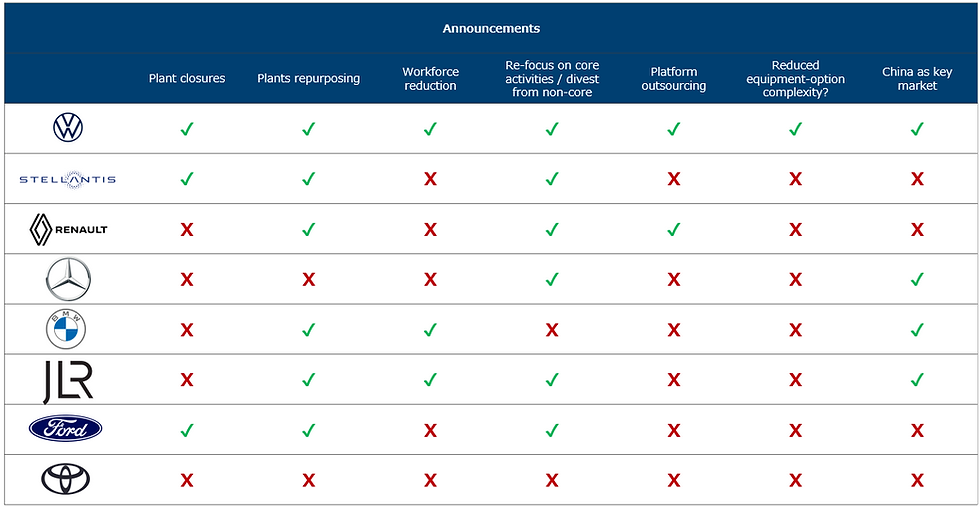
Therefore, it is important for OEMs and suppliers to better understand the decisions and consequences from the competition to better define their own set of actions.
Learnings and questions for other OEMs
At a very high level, there are certain initial questions and findings that are useful to direct other OEMs into their current transformations, following internal discussions with our experts, here are some common points:
Other OEMs, particularly those with legacy finance, mobility or non-core industrial holdings, will be pushed to articulate clear strategic tests for capital deployment and accept divestment where synergies are weak.
Commit to platform and software convergence with disciplined brand governance, ensuring each brand has a distinct role rather than overlapping line‑ups.
Use simplification gains to fund genuine differentiation in areas where Chinese competitors are not yet dominant in Europe (e.g. Energy services, grid integration, and advanced charging/V2G ecosystems). This will turn European regulatory complexity into a barrier to entry rather than a cost drag.
These questions are just a first pass at such complex situation. In-depth discussions are needed across management teams to understand the best way to react to executive decisions and still deliver a competitive and profitable offer.
“The next 3 years will see a shift in the core competencies that OEMs need to deliver to differentiate. At SBD are engaging constantly at a strategic and implementation level with OEMs to support their vision. If you are interested in knowing more about how upcoming decisions will impact your teams, contact me. I will be happy to have a conversation on this." Edward Páez - SBD Automotive Senior Consultant |  |
How SBD can help
If you or your team would like to understand how the highlighted analysis could impact your strategy, we invite you to get in touch. Email info@sbdautomotive.com to connect with one of our experts and discuss your specific requirements. |


