
More software in-house. More control or just more work?

During a recent Detroit visit, conversations with three Tier-1 suppliers kept returning to the same concern: automakers want greater control of vehicle software, but do they fully appreciate the integration work they are taking on?
It is a fair question. Suppliers have spent years making complex vehicle systems work.
But I came away with another question: if OEMs need help, why should that work return to the same suppliers, in the same form?
The emerging partnerships suggest both sides need to reconsider what they mean by control.
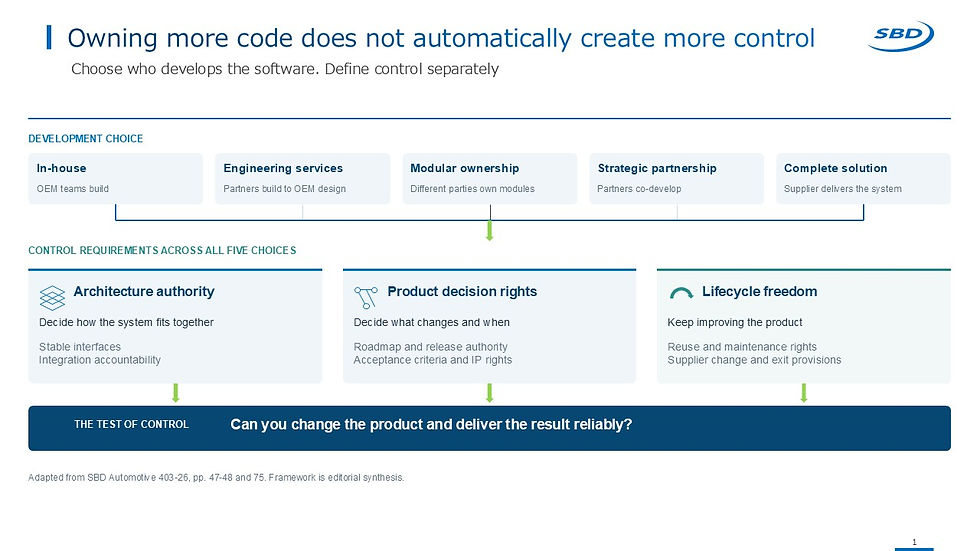
Writing the software is not the same as controlling the product
An OEM might write more code internally and still struggle to release a feature because teams use incompatible interfaces, vehicle programs follow different priorities, or nobody owns the final integration decision.
Conversely, an OEM can use externally developed software while retaining authority over its architecture, customer experience and release roadmap.
SBD’s 2026 Automotive Organization Strategies Deep Dive makes this distinction through its analysis of modular creation and ownership. Its recommendations emphasize the capability to integrate, govern and evolve a platform, alongside clear rights covering interfaces, reuse, maintenance and supplier exit.
The useful question is not simply how much software an OEM writes. It is whether the OEM can change its product, understand the consequences and deliver the result reliably.
The next partner may be another automaker
Volkswagen’s partnership with Rivian makes the old OEM-versus-supplier distinction harder to sustain. Their joint venture builds on Rivian’s existing software and electrical architecture. Capabilities developed within an automaker are becoming the basis of a platform intended for both companies.
For established suppliers, that presents a different competitive challenge. The alternative to their offering may be another vehicle manufacturer’s technology.
BMW and Qualcomm illustrate a second shift. Their jointly developed Snapdragon Ride Pilot debuted in the BMW iX3, and Qualcomm offers the platform to other automakers and Tier-1s.
This raises a revealing question: if part of the underlying technology is available to competitors, where does the distinctive BMW experience reside?
My reading is that OEMs need to identify differentiation much more precisely. Ownership of an entire stack is a very different investment from control over the capabilities customers notice and value.
Common software changes what suppliers can charge for
Shared foundations introduce another challenge: some software may become less valuable as an exclusive asset, while the expertise needed to deploy and maintain it remains valuable.
ETAS’s work with Eclipse S-CORE illustrates this distinction. Its stated focus includes turning a shared code base into a supported product through integration, validation, documentation, dependable releases and lifecycle management.
The opportunity is substantial, but demanding. Suppliers need to demonstrate that their contribution reduces the effort required to bring a feature into production and keep it working.
That does not mean traditional Tier-1s disappear. Volkswagen’s announced MQB collaboration combines Valeo’s hardware and parking capabilities with Mobileye’s ADAS platform. It shows how specialist capabilities can be assembled within a different division of responsibilities.
These examples establish different approaches to sourcing. They do not establish one universally superior model, or prove the lifetime savings each will achieve.
Complexity can move without getting smaller
If an OEM replaces several supplier relationships with several internal software organizations, has it simplified delivery or moved the coordination problem onto its own payroll?
And if a supplier offers a broad platform, does it reduce integration effort or make future changes more dependent on that supplier?
SBD’s organizational research connects these questions to decision rights, platform funding, configuration management and stable interfaces. The architecture and the organization have to work together.
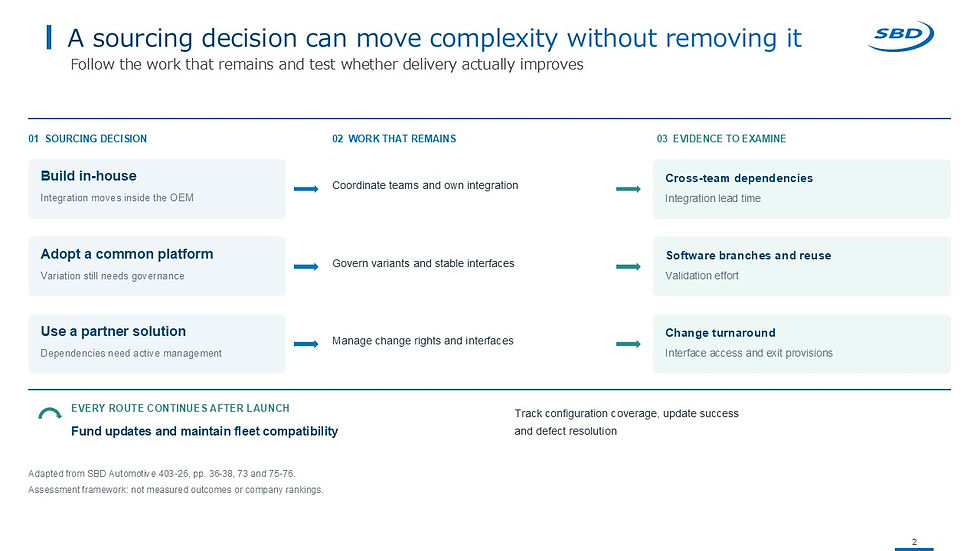
Before choosing a sourcing model, I would want to know:
Who can approve a change that affects several vehicle functions?
How much software can be reused without creating another program-specific version?
Who funds updates and defect resolution after launch?
Can the OEM change a partner without rebuilding the surrounding system?
These questions reveal more about practical control than an in-house development target.
A different test of supplier value
The next phase of SDV sourcing should be judged by what becomes easier to deliver, maintain and change.
For OEMs, that means being selective about where ownership creates an advantage. For suppliers, it means proving where their expertise creates a better outcome than internal development or an alternative partner.
Building on SBD’s earlier Sourcing the Software Defined Vehicle work and our latest organizational research, the next useful step is to compare those choices with actual delivery outcomes.
Targeted benchmarking and shared research could help establish that evidence.
I would welcome perspectives on where greater ownership has improved delivery and where it has simply moved the complexity.
"The real test of control is whether you can change the product, understand the consequences and deliver the improvement, not how much of the code you wrote." Bibin Thomas, RSM - Americas at SBD Automotive |  |


