
Is connectivity still being measured by the wrong KPIs?

For many OEMs, connectivity discussions still begin with the same questions: What's the cost per MB? Which operator offers the best commercial terms? How can roaming costs be reduced?
Those are important questions. They're also increasingly the wrong place to start.
As vehicles become more software-defined, connectivity is no longer just a mechanism for moving data. It's becoming the foundation that enables OTA updates, connected services, AI-driven experiences, predictive maintenance, cybersecurity compliance, feature activation, and future mobility ecosystems.
The challenge is that many organisations continue to assess connectivity primarily as a procurement decision rather than a strategic capability. This creates a growing gap between how connectivity is purchased and how connectivity is actually used.
Why connectivity matters more than ever.
Several industry trends are placing new demands on connectivity architectures.
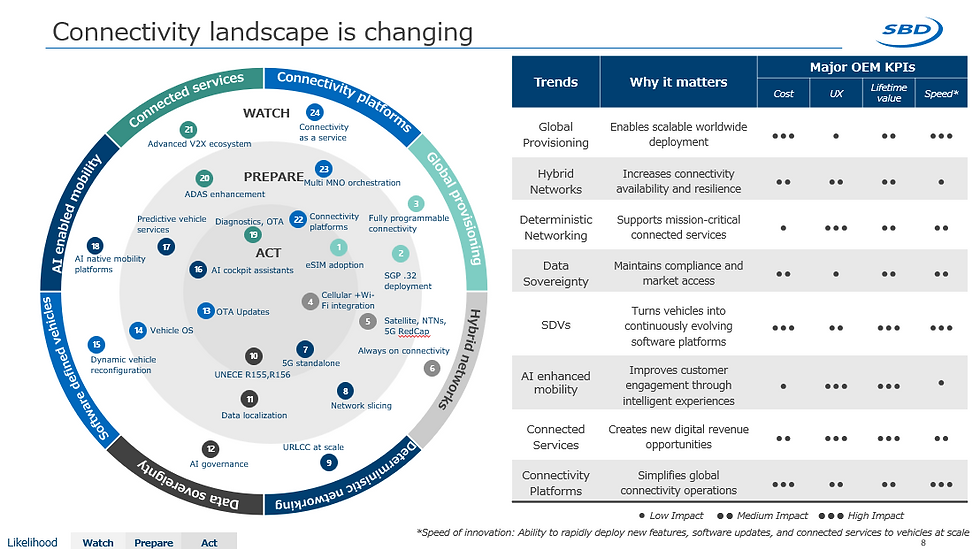
OTA updates now require reliable, secure and cost-efficient connectivity to support continuous software deployment. Vehicle operating systems increasingly depend on connectivity to integrate cloud services and applications. AI-enabled mobility services, predictive maintenance, V2X ecosystems, network slicing, satellite communications and multi-MNO orchestration are all moving from future concepts to active development areas.
At the same time, connectivity is beginning to influence some of the metrics OEM leaders care about most:
Operational cost
Customer experience
Customer lifetime value
Speed of innovation
The result is a simple reality: connectivity decisions are no longer isolated telecom decisions. They increasingly affect product, software, operations, cybersecurity and business strategy.
The hidden cost of treating connectivity as a commodity
During recent discussions with industry stakeholders, one theme emerged repeatedly.
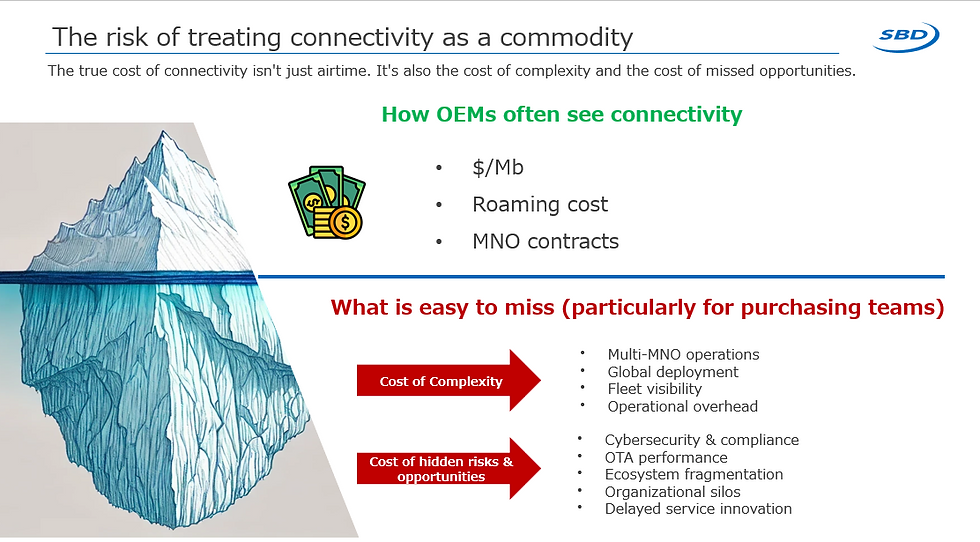
The visible cost of connectivity is relatively easy to measure.
The hidden costs are much harder to quantify.
A connectivity programme may appear commercially competitive on paper, yet still create challenges around:
Managing multiple operators across global markets
Maintaining visibility across connected vehicle fleets
Supporting global OTA deployments
Meeting cybersecurity and compliance obligations
Integrating connectivity into software delivery strategies
Scaling future connected services
In some cases, the biggest cost isn't operational at all. It's the opportunity cost of slower service innovation, delayed software rollouts, or an inability to support emerging SDV capabilities.
That is why reducing "$/MB" does not automatically reduce the total cost of connectivity.
Not all OEMs are pursuing the same path.
One of the most interesting observations from our research was that leading OEMs are taking noticeably different approaches to connectivity.
Some are focused on building premium connected ecosystems. Others prioritise standardisation and operational scalability. Some use connectivity primarily to drive customer adoption and product differentiation, while others have embedded connectivity directly into their software and services operating model.
None of these approaches are inherently right or wrong.
They simply reflect various levels of connectivity maturity and different business priorities.
The more important question is whether an organisation's connectivity capabilities are aligned with its long-term digital ambitions.
A connectivity maturity journey is emerging.
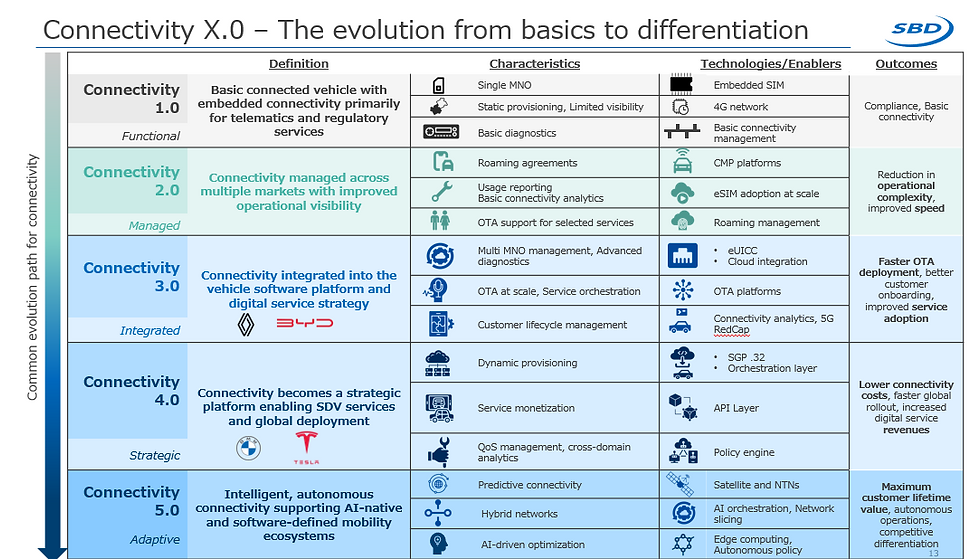
During our work, we developed a Connectivity Maturity Index to help structure these conversations. The framework outlines a typical evolution path from basic connected vehicle deployments through to intelligent, adaptive connectivity ecosystems.
At a high level:
Connectivity 1.0 focuses on basic telematics and regulatory services.
Connectivity 2.0 improves visibility and operational management across markets.
Connectivity 3.0 integrates connectivity into software platforms and digital services.
Connectivity 4.0 treats connectivity as a strategic platform supporting SDV deployment and monetisation.
Connectivity 5.0 enables AI-driven, autonomous and adaptive connectivity operations.
The value of the framework is not in assigning a score.
The value comes from asking better questions.
Can new services be deployed globally without hardware changes?
How quickly can connectivity issues be detected and resolved?
How dependent is the organisation on individual operators?
Is connectivity owned by procurement, engineering, product teams, or all three?
Is the current architecture capable of supporting future AI and SDV ambitions?
The answers are often more revealing than any maturity rating.
The next battleground may not be connectivity itself.
Many automotive technology discussions today focus on AI, SDVs, autonomous vehicles, or digital services.
What often receives less attention is the enabling infrastructure underneath them.
Yet many of these future capabilities rely on resilient, scalable, secure and intelligently managed connectivity.
The OEMs that extract the greatest value from software-defined mobility may not necessarily be those with the cheapest connectivity contracts but the organisations that recognise connectivity as a core business capability and invest in it accordingly.
My view is that the industry is approaching a point where connectivity stops being something organisations buy and starts becoming something they orchestrate. The firms that make that transition early will be in a far stronger position to scale software-defined vehicles, AI-enabled services and future mobility ecosystems over the next decade.


