
Is 2026 policy leaving the U.S. in the dust?
Innovating at break-neck speeds.
As we mark the halfway point of 2026, one thing is apparent: consumer and industry technology is evolving faster than ever… still.
Whether it’s an explosion around AI at the consumer, enterprise and industrial levels, a revitalization of investments in autonomous driving, more electrification whiplash, new platform-based Feature-as-a-Service (FaaS) models, a rise in monitoring and surveillance tech, or newly realized safety challenges, the first half of 2026 has been jam-packed with trials (and errors) that have been pulling the automotive sector in every direction.
Such rapid change requires thoughtful guardrails that are able to balance safety and security while still allowing for innovation.
Policy: a help or hinderance?
Government regulation and legislation have the power to propel technology to new heights through dedicated funding and research, shared infrastructure, market certainty (technology / platform mandates), and creating a safety net of public trust and confidence through liability and accountability frameworks.
However, this is only achieved when policy is implemented in the right way: freshly, collaboratively, clearly, and globally.
Freshness: policy should be developed proactively and built on real-world data and market forecasting. At the very least, governing bodies and their internal infrastructure should allow for agile, reactive policy implementation that keeps pace with industry.
Collaboration: policy development should deliberately involve industry and consumer participation to anticipate the direction of technology advancements and trends, which supports freshness.
Clarity: requirements should be designed to be clear, referential, and easy to follow between separate rulings and agencies. Prescriptive requirements must be well-defined.
Globalization: policy and industry compliance should be treated as a global matter.
Mandates become safety considerations, conveniences, and trends that global consumers want or expect as they are increasingly exposed to them by media, travel, and global trade. Costs can significantly compound for manufacturers, developers, and consumers under divergent regulations.
When policy is fragmented and does not align with industry and economic realities, it not only stops acting as an enabler, it becomes a serious barrier.
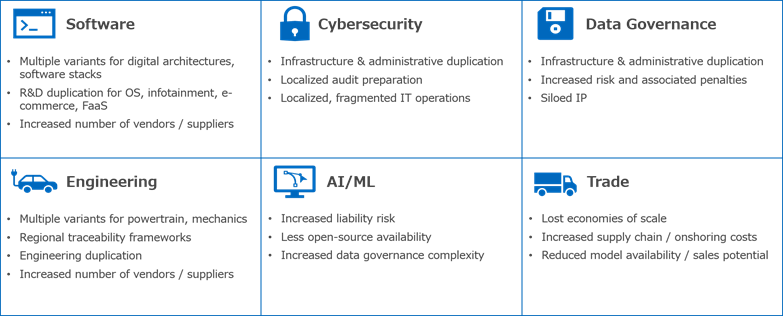
In one November 2025 study published in the Technical Disclosure Commons, titled “The Fragmentation Tax,” researchers found that, for AI/ML systems alone: a multi-national corporation operating high-risk (per E.U. AI Act definitions) AI across the U.S., E.U., and APAC faced up to $47M in added annual costs via duplicated infrastructure, complex operational processes, and the need for specialized and localized talent.
Around the world, around the world.
Policy development has been active across nearly all major automotive domains in nearly all major markets in HY1 2026, with AI/ML being the ‘hot topic’ of the year and China in particular churning out relevant, strategic policy across the board.
If you’ve been paying attention, the exception should come as no surprise: the U.S.
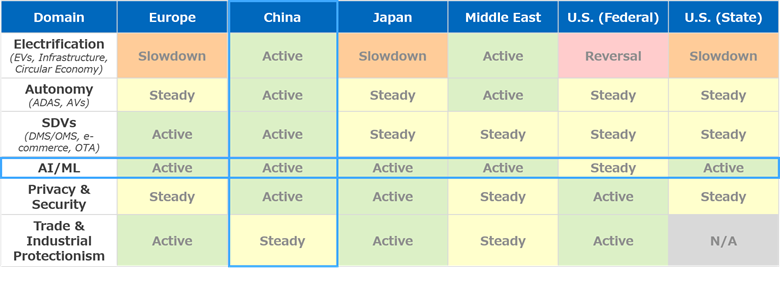
At the federal level, the U.S. has been comparatively quiet in domain areas that are seeing a ramp up in regulation elsewhere. Notably:
Driver and Occupant Monitoring Systems (DMS / OMS): delayed implementation of a rule ordered by the Infrastructure Investment and Jobs Act back in 2021, and just recently planned studies into DMS efficacy and acceptance, for which a notification of intent was published in June 2026.
AI/ML, data privacy, and autonomous vehicle deployment: largely left up to state laws and programs. While the U.S. federal government has touted a ‘deregulatory environment’ to support innovation, a patchwork of policy scopes, stringencies, unstandardized definitions, and liability frameworks (and sometimes no policy at all) across states has ultimately resulted in greater cost, deployment, administrative, and legal onuses just within national operations.
Electrification: initiatives have seen federal funding, incentive, and research programs cut, leaving incentivizing – or disincentivizing – EVs up to state discretion, OEMs to reconcile existing and planned products with stagnant infrastructure support, and multi-billion dollar investments left on the table.
U.S. policy is increasingly losing freshness in a region where legislation and rulemaking can already lag years behind technology invention and identified risks. In domains where the U.S. has been most active – namely, security and trade restrictions – policy has ended up adding barriers to industry and reducing global harmonization.
Luckily for regulators and policy advocates in the U.S. industry, there has been a high volume of proactive, strategic global actions in just the last 6 months that the U.S. can look towards and learn from to start anticipating and modeling future regulatory needs and keep the U.S. automotive market from becoming a lonely island.
1. Let’s keep it simple.
E.U.
The E.U. has issued a series of proposed omnibus packages to amend and simplify certain regulations. For an automotive audience, the ones most applicable would be:
VII – Digital: covering data, cybersecurity, and AI.
VIII – Environmental: covering industrial emissions, circular economy, and geospatial data (relative to environmental assessments).
IX – Automotive:
Covers technical requirements, testing procedures, and type approval of vehicles, including for:
Euro 7: harmonized EU OMB/OBFCM data infrastructure; reduced test-related adjustment costs; HDV type-approval by category rather than weight.
Speed limitation devices: exemptions for N2 EVs (commercial vans).
Noise: repealing obsolete EU 540/2014 to align with UN R51, R59, and R138.
Amends major type approval regulations 2018/858, 2019/2144, 2024/1257.
E.U. regulators have recognized that their complex, interwoven, fragmented policy rollouts can be a barrier to industry, citing increased administrative (for both corporations and themselves in government) and development costs.
The omnibus packages will maintain the freshness, relevancy, and clarity of older, effective, amended regulations and support the E.U.’s push for local industry and economic competitiveness.
Japan
In an effort to improve its trade deficit with the U.S., Japan has revoked requirements for additional testing of U.S. imports to streamline the certification and import process. U.S. imports will now be considered compliant and approved through an assessment of existing U.S. documentation, and given a dedicated sticker label and inspection record entry.
While this can allow OEMs to further capitalize on their higher margin models – e.g., Toyota plans to import the U.S.-built Camry, Highlander and potentially the Tundra; Honda is considering the Ridgeline and Pilot, and Nissan the Murano and Pathfinder – it also raises new safety and reputational risks for brands.
Any additional safety and market adaptations are encouraged but completely voluntary. This includes side marker reflectors, vehicle weight, headlight orientation, emissions standards, and bumper height. This compliance ‘short-cut’ could unintentionally result in more severe collisions and injuries due to differences in vehicle weight and bumper height, or infrastructure and public safety complications with increased emissions and road wear.
2. AI, everywhere, all at once.
As mentioned earlier, AI is the hot topic on everyone’s mind, but no two governments are approaching it alike.
Middle East
Saudi Arabia was on the money when its Council of Ministers labeled 2026 the “Year of AI” in March. This marked an initiative to position Saudi Arabia as a global hub for AI and data technology under Vision 2030 and the National Strategy for Data and AI – built on the foundation of 70 new deals in 2025, under which Saudi AI companies acquired a total $9.1B USD in government investment.
Furthering AI leadership efforts across the Middle East, the UAE enacted the AI Act 2026, also in March, which applies to any organization operating any AI system (autonomous vehicles, financial modeling, diagnostics, chatbots) within the UAE, and uses a 4-tier risk classification modeled after the E.U. AI Act.
China
China, meanwhile, has cracked down on AI’s role in economic and domestic security.
Effective June 1, 2026 China’s State Administration for Market Regulation now formally extends trade secret protections to AI data, algorithms, programs, and code with new, extraterritorial restrictions on:
Employee travel.
Global hiring of China’s AI talent.
Remote work.
File access (logs must be kept for all cross-border collaboration).
User activity (via monitoring).
Tech exports.
This effort coincides with the Outbound Investment Regulations, effective July 1, 2026, which allow China’s government to block, undo, or penalize overseas deals involving any technology, data, services, or personnel deemed “restricted” – including through third-party / indirect transfers, like consulting.
Both efforts are centered around personnel, hiring, and M&A, so it is not expected that enforcement will explicitly target strategic joint ventures and collaborative development. However, companies with China-based R&D may see increased IP audit costs, administrative burdens on R&D lineage and Software Bills of Material (SBOM), infrastructure / engineering duplication, and weakened cross-border information sharing.
Global companies may also be deterred from investing in Chinese AI startups – a potential win if redirected to AI talent in the rest of the world.
China is also regulating the technology itself more strictly, with an interesting new regulation published in April and going into effect July 15, 2026: Interim Measures for the Administration of Anthropomorphic AI Interaction Services.
Provisions of this rule cover “content control” (ethical and moral alignment), data governance in compliance with the Personal Information Protection Law, proactive user protection mechanisms, reactive risk intervention, and specific protections for minors, and applies to virtual companions, chatbots, emotionally responsive digital assistants (think Tesla’s Grok), and any other anthropomorphized engagement. It signals a recognition of the risks associated with over-confidence and trust in consumer-facing AI, and may limit the scope of future in-vehicle AI personalization and virtual personal assistant (VPA) services.
Japan
On the far other side of the spectrum, Japan is approaching AI regulation – or rather the lack thereof – with a concept called “soft law.”
Prime Minister Takaichi has sought an accelerated AI approach following her February 2026 election, aiming for Japan to be the ‘most favorable’ place to develop and launch AI.
This approach is based on the AI Promotion Act 2025, a legislative instrument directing AI R&D and commercialization without strict penalization, guided solely by a ‘duty to cooperate’ and non-binding recommendations. Similarly, the AI Basic Plan is a strategy framework under the AI Promotion Act, rather than a regulatory mandate.
In April 2026, new amendments to the Act on the Protection of Personal Information (APPI) were passed by the Cabinet. If approved by the Diet, the amendments will go into effect in 2028 and allow businesses to collect publicly available personal and identifying information and share that data with third parties for statistical processing and AI development without consent (but with transparency). There would also be unique new exceptions for processing that does not explicitly harm an individuals’ rights or interests.
Where this deregulatory approach differs from the U.S. is in its clear, top-down national guidance and precedent. The AI Basic Plan promotes a deployment-first model aligned with established, comprehensive laws on data protection, IPR, consumer rights, and specific sectors and most importantly: the government leads by example.
In May 2026, the Japan government adopted the Government AI “Gennai,” a secure generative AI platform developed ‘in-house’ by the Japan Digital Agency, for government employees’ document drafting and summarization.
3. Driving autonomy forward.
UNECE Signatories
At the E.U. and UNECE signatory level – which is a significant chunk of the world besides the U.S. and China – clear definitions and frameworks to enable SAE L2 / L2+ driving and the future transition into widespread L3 are evolving.
UN R171 went into force in September 2024, creating a unified regulation for Driver Control Assistance Systems (DCAS). In September 2025, the UN R171 01 Series of Amendments went into force, covering extended hands-free highway driving, notice periods for system-initiated lane changes, DMS hands-on / eyes-on evaluation, and Risk Management Function (RMF) safe-stop.
On June 8, 2026, the proposed 02 Series of Amendments was reissued, covering:
Definitions to consider “highway-like roads” (divided, uninterrupted driving) and hands-on requests at least 7s before the end of ‘highway-like’ conditions.
Warning strategies that prioritize simultaneously activated emergency assistance systems.
System handover and timing.
DCAS responsibility to initiate unavailability responses.
OEM liability to describe system behavior if a driver is disengaged during maneuvers.
And much, much more.
Of note, global DCAS regulation is increasingly tying in to requirements for contextual, data-rich DMS systems. As the U.S. lags on a comprehensive federal regulatory framework for both autonomous driving and DMS, configuring compliant and consumer-accepted models for the U.S. market will become increasingly complicated.
China
China’s 2026 Automotive Standards Roadmap places emphasis on research, regulation, and national standards for autonomous driving and intelligent connected vehicles, testing, and associated features like autonomous valet parking (AVP).
By February 2026, MIIT had already published a draft proposal for a mandatory safety standard (GB XXXXX-XXXX: Safety Requirements for ADS of ICVs), with a public comment period closing on April 13, 2026. The proposal would be the first mandatory technical safety regulation for AVs in China, and includes requirements for:
Basic performance, stating automated systems must operate “at least equal to that of a qualified human driver.”
L3: takeover and risk maneuvers.
L4: remote assistance responsibility and data exchange.
Driving data recording systems (localization of geographic, traffic flow, external video / image data).
OEM liability: confirmation of driver training before ADS activation.
The standard was proposed to provide a clearer strategic direction amid fragmented local requirements that had ultimately led to a MIIT ban on select operations following an increase in unregulated public road tests. While the standard sets strict expectations for human-equivalent performance, the provisions are not technologically prescriptive, maintaining some flexibility.
4. Don’t get distracted.
In the age of digital cockpits and ADS reliance, driver distraction is a growing safety concern.
In a reversal of recent design trends, both the E.U. and China are attempting to address distractions caused by touchscreen input, but their initial approaches differ.
Voluntary: 2026 EuroNCAP adds expectations for physical controls for key driving functions (horn, indicators, headlights, hazards, windshield wipers). In lieu of physical controls, they will also consider a fixed segment of the screen dedicated to these controls, with the intention of minimizing menu navigation. EuroNCAP is a voluntary safety rating program, but often influences future regulation through OEM implementation and consumer uptake.
Mandatory: in a draft published March 2026, GB 4094-202[X] will revise China’s mandatory standard Marking of Automotive Control Components, Indicators, and Signaling Devices to require physical controls that are accessible and blind-operable for signaling (turn signals, hazards), gearshifts, safety (windshield wipers, defroster, power windows, eCall, vehicle power), and ADAS activation.
While they vary in enforcement, both measures will lead to a similar result: increased redesign costs for OEMs, and a potential surge of fresh investment in both analog cockpit design and voice recognition.
Take it all in.
There are so many other new policies effective or introduced around the world this year, from banning electric door handles, new data and cybersecurity rules, trade, more on autonomy, and beyond – really, this already long article could go on for a while.
For the U.S., it is more important than ever to monitor these growing regulatory changes and their impacts on the industry.
Collaboration between U.S. regulators and automotive industry stakeholders to understand compliance and fragmentation burdens, supply chain costs, market variants, and visibility of global technology and regulatory drivers makes for more informed, proactive, and strategic policy that not only keeps the U.S. from falling behind, but positions it to lead.
"The way we interact with the modern vehicle, and all the technology behind the scenes, is evolving rapidly. Governments around the world are tasked to balance safety, security, and certainty with innovation and industry leadership. It’s no small feat, and not all governments agree on what that balance looks like or how quickly to act. When done well, policy can drive technology forward, but when disjointed or slow to follow, it can create more barriers than it solves. In this insight I discuss the pitfalls of policy divergence and dive into some of 2026’s most interesting actions that the U.S. industry should be keeping in mind, and why." Riley Keehn, Sr. Consultant – Government & Regulatory Affairs |  |
How SBD can help
SBD Automotive can help benchmark your position against the wider industry and identify where action is needed most. To explore how these trends impact your strategy, architecture and supplier roadmap, get in touch with SBD Automotive for a deeper discussion. Email info@sbdautomotive.com |


