
India's in-car app store race: from infotainment to software platforms
For most of the last decade, the touchscreen in an Indian car was a glorified stereo. You simply plugged an aux cable into your infotainment system to play music or, if you were lucky, it had a Bluetooth connection so that you could pair your smartphone and play music.
Things got a bit more exciting in 2015 when Maruti Suzuki introduced CarPlay in the Suzuki Baleno, followed by Mahindra introducing Android Auto in the XUV500 the following year.
However, while smartphone mirroring brought mobile apps to a larger centre display, dramatically upgrading in-cabin usability, it effectively treated the vehicle as a passive screen.
In the space of three to four years, four of India’s largest automakers have opted to put something resembling a native, branded app store into their infotainment systems. Renault introduced the Google Play Store in the new Duster. MG has handed its dashboard over to Jio. Tata is using Harman’s white-label solution, while Mahindra has selected ACCESS Twine4Car for its premium electric vehicle range.
Interestingly, none of these OEMs consulted one another about it. However, all of them arrived at roughly the same idea within a few years of one another.
How did it start?
The shift has a clear origin point: Android Automotive OS (AAOS), which Google introduced in March 2017. Once Google offered a proper, certifiable operating system that could run natively on a car’s chip rather than simply mirror a phone, it created an opening.
For automakers that previously had just two options, build an expensive software stack from scratch or surrender the dashboard to technology companies, AAOS provided a pre-built, certifiable foundation that allowed them to protect their branding, sign exclusive digital content deals and control future monetisation, such as subscription features or in-car apps, rather than letting Apple or Google capture all that revenue.
For Tier 1 suppliers that had spent years building infotainment hardware, it provided an opportunity to introduce white-label solutions. Harman introduced the Ignite App Store, and ACCESS introduced its Twine4Car solution, in 2020.
Closer to home in India, major telecom player Jio, with access to India’s cheapest mobile data and its own content stack, including JioSaavn, JioPay and JioAds, started pitching automakers an “Innovative Connectivity Platform” that would extend its ecosystem from the phone into the car.
Four platforms, Four bets
1. MG (JSW MG Motor India) with Jio
MG Motor was the first out of the gate, entering into an agreement with Jio that matured into the “Innovative Connectivity Platform”, unveiled alongside the MG Windsor EV. The platform bundles a HelloJio voice assistant that works in six Indian languages, a dedicated app store called JioStore, JioPay for in-car payments and a “visual radio” screensaver product called JioHalo, which is essentially an in-car advertising unit. It is the most telecom-flavoured of the four, with Jio extending its own ecosystem onto a new screen rather than simply servicing MG.
2. Tata Motors with Harman Ignite Store
Tata opted for a white-label solution, licensing Harman’s Ignite Store as the engine behind its own branded app suite, called Arcade.ev. It launched in April 2024 on the Nexon.ev and Punch.ev and has since been extended to the rest of the line-up. Content partners include Gaana, JioSaavn, Dash Radio, Treble FM and a growing list of gaming and video apps.
Tata has also built one genuinely native feature worth noting separately: UPI-based in-car payments on the Harrier.ev and Sierra.ev, allowing owners to pay tolls and manage FASTag and services without touching a phone. It is an excellent example of something that actually needs to live in the car, rather than among the content apps around it.
3. Mahindra with ACCESS Twine4Car
Mahindra announced its collaboration with ACCESS Co., Ltd. to use the ACCESS Twine for Car (Twine4Car) infotainment and content platform in its electric-origin SUVs, starting around 2025. This white-label IVI app-store engine is used globally by XPENG and Great Wall Motors.
4. Renault with Google built-in
Notably, native in-car app stores debuted almost exclusively on electric vehicles. The sole outlier to this trend is the new-generation Renault Duster, unveiled in January 2026, which brings an embedded app ecosystem to an ICE platform.
The vehicle ships with Renault’s OpenR Link multimedia system, running Google built-in with full Google Automotive Services. It has native Google Maps, Google Assistant with Gemini and Play Store access built into the infotainment unit.
The global playbook
A closer look at these strategic bets brings to the fore the broader battle playing out globally over who ultimately controls the software layer of the car. To keep things simple, let us consider the US market. On one side, OEMs such as Honda, Ford and GM have, to varying degrees, embraced Google’s automotive ecosystem.
Yet GM, despite initially adopting Google built-in, has taken a different path, dropping Apple CarPlay and Android Auto from its new EVs as it seeks greater control over its own software experience. The situation is still evolving, and according to the latest update, GM will introduce a redesigned infotainment interface that allows CarPlay and Android Auto to run in a windowed or picture-in-picture mode.
At the other end of the spectrum, Tesla and Rivian have never embraced phone projection as their primary interface, instead building proprietary, vehicle-native digital ecosystems from the outset.
Automotive technology is currently in a major state of flux, and the implications warrant a much deeper discussion. However, that is for another day.
One thing, though, is clearly evident: the app store is emerging as an increasingly important battleground in the race to control the in-car digital experience.
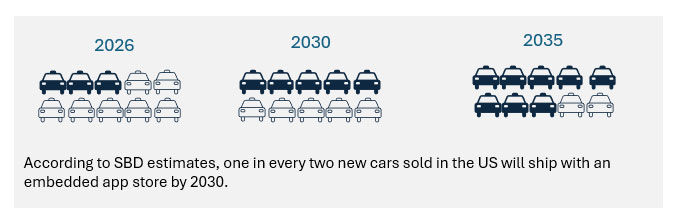
What does it mean for the Indian car landscape?
Indian consumers clearly understand apps. They are highly accustomed to digital payments, streaming, navigation and smartphone-based services. However, this does not mean that they want to sit in their cars and browse an application catalogue.
The real question is:
Which services genuinely become better and add value when they are native to the vehicle?
Navigation is one. Charging is another. Parking, payments, vehicle diagnostics, service booking and energy management could be others.
However, an OEM does not necessarily create additional consumer value simply by putting 50 smartphone applications on a 12- to 15-inch screen.
That is where the industry could make the same mistake it has made with other technology features, measuring success by feature count rather than usage.
Drawing on more than 500,000 connected-car data points across the US, European and Chinese markets, SBD Automotive has established a strategic feature framework that converts market intelligence into clear operational priorities, pinpointing where OEMs should place long-term bets, capture quick wins and capitalise on emerging opportunities.

Where is this heading?
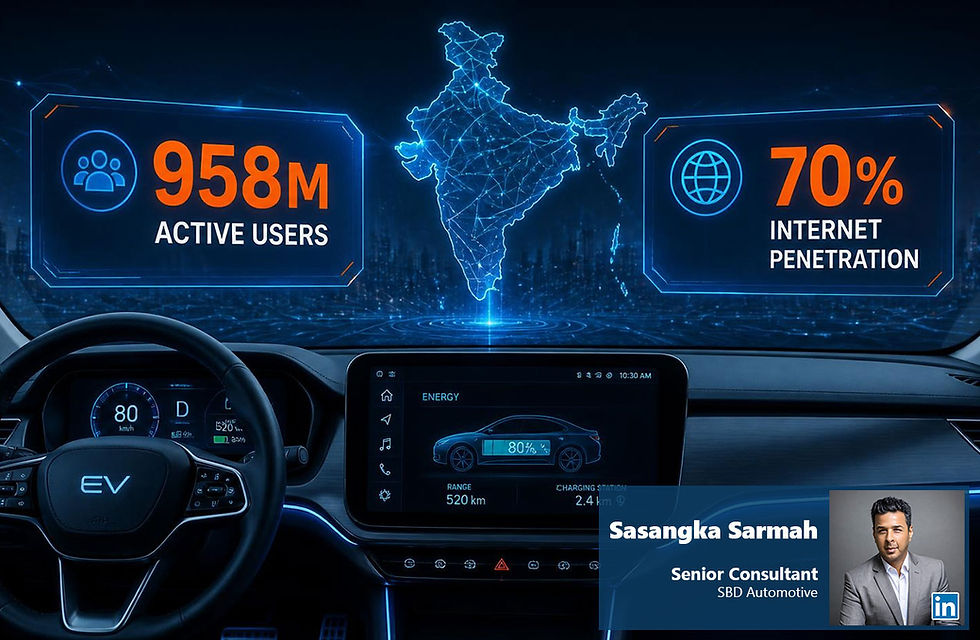
With 958 million active users pushing internet penetration above 70%, India is emerging as a test bed for the vehicle as a digital platform. EVs are serving as the initial proving ground, forcing OEMs to experiment aggressively with software, content and ecosystem control. The next phase will probably not involve an explosion of hundreds of random applications within a native app store.
Instead, the market will probably move towards a more curated list of applications capable of interacting with the vehicle, for example, charging apps that understand battery state and route, parking apps integrated with vehicle location and payments, and service applications that understand vehicle health.
The winners in this race will not necessarily be the OEMs with the largest app stores.
They will be the ones that answer a much harder question:
Which digital services are genuinely better when delivered by the car itself?
Four strategies, One digital battleground
Four OEMs are taking different routes to address the same strategic question: who controls the in-car digital experience?
Mahindra, MG and Tata are building OEM-led app ecosystems, while Renault is leveraging Google built-in to bring a mature third-party ecosystem directly into the vehicle.
The bigger question is whether Indian consumers will value these native ecosystems or continue to see seamless Android Auto and Apple CarPlay integration as sufficient.
The next few years of market data will tell us.
"In-vehicle app stores are a global trend now reaching India. However, the real test is not whether they exist. It is whether owners still open them a year after buying the car. That can happen only when the value is genuinely vehicle-native, rather than when phone apps are simply wearing a different skin." Sasangka Sarmah, SBD Automotive – Senior Consultant |  |
How SBD can help
If you or your team would like to understand how the highlighted technologies, partnerships and market dynamics could impact your strategy, we invite you to get in touch. Email info@sbdautomotive.com to connect with one of our experts and discuss your specific requirements. |


