
From data compliance to competitive advantage: what the EU Data Act means for automotive

The EU Data Act is requiring car makers to provide users with access to a broader range of data generated by connected vehicles and the cost and complexity of building and operating data platforms can be significant. For this reason, we are seeing that some OEMs are taking a minimum-compliance approach, limiting the data they make available to what is strictly required. However, a vehicle data platforms could be used to support dozens of potential use cases rather than just legislation compliance. For example, the same data infrastructure can be used to:
Commercialization of vehicle data
Improve the vehicle and ownership experience
Identify opportunities for new customer services
Reduce warranty and operational costs
Improve vehicle quality and reliability
Increase aftersales revenues
Improve customer retention and loyalty
Support insurance, fleet and other ecosystem partnerships
Create new data-enabled revenue streams
BMW is a good example. Almost a decade ago, BMW pioneered its CarData platform with the ambition of creating a broader ecosystem around vehicle data. While the data economy did not develop exactly as originally anticipated, the investment created an important foundation for the company to respond to future regulatory requirements, including the EU Data Act. Volkswagen and Mercedes-Benz, among others, have invested in structured data environments, partnerships and joint ventures to create controlled mechanisms for sharing vehicle data with external parties.
Given that automakers have to how to comply with the new regulation, how can they use the data that they are required to make accessible to create value across the entire organisation?
Start with high-value use cases
A more pragmatic approach is to begin with a small number of high-value use cases that have a clear business case. Successful selected use cases should be linked to clearly defined KPIs and have an identifiable owner within the organisation. The data platform could be used to measure improvements against those KPIs, while providing the necessary consent management, governance and data-handling capabilities.
One of the most compelling examples is vehicle prognostics.
OEMs and aftermarket players have made significant progress in predictive maintenance, but current solutions remain relatively narrow in scope, typically focusing on a limited number of vehicle components and operating as individual applications rather than as part of an integrated vehicle-health platform.
GM's Proactive Alerts, for example, has demonstrated the potential of connected-vehicle data and trend analysis to predict certain failures before they occur, including issues involving the 12V battery, starter and fuel pump.
BMW's Teleservice Battery Guard and Volkswagen's oil-life and brake-pad prediction capabilities demonstrate how vehicle data can be used to anticipate specific maintenance requirements.
However, most current prognostic programmes monitor only a relatively small number of vehicle components and do not complete the full Prognostics and Health Management chain. The result can be missed failures, false alarms and limited customer engagement.
Today, we would describe most OEM approaches as Predictive Maintenance 1.0. where critical systems such as power electronics, drivetrains and chassis systems can remain outside the scope of predictive monitoring, leaving opportunities to reduce unexpected failures, warranty costs and customer inconvenience unrealised.
The next generation of prognostics will move beyond isolated component monitoring towards an integrated, vehicle-wide health-management platform.
A more mature system could combine:
Data acquisition: broader coverage of high-fidelity vehicle sensors and flexible data-logging policies
Data manipulation: edge processing and cloud analytics to process and combine high-volume vehicle data with external information such as weather and route conditions
State detection: onboard and cloud-based models capable of identifying subtle deviations from expected behaviour
Health assessment: standardised health indicators for critical vehicle systems, including confidence levels
Prognostic assessment: a combination of physics-based models and machine learning to estimate remaining useful life
Advisory generation: automated recommendations that connect vehicle-health insights directly to customer and dealer actions
This could enable OEMs to move from reactive maintenance towards just-in-time servicing, improve customer convenience, reduce warranty exposure and create additional aftersales opportunities. The difference can be summarised simply:
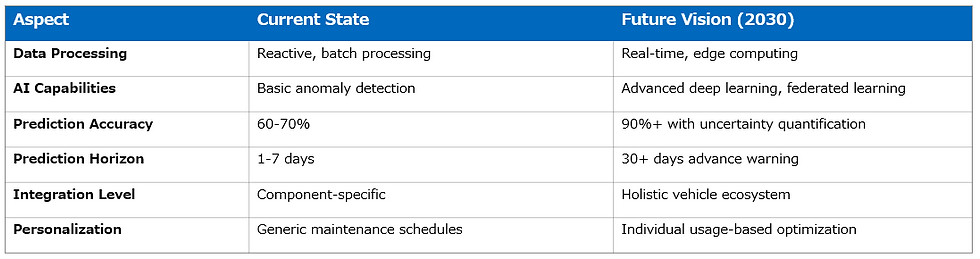
The journey from 1.0 to 2.0 is therefore not simply about deploying better algorithms: it requires OEMs to build the data, technology, organisational and commercial capabilities needed to turn vehicle data into repeatable business value.
Key lessons from the most advanced OEM data platforms
Our analysis of leading OEM data platforms has highlighted seven key trends:
OEM data-sharing models are converging, but at different speeds
Across the industry, vehicle-data sharing is moving away from fragmented and limited access models towards more formalised, OEM-controlled platforms. Mercedes-Benz, BMW and Volkswagen appear structurally more advanced, with established platforms and ecosystems, while other OEMs continue to rely more heavily on individual contracts and data access embedded within specific services. The direction of travel is clear: data sharing is becoming a defined organisational capability rather than a collection of individual partnerships.
The EU Data Act is driving governance clarity before commercial disruption
To date, most OEM responses to the EU Data Act have focused on establishing the foundations required for compliant data access: data categorisation, consent, access rights, governance and mechanisms for mediated data sharing. For many OEMs, the immediate priority is establishing control over what data can be shared, with whom, under what conditions and for what purpose.
Clear B2C and B2B separation is becoming a core design principle
Leading OEMs increasingly distinguish between customer-facing and business-facing data use cases.B2C applications typically focus on customer applications, consent management and value-added services.
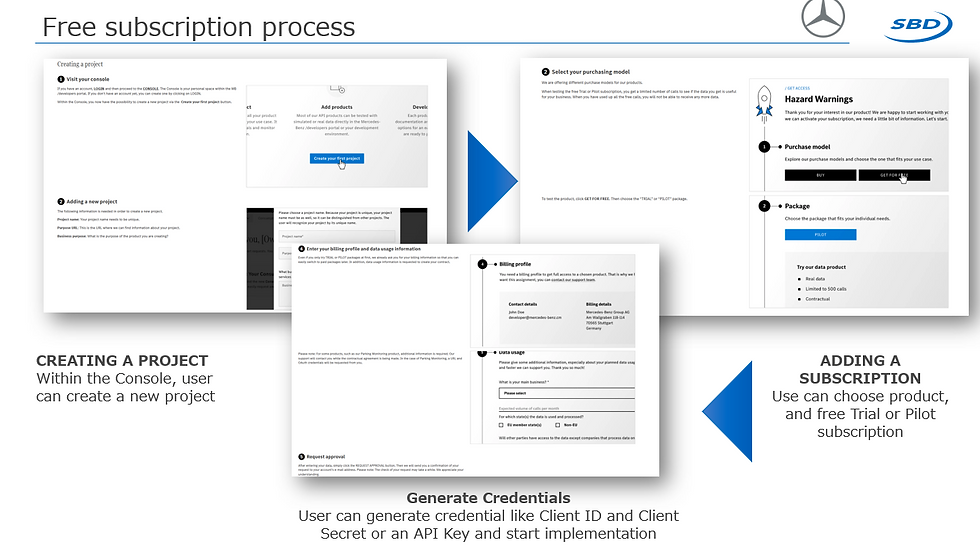
B2B applications more commonly involve mediated APIs, fleet and insurance partnerships and contract-based access.
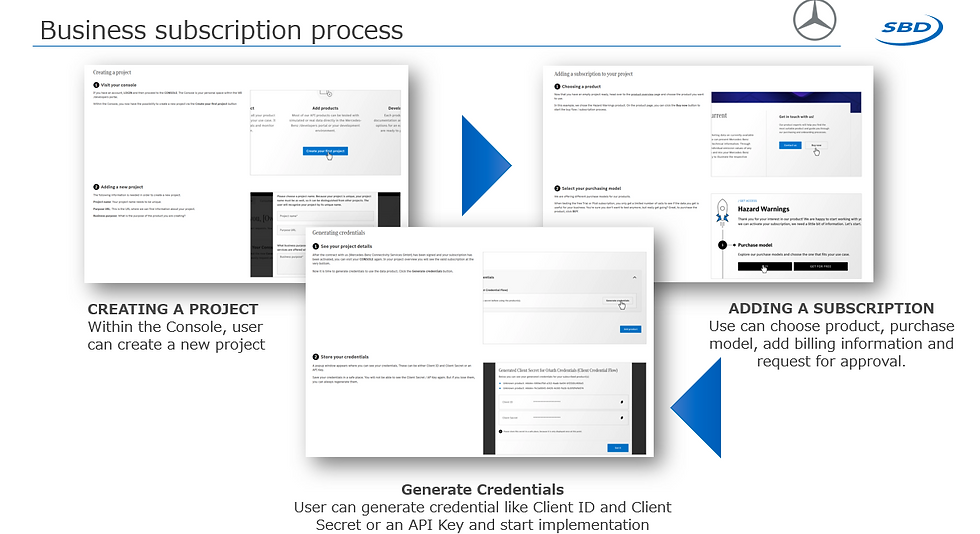
This separation allows OEMs to support different use cases while maintaining control over data access, customer relationships and regulatory risk.
Data monetisation is increasingly value-based and bundled
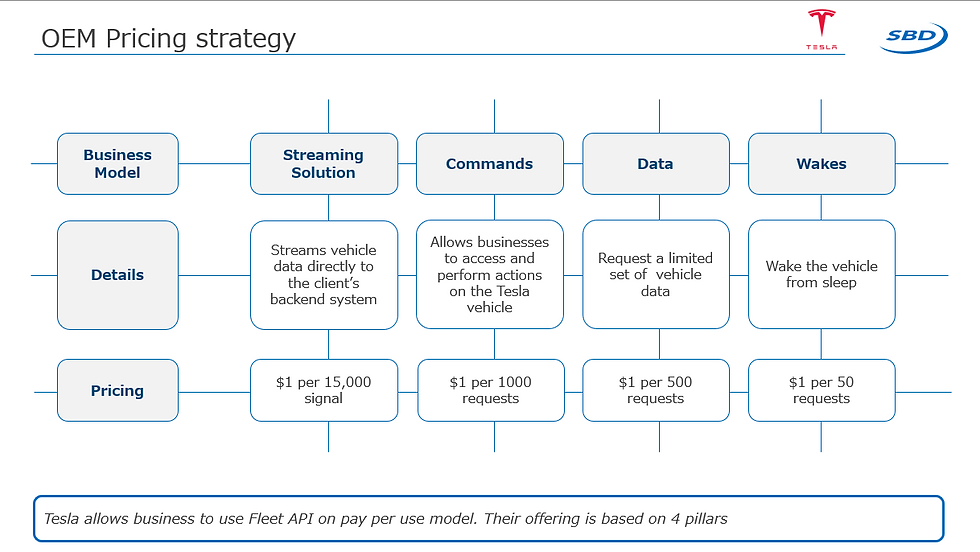
Most OEMs do not currently expose simple per-API or per-event pricing models. Instead, data access is typically incorporated into broader commercial relationships, including fleet, leasing, insurance and service offerings.
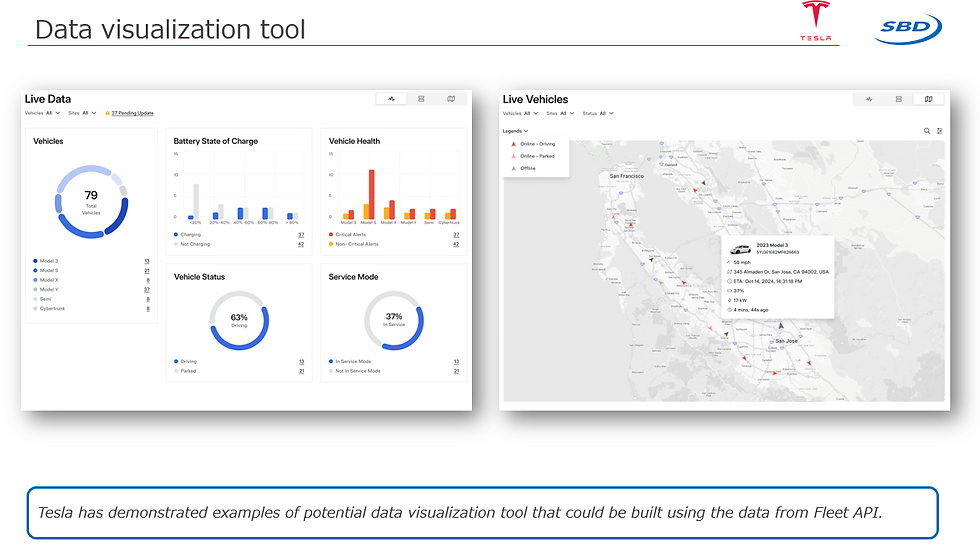
BMW provides structured, API-based access to vehicle data through its CarData ecosystem, while Tesla takes a more controlled approach in which businesses and third parties request access to specific vehicle or energy data. The common theme is that data is increasingly being treated as an enabler of a broader value proposition rather than as a commodity sold purely by volume.
Streaming capabilities remain largely enterprise-led
Several OEMs now support near-real-time vehicle data access. However, these capabilities are generally targeted at strategic partners, large fleet operators and insurance companies rather than being offered through open, self-service developer environments. Real-time data therefore remains an important strategic capability, but one that OEMs continue to control carefully.
AI and machine learning are being used to create value from data, rather than simply expose more of it
Leading OEMs are increasingly using AI and machine learning to transform raw vehicle signals into more useful insights. Examples include collision detection, driver behaviour indicators and vehicle-health information. This highlights an important principle: the greatest value may not come from exposing more raw data, but from transforming that data into actionable information.
Data sharing is becoming a strategic capability
OEM data sharing is increasingly linked to broader strategic objectives around customer experience, safety, vehicle quality and future software-enabled revenues. As a result, leading OEMs are favouring controlled openness and strong internal governance rather than pursuing data monetisation at any cost. The key lesson is that the data platform should not be viewed as an isolated technology investment but like an enterprise capability supporting multiple strategic objectives.
How SBD Automotive can help
The EU Data Act creates a significant new obligation for OEMs, but it also creates the opportunity to build the foundation for new customer experiences, operational improvements, aftersales opportunities and data-enabled business models.
Prognostics is just one example. The same approach can be applied to areas such as warranty reduction, predictive service, customer retention, insurance, fleet management, vehicle quality and new connected services.
The challenge for OEMs is determining which opportunities to pursue, what capabilities are required, and in what sequence they should be developed.
SBD Automotive helps OEMs translate the rapidly changing vehicle-data landscape into practical, prioritised business opportunities.
For one client, for example, we assessed the gap between its current predictive-maintenance capabilities and a future Predictive Maintenance 2.0 model. Our work focused on three areas:
Gap analysis: assessing the current position against the capabilities required for a future-state prognostics architecture
Capability definition: identifying the key technological, data and organisational enablers required at each stage
Roadmap development: defining a realistic sequence for extending capabilities and prioritising the areas with the greatest potential business value
This approach helps OEMs move beyond the question of “How do we comply with the Data Act?” towards the more strategic question of “How can we turn the data we are required to make accessible into a competitive advantage?”
If your organisation is assessing its response to the EU Data Act, reviewing its vehicle-data strategy or looking to identify the highest-value use cases for connected-vehicle data, SBD Automotive can help you assess your current capabilities, identify the opportunities and build a practical roadmap from compliance to value creation.
Get in touch with SBD Automotive to discuss how we can support your data strategy.


