
Digital Key and Anti-theft: why the investment case is security-led, not feature-led
An SBD insight for vehicle manufacturers — 2026
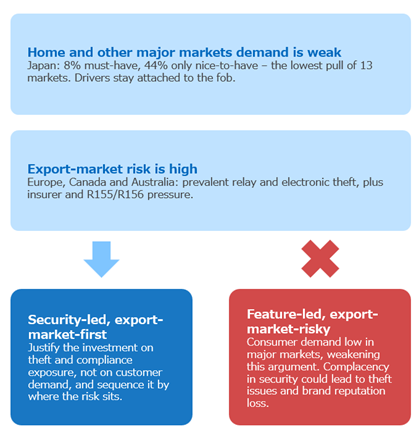
Digital key is usually presented as a customer feature. Our analysis suggests that framing is the wrong one for OEMs, and that treating it as a security and compliance decision leads to better investment choices.
Customer demand will not carry the business case
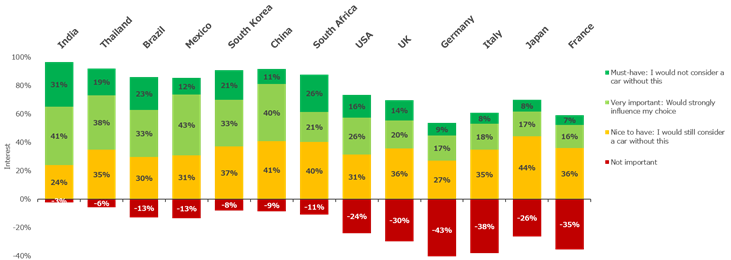
In our survey of current car owners across 13 markets, Japan sits near the bottom for digital key importance: only 8% call it a must-have, while 44% rate it merely nice-to-have — the highest "nice to have" share in the sample. Appetite is concentrated in emerging markets such as India, Thailand, Brazil and Mexico, where smartphone-centric behaviour is more embedded in daily life. In Japan, Europe and the USA, the physical key is still seen as sufficient.
The fob also carries something the phone does not: emotional attachment, brand loyalty and a premium feel. Persuading owners to give that up is a difficult sell, and OEMs' own reluctance to retire conventional LF/UHF systems reflects the same judgement — digital key is currently treated as an addition, not a replacement.
Theft risk and regulation drive the business case
The markets where Japanese OEMs carry significant export volume — Europe, Canada, Australia, alongside Japan itself — are precisely those with the highest exposure to relay and electronic theft. R155 and R156, Insurance ratings and insurer pressure turns digital key security from a customer preference into a compliance and reputational exposure. That case does not depend on the customer wanting the feature.
What the technology comparison shows
Fully CCC-compliant BLE/UWB scores highest on security resilience, regional suitability and future proofing, but carries the highest cost. BLE 6.0 with Channel Sounding is the significant development: it delivers distance bounding comparable to UWB at a mid-cost position, and scores nearly as well overall. Legacy BLE 4.0 and below remains highly vulnerable to relay attack and is unsuitable for high-risk regions at any price.
For the key fob itself, the picture is different. BLE draws 10–20 μA against under 1 μA for LF/UHF, cutting typical battery life from 5–10 years to 2 year or less. Since smartphones are expected to be charged regularly, power consumption and battery-life concerns, which are critical considerations for key fobs, become much less important.
As a result, the current technology comparison suggests the following:
Physical key fobs: LF/UHF remains the preferred solution.
Smartphone-based digital keys: BLE (particularly BLE 6.0 with Channel Sounding) and UWB are the leading options.
Our recommendations
Build the investment case on theft and compliance risks rather than customer demand, and sequence investment by where the risk sits — export markets first.
Tier the architecture rather than standardising globally: CCC-compliant UWB for high-risk markets and upper trims, Channel Sounding as the step-up baseline elsewhere, reserving lower-cost options for genuinely low-risk markets.
Fund it through the connected-services budget as standard fit, keeping paid tiers for key sharing and premium convenience rather than charging for the key itself — the direction most OEMs are converging on.
Do not retire LF/UHF prematurely. We expect 5–10 years before digital key is fully established in major markets, with China the exception. Smartphone-maker adoption of Channel Sounding is the variable that could change this timeline.
A note on this analysis: this is a thought piece drawing on SBD expert judgement and our consumer research (approximately 150 respondents per market, n=2,116 total). The technology predictions are opinion-based rather than quantitatively verified. We would be glad to discuss a full forecast validated against data from your target markets. Sam Nelstrop, SBD Automotive Manager |  |


