
Four lessons from the Mercedes-Benz GLC on the future of automotive software
Updated: Aug 28
Over more than 15 years of in-market benchmarking and prototype evaluation, SBD has observed multiple generations of automotive HMI. During this time, the industry has evolved from deploying relatively discrete digital features to delivering more integrated software ecosystems spanning infotainment, connectivity, electrification, driver assistance and personalisation. More recently, this has extended to larger displays, increasingly capable voice assistants and generative AI.
This evolution has expanded both capability and the number of dependencies that must work together. The customer experience now depends on the quality of integration across:
Displays, accounts and user profiles
In-vehicle apps, media and navigation services
Connectivity, cloud services and real-time data
Voice capture, speech recognition and AI responses
EV route planning, charging services and payment
ADAS availability, system status and transitions of control
Software updates, vehicle states and exceptional conditions
Automotive software can now deliver richer interaction and more sophisticated functionality than ever before. The next competitive challenge is execution: ensuring these increasingly interconnected systems provide a coherent, dependable experience in real-world use.
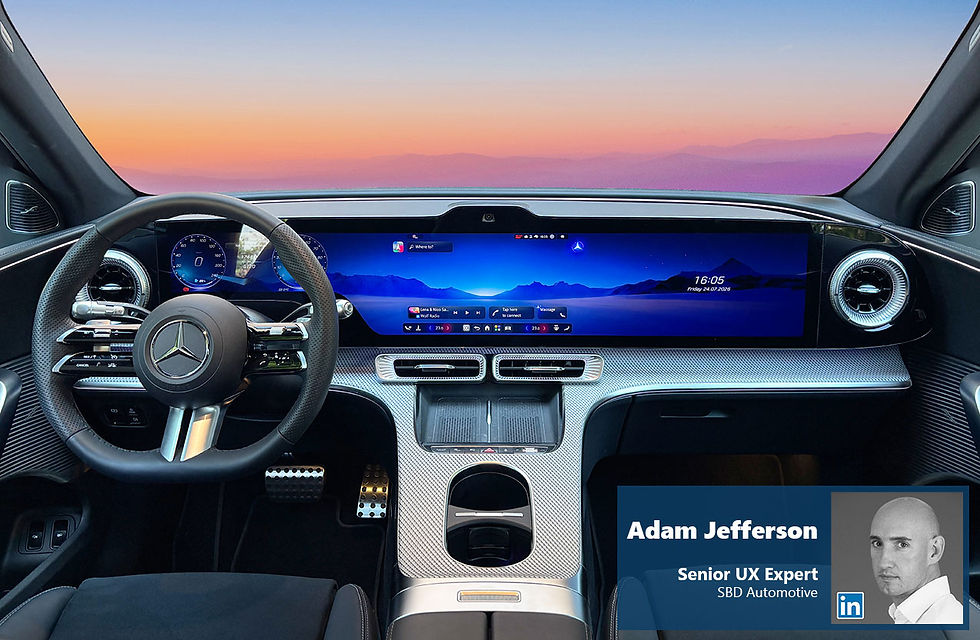
SBD’s recent evaluation of the latest Mercedes-Benz GLC, conducted as part of the 635 HMI Catalogue report series, provides a useful perspective on this challenge. The vehicle delivers a broad and technically ambitious feature set, spanning multi-display interaction, EV navigation, conversational AI and driver-assistance systems. Its strengths and limitations highlight several areas in which successful execution is becoming as important as feature capability itself.
1. Do passenger displays create user value?
The MBUX Hyperscreen creates a strong visual impression and reinforces Mercedes-Benz’s technology credentials. However, the value of a multi-screen system depends less on the number of displays than on the quality of the workflows between them and whether the passenger display can offer value over a brought in mobile device.
In the GLC, the passenger display offers very limited integration with the driver’s primary journey. For example, no navigation app is available for the passenger. The displays can support separate activities but provide less support for collaborative or transferred tasks than might be expected from such an extensive hardware implementation.

This matters because users do not experience displays in isolation, they experience tasks that may begin in one interface and need to continue in another. The value of a multi-display environment therefore depends on whether related functions feel connected, rather than requiring the user to understand which screen, menu or application owns each part of the task. This is further complicated by the requirement for the passenger display to be linked to a separate profile from the central display, adding another layer of account and system management to what should be a shared in-vehicle experience. The media experience illustrates the same issue: accessing core media channels requires a secondary application, introducing an additional step and making a routine activity feel more fragmented than it needs to be.
Takeaway: The next competitive step may be cross-display orchestration: making separate screens behave as one system, and integrating more seamlessly with the user’s ecosystem.
2. Can additional data boost trust in the system?
In addition to conventionally available charging information, the GLC’s charging POI view now shows the elapsed charging time for vehicles currently occupying individual chargers.
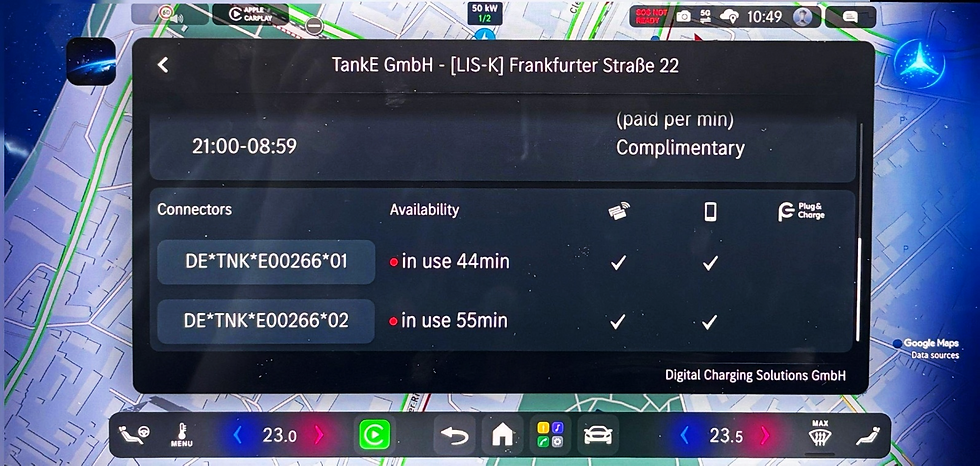
This additional context addresses the familiar EV charging problem of uncertainty at a busy hub. A connector marked as occupied provides only limited value to a driver deciding whether to wait or continue to another site. Showing that a vehicle has been connected for five minutes rather than 45 minutes can help the driver make a more informed judgement about the likelihood of a near-term opening.
However, elapsed charging time remains a proxy for the information drivers ultimately need. A vehicle may have been connected for 37 minutes, but this does not reveal its current state of charge, charging curve, likely departure time or when the connector is expected to become available. The information is therefore useful, but not yet truly predictive.
Mercedes-Benz’s implementation nevertheless represents a meaningful step beyond conventional charging-point information. Rather than simply reporting that a connector is occupied, it gives the driver context that can help them judge whether waiting may be worthwhile or whether an alternative location is likely to be preferable. It sits between today’s largely static availability information and a more advanced charging experience that predicts connector release times and likely queueing at busy hubs.
This is where charging UX is likely to evolve next. Route-planning and charging services have historically focused on charger discovery, power capability and current availability. The greater opportunity is to interpret car and owner data to accurately predict waiting time before arriving at the charger.
Takeaway: Mercedes-Benz demonstrates an emerging move from charger discovery towards richer charging intelligence. Presenting elapsed charging time in addition to expected cost and future availability provides drivers with more useful context, but the longer-term opportunity is predictive availability: estimating or knowing when a connector will be released and, ultimately, forecasting queues at charging hubs.
3. Is conversational AI progressing faster than the voice stack beneath it?
Mercedes-Benz has integrated advanced conversational capabilities, including ChatGPT and Gemini-powered experiences. These functions expand the scope of queries and interactions that the assistant can support, helping to move the in-car assistant beyond a fixed set of predefined commands.
However, the customer experience remains dependent on more conventional components of the voice interaction stack: wake-word detection, microphone performance, cabin-noise handling, speech capture and recognition reliability. Missed wake-word activations and occasions where a command must be repeated, as experienced in the GLC, can undermine the apparent sophistication of the conversational layer.
From the customer’s perspective, a highly capable assistant that cannot be engaged reliably may be considered less useful than a more limited assistant that works consistently. Advanced language models may improve what an assistant can understand and respond to, but they do not remove the need to reliably capture the driver’s intent in the first place.
Takeaway: Generative AI can extend what an in-car assistant is able to do, but dependable voice capture and activation remain the foundation of the experience.
4. Is ADAS progress coming at the expense of core reliability?
Modern ADAS are increasingly capable, and many individual functions are now widely available across vehicle segments. As a result, users are likely to regard the dependable operation of core assistance features, such as consistent lane support, predictable availability, clear system status and well-managed transitions of control, as baseline expectations rather than sources of differentiation.
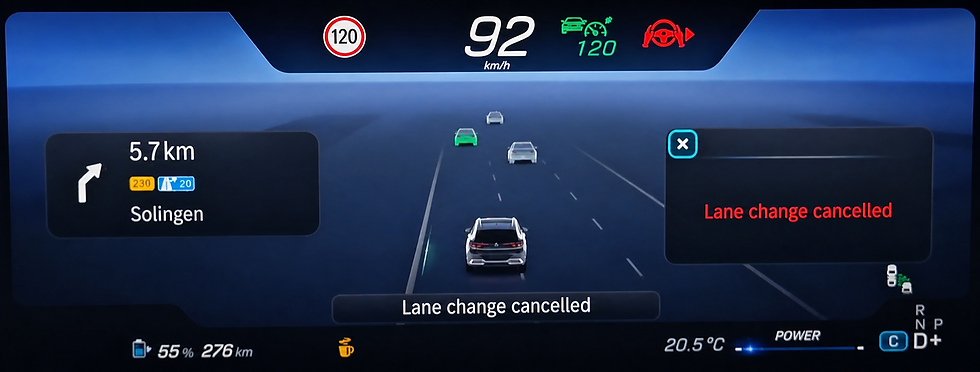
The evaluated GLC met some of these expectations, however, the wider ADAS experience raised questions around several fundamental areas including unexpected Assisted Driving deactivations, inconsistent lane-keeping behaviour and complete system disengagement when supervision requirements were no longer met for an extended period.
The parking-assistance experience also highlighted the same issue, with basic parallel parking performing below expectations and diagonal parking unsupported. These are the everyday interactions through which customers form an opinion of the system’s maturity and dependability.

This matters because customers do not evaluate ADAS solely by its best-case performance. They develop trust through repeated use: whether the system works consistently in comparable situations, whether it communicates what it is doing and whether it makes its limitations sufficiently clear. Where core functions behave unpredictably, even an otherwise advanced feature set can feel less mature.
In detailed ADAS benchmarking, SBD considers Safety of the Intended Functionality (SOTIF) to identify risks associated with the intended operation of a feature, including risks arising from user understanding, system communication and transitions of control. Risks considered relevant to the GLC are shown below:
End-user question | SBD concern |
Do I understand when I should not rely on this feature? | The driver may place inappropriate trust in the feature, including in situations where its capability, confidence or operating conditions are limited. |
Do I understand when and why this feature will stop or disengage? | The feature may reduce, stop or disengage without the driver understanding the trigger, the system’s remaining capability or the action they need to take. |
Does the system clearly communicate what it is doing? | The system’s active function, intended behaviour, current capability or response to the driving environment may not be sufficiently clear to the driver. |
Are the system’s behaviour and limitations easy for a non-expert user to understand and accept? | The driver may struggle to form an accurate mental model of how the feature behaves, where it can be relied upon and how its limitations affect their responsibilities. |
Does the system respond consistently across similar situations? | Behaviour may appear inconsistent or unpredictable to the driver across comparable scenarios, making it harder to anticipate system actions and maintain appropriate trust. |
Takeaway: Baseline ADAS capability is a hygiene factor. In addition to more advanced capabilities, differentiation will depend on how safely, clearly and predictably systems manage degraded, limited and exceptional conditions.
The next stage of competition
The Mercedes-Benz GLC demonstrates the scale and maturity that contemporary vehicle software can now achieve. Its feature set spans multi-display interaction, connected navigation, advanced voice assistance and driver-assistance functions that would have been exceptional even five years ago.
Yet the evaluation also illustrates a change in the nature of competition. The most difficult challenge is increasingly not developing an individual feature, but ensuring that every element, and particularly hygiene features, works together predictably across real journeys, changing vehicle states and exceptional conditions.
This emphasis on execution will also shape how future functionality is experienced. Vehicle capability will continue to expand, but greater software maturity should make that capability feel less visible and less demanding in day-to-day use.
The next phase will be defined by more selective, context-aware interaction: systems that understand the driver, journey and vehicle state well enough to reduce unnecessary prompts, surface information only when it is useful, and automate low-value interactions without removing meaningful user control. AI will play an important role here, not simply by adding new conversational features, but by helping to determine when the vehicle should remain quiet.
"This approach reflects a wider shift towards products that offer advanced capabilities without demanding constant attention. The appeal of simpler technologies, such as corded headphones and cassette tapes, is not necessarily nostalgia or a rejection of progress; it is often a response to digital overload. In the vehicle, rather than a return to analogue controls or reduced functionality, the solution will be a more calm, focused experience in which technology is present and capable, but remains unobtrusive until it can provide clear value. As feature parity becomes more widespread, differentiation may increasingly come from delivering this sense of quiet capability: a vehicle that feels coherent, trustworthy and less overtly technological, precisely because its technology is better integrated.” Adam Jefferson - Senior UX Expert at SBD Automotive |  |
How SBD can help
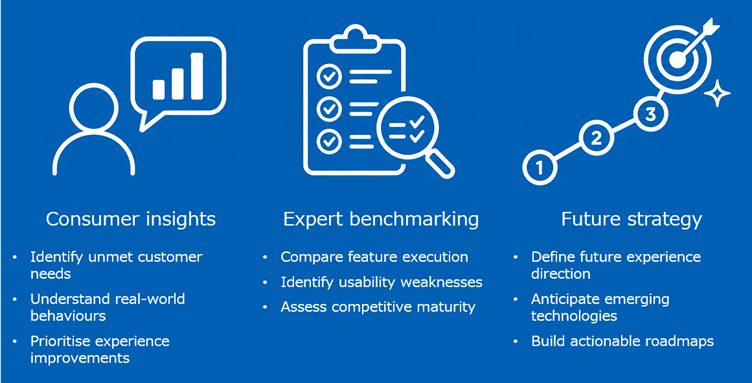 SBD helps OEMs and technology suppliers translate software ambition into dependable customer experiences. Drawing on consumer insight, expert benchmarking and future-focused strategy, we identify where digital features create meaningful value, where execution risks undermine trust, and where investment should be prioritised. From assessing multi-display workflows, EV charging intelligence, conversational AI and ADAS handover behaviour through to defining longer-term product direction, SBD supports teams in creating vehicle experiences that are more integrated, context-aware and robust in real-world use. |


