
Different Roads, Same Goal: Winning Through Software

We have reached a point where Over-the-Air (OTA) updates are one of the clearest indicators of the maturity of Software-Defined Vehicles (SDVs). The ability to remotely fix bugs, improve performance, introduce new features, and reduce dealership visits fundamentally changed how OEMs maintain and enhance vehicles after purchase. However, as OTA capability becomes increasingly common across the industry, the focus of competition is shifting.
The more pressing question today is not about whether automakers can deliver over-the-air (OTA) updates, but rather how they utilize this capability. Consumers are increasingly assessing vehicles based on the speed at which new features are introduced, how effectively the software enhances their ownership experience, and how continuously vehicles evolve throughout their lifespan. In this context, OTA is emerging as a fundamental component of vehicle infrastructure rather than simply a unique selling point.
A comparison between Tesla and Ford highlights this transition. Both OEMs support OTA updates across major vehicle categories, yet their approaches reveal two different paths toward leading OTA updates. While Tesla uses OTA to drive continuous feature innovation and rapid software evolution, Ford emphasizes software accessibility, reliability, and lifecycle support. Together, these approaches illustrate how the next competitive battleground is moving beyond OTA delivery toward software execution and continuous vehicle evolution.
Historically, OTA updates were revolutionary because they allowed vehicles to be improved after purchase. Traditional automotive development followed a largely static model in which vehicle functionality was determined before production and changed little throughout ownership. OTA disrupted this paradigm by introducing a more dynamic software lifecycle. However, OTA capability is becoming increasingly common among major automakers today. As implementation barriers continue to fall and software platforms mature, OTA support is gradually transitioning from a differentiator into a baseline expectation. Much like smartphone app ecosystems eventually became a standard feature rather than a unique selling point, OTA is entering a similar phase of industry maturity.
Two distinct approaches between Tesla and Ford
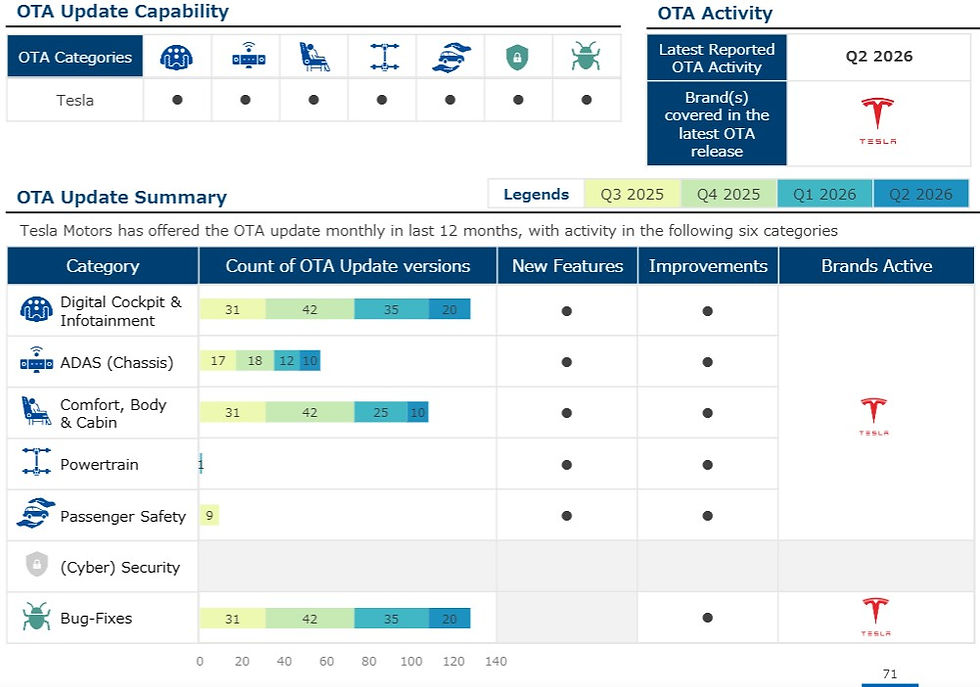
Tesla provides perhaps the clearest example of how OTA can evolve from a bug-fix tool into a strategic product-development mechanism. Across Europe and the United States, Tesla maintained monthly OTA activity throughout the last rolling year (Q3 25 to Q2 26), while China continued to receive quarterly releases. Updates consistently touched every major vehicle domain, including digital cockpit and infotainment, ADAS, comfort systems, powertrain, and passenger safety.
For instance, the June 2026 release updates enhanced Full Self-Driving capabilities, introduced new AI-powered and Grok-related features, improved navigation and media functionality, expanded user interface capabilities, and addressed broader software reliability and security improvements.
This method offers several benefits, such as pace and agility, to vehicle owners. Frequent OTA deployments enable Tesla to quickly introduce features, address customer feedback, and enhance vehicle functionality throughout the ownership period. Customers increasingly perceive their vehicles as evolving products that can acquire new capabilities over time.
Software deployment alone does not ensure effective leadership. More frequent OTA releases can improve software validation, but they also raise customer expectations for ongoing innovation. As over-the-air (OTA) updates become more common, the benefit of frequent updates may decrease unless these updates continue to deliver meaningful improvements to the user experience.
Whereas for Ford, instead of focusing on monthly software releases, Ford has adopted a quarterly or tri-annual update schedule in the United States and Europe, respectively. Despite the less frequent updates, Ford ensures that OTA capabilities remain supported across all vehicle domains.
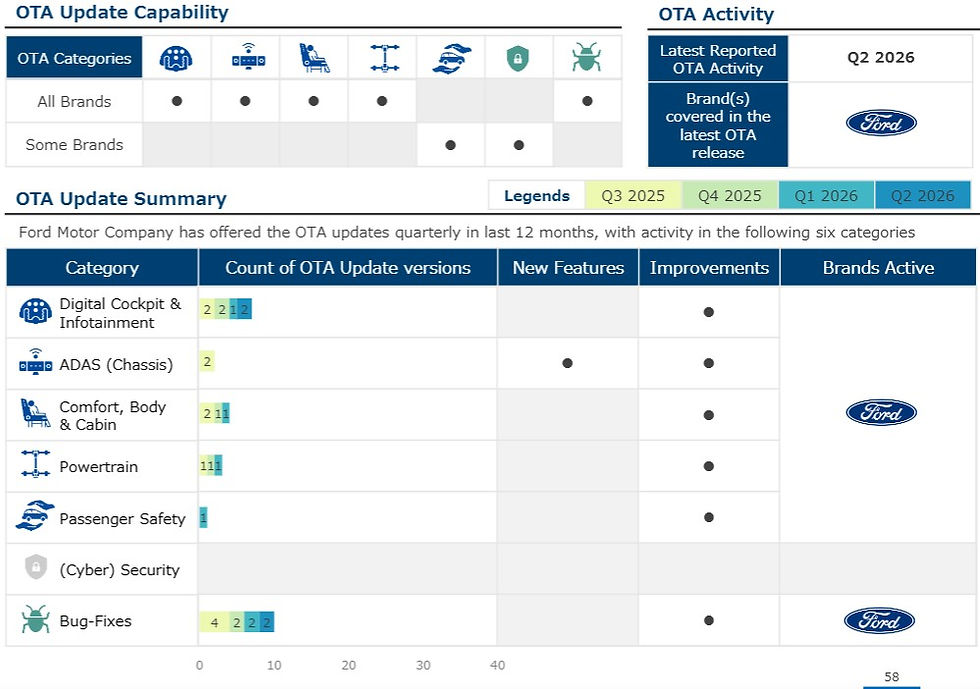
In Europe, recent Mustang Mach-E updates improved Plug & Charge functionality and resolved software-related service notifications. In the United States, OTA deployments restored instrument cluster functionality, enhanced ADAS-related user experiences, improved battery display readability, and delivered safety-related fixes through OTA recall campaigns.
While Tesla focuses on continuously introducing new capabilities, Ford prioritizes reliable software operations and customer adoption. The contrast highlights an important industry shift: competitive advantage increasingly depends not on the ability to deliver updates, but on how effectively software improves the ownership experience. Software value is created through innovation, reliability, usability, and lifecycle support—not update frequency alone.
From a customer perspective, a seamless installation experience can be just as crucial as the frequency of updates. After all, software improvements are only valuable if customers can comfortably and consistently adopt them. Ford's approach underscores an increasingly important reality in the industry: Leading in OTA updates is not defined solely by their frequency; they are also determined by how effectively those updates reach customers.
China serves as a prime example of user-centric over-the-air (OTA) updates. While many vehicles support OTA capabilities, it's increasingly important to distinguish between the ability to perform OTA updates and the actual activity of doing so. For instance, Tesla in China consistently demonstrates visible OTA activity and regularly provides software enhancements across various vehicle domains. This illustrates how software can enhance both the customer experience and vehicle functionality after purchase. In contrast, while Ford emphasizes that OTA support exists across multiple categories, its actual OTA activity has been considerably less visible, with fewer publicly reported deployments. However, this does not necessarily indicate a lack of software capability, but rather how frequently and meaningfully it is used.
This distinction could ultimately define the next phase of competition in automotive software. In the early days of software-defined vehicles (SDVs), the critical question was whether cars could be updated remotely. Today, consumers generally expect over-the-air (OTA) capability to be standard. Consequently, the focus of differentiation is shifting toward how often and effectively vehicles can be improved through software updates.
The evolution of the vehicle lifecycle further supports this shift. Historically, OTA maturity has been evaluated through measures such as deployment frequency, domain coverage, installation times, and update availability. While those indicators remain important, they may no longer capture the full value of software-driven vehicles. Future competitive benchmarking will likely emphasize rapid deployment of new features, ongoing AI-driven enhancements, personalized vehicle experiences, integration of cloud services, and long-term value generation beyond the vehicle sale.
Tesla and Ford demonstrate two distinct paths toward leading OTA deployment in the SDV era. Tesla's strength lies in software velocity, continuous innovation, and feature expansion, while Ford's strength lies in software reliability, accessibility, and lifecycle support. Both approaches illustrate that future competitiveness will be determined less by OTA capability itself and more by how effectively software can evolve the vehicle after it leaves the factory.
"Evidence suggests that over-the-air (OTA) updates are no longer a key differentiator on their own. As OTA capability becomes standard across the industry, it is transforming into a foundational infrastructure for software-defined vehicles. The next phase of competition will focus on software speed, AI-driven enhancements, innovative features, and the ability to continuously evolve vehicles after purchase. In this context, OTA is not becoming obsolete; rather, it is becoming essential. The true differentiator is no longer just the ability to deliver updates, but the capacity to continuously create customer value through software." Leena Khandelwal, SBD Automotive Senior Product Owner |  |
The SBD Automotive 638 – FOTA & Software Delivered Features Guide is now live to download on our hub. If you require access please just email info@sbdautomotive.com to start the conversation.


