
Beyond Assisted Driving: Why Parking Is Emerging as the Software Defined Vehicle's Everyday Experience
As the automotive industry accelerates towards Software Defined Vehicles (SDVs), much of the conversation continues to revolve around centralized compute, vehicle operating systems, AI models and higher levels of automated driving. Yet one of the clearest demonstrations of SDV maturity may emerge somewhere far less glamorous: the parking lot.
Much like the recent evolution of L2++ assisted driving, the momentum in parking is shifting towards features that solve everyday customer frustrations rather than chasing higher levels of automation. Parking may not generate the same headlines as highway autonomy, but it offers something arguably more valuable: a customer-visible demonstration of how software can deliver tangible value.
If recent developments in China are any indication, parking is no longer just another fragmented Advanced Driver Assistance System (ADAS) feature. It is rapidly becoming one of the industry's most compelling proving grounds for the Software Defined Vehicle and integrated driving experience.
Legacy parking has reached a tipping point
Today's parking technologies from Park Assist and Remote Parking to early Automated Valet Parking (AVP) have come a long way. They make difficult manoeuvres easier and have become an important part of the ADAS offering across many vehicles. But despite years of development, they haven't fundamentally changed how most people park.
Despite continuous technical improvements, today's parking systems remain largely assistance features rather than fully delegated operations. They often require driver supervision, can struggle with complex parking environments, and early AVP deployments have largely been confined to infrastructure-enabled pilots.
The technology has improved, but the customer experience hasn't improved at the same pace.
That raises an important question: is the future of parking about making today's systems better or rethinking parking altogether? Leading Chinese OEMs appear to be pursuing the latter.
China's new direction: parking as an SDV capability
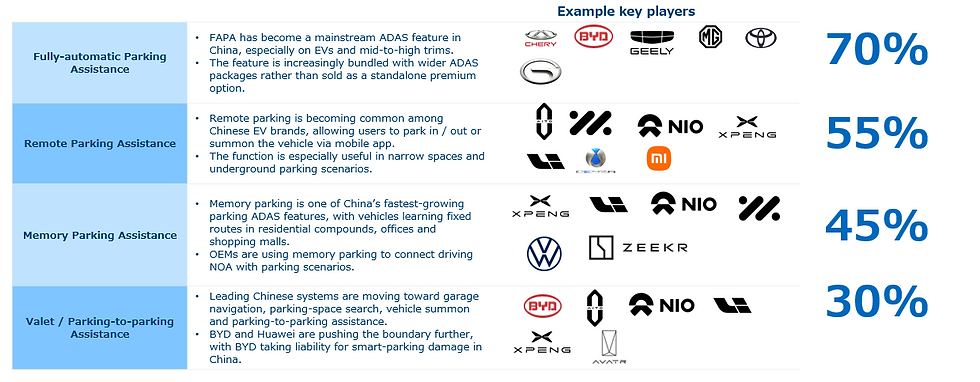
Rather than refining conventional park assist, Chinese OEMs are rethinking parking as an intelligent software capability that continuously improves through AI, data and over-the-air (OTA) updates. What is emerging is not a single breakthrough feature, but an evolution of parking capabilities that progressively removes friction from everyday driving.
From assistance to delegation
Perhaps the most significant shift is that parking is no longer about assisting the driver. It is about removing them from the task altogether.
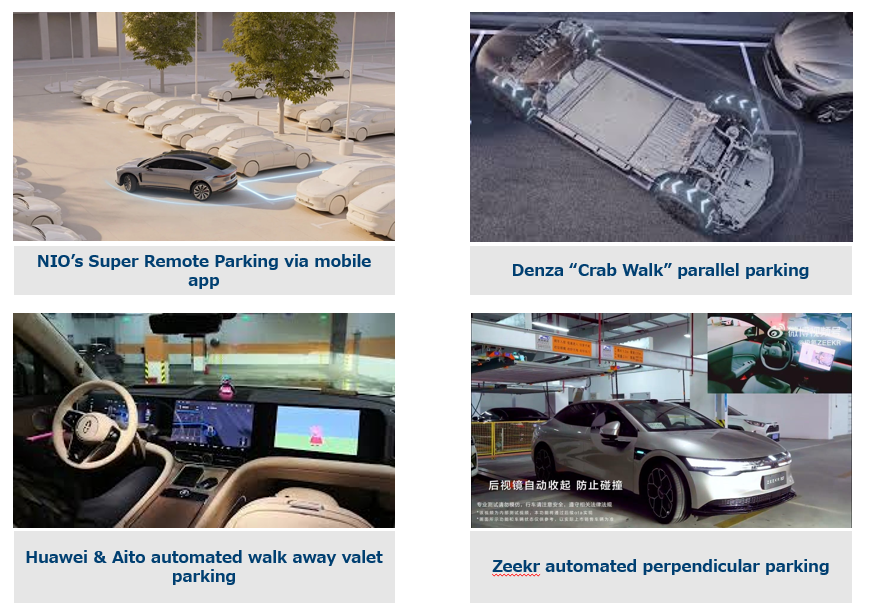
Huawei ADS and AITO already demonstrate Automated Valet Parking experiences where drivers can stop at a designated drop-off point, exit the vehicle and allow it to autonomously locate a parking space before later responding to a summon request. This marks a fundamental transition: the driver's role is no longer to supervise an automated manoeuvre, but to delegate the entire parking task to the vehicle.
From parking to intelligent mobility
Remote Parking and Memory Parking extend automation beyond the vehicle itself.
NIO's Super Remote Parking enables drivers to remotely park or retrieve their vehicle using a smartphone, while Memory Parking allows vehicles to learn frequently travelled routes such as home garages or office car parks and replay them autonomously. These capabilities bridge today's intelligent driving systems with tomorrow's fully autonomous parking experience.
New vehicle architectures, new manoeuvres
Software is only part of the story. Vehicle architectures are also expanding what parking systems can physically achieve.
Zeekr's automated perpendicular parking demonstrates increasingly precise low-speed control, while Denza's Crab Walk showcases how four-wheel steering and e-Corner technologies enable manoeuvres that would be impossible using conventional steering systems. Although visually impressive, these capabilities also solve genuine customer challenges in increasingly constrained urban environments.
Collectively, these developments indicate that parking is transitioning from a fragmented ADAS functionality into a software-defined experience.
Why parking matters for SDVs
From an OEM perspective, few vehicle functions exercise as many elements of the SDV stack as advanced parking.
Delivering AI-enabled parking requires centralized compute, robust perception, AI planning, cloud connectivity, fleet learning and reliable OTA deployment. Unlike highway automation, these capabilities can be deployed within a bounded, low-speed environment, making parking an ideal proving ground for SDV architectures.
Parking also aligns naturally with software business models, from premium feature packages and post-sale feature activation to connected parking, charging and payment ecosystems.
Most importantly, customers experience the value almost every day.
Drivers rarely ask for a higher SAE level. They ask for less stress. Automated Parking delivers exactly that.
An emerging competitive gap
The evolution of parking features also highlights a broader regional divergence.
Chinese OEMs increasingly use parking to showcase AI capability, rapid OTA iteration and SDV maturity. Parking demonstrations have become central to vehicle launches and are helping redefine customer expectations of what an intelligent vehicle should be capable of delivering.
In Europe and North America, parking largely remains positioned as a premium convenience feature, while strategic attention continues to focus on highway automation.
The question is no longer who offers the best parking technology, but who sets the benchmark for software-defined user experiences.
Looking ahead
The automotive industry has traditionally viewed parking as the final step of a journey.
Increasingly, it may become one of the first meaningful demonstrations that an SDV architecture is delivering tangible customer value. Customers rarely notice centralized compute, zonal architectures or AI models. They notice experiences that remove friction from everyday driving.
That leaves several interesting questions for the industry:
Will parking become a truly customer-visible demonstration of the Software Defined Vehicle?
Will AI-powered parking become a stronger competitive differentiator than incremental advances in highway automation?
As customer expectations continue to evolve, should OEMs rethink where they prioritise software investment across the automated driving roadmap?
"The answers will likely differ across regions, market maturity and OEM strategies. However, one thing seems increasingly clear, the future of automated driving may not be shaped solely by what happens at highway speeds. Some of its most meaningful competitive advantages could emerge at walking pace. Whether parking becomes the next major SDV differentiator remains to be seen. What is clear is that OEMs will increasingly need to decide where it sits within their broader ADAS, SDV and software monetisation roadmaps. At SBD, we're actively tracking this evolution and would welcome the opportunity to discuss how these trends are shaping future vehicle programmes." Varun Krishna Murthy - Consulting Manager at SBD Automotive |  |
How SBD can help
SBD Automotive can help benchmark your position against the wider industry and identify where action is needed most. To explore how these trends impact your strategy, architecture and supplier roadmap, get in touch with SBD Automotive for a deeper discussion. Email info@sbdautomotive.com |


