
The EV slowdown that reshaped the battery supply chain
The EV battery market is diversifying, but the battery supply chain is not necessarily decentralising. Today, the answer to higher EV adoption does not seem to lie with a single miracle battery chemistry. The direction that more stakeholders are taking instead is diversification. While developments such as solid-state cells are still a key target for most automakers and battery manufacturers, the ecosystem is evolving toward a wider segmentation. This trend opened opportunities for industry stakeholders to reduce dependence on very consolidated resources necessary for specific chemistries such as Cobalt and Lithium.
The newly released 2026 EV Battery Technology & Ecosystem report looks into different market dynamics identifying what the drivers of these changes are. To create a complete and cohesive understanding of this segment, the report also covers key battery chemistries, technologies, as well as key players among automakers, battery manufacturers, recyclers, and more.
In previous editions we highlighted how regulations and investments over the past few years encouraged the localisation of both battery manufacturing and recycling with the aim of creating a closed-loop supply ecosystem. The story changes in 2026 though, with regional battery ecosystem development shaped by wider EV market dynamics. The last two years have, in fact, been extremely complex for the EV market in Europe and the USA. After strong growth recorded in both 2022 and 2023 even when compared to China (which was starting from a much higher volume anyway), different factors began to affect it negatively.
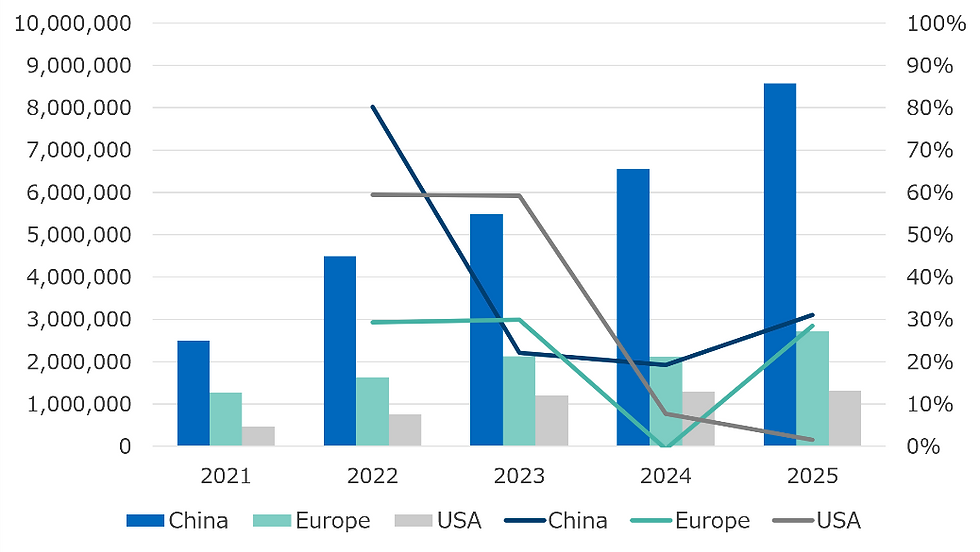
In 2024, the regulatory environment changed significantly under the new administration in the US taking the industry momentum in a different direction. Sales, however, slowed drastically in Europe as well. Customers in both regions started opting for alternatives, due to frictions with the charging experience, range and higher than average pricing in a period in which most are becoming increasingly price-sensitive. Last year, as visible in the graph, the European region experienced a strong recovery, while the US stagnated. In this growth, Chinese BEVs accounted for almost 17% of the total increase in volume, growing by over 50% from around 200,000 in 2024 to over 300,000 the year after.
Even through this recovery, in the European market several legacy OEMs facing severe financial losses had to delay, or even cancel plans and targets for their electrification strategies. Without segment distinctions, automakers from Porsche to Stellantis, Ford, Honda, and more, revised their short to mid-term strategies reintroducing ‘multi-powertrain’ plans that focused more on internal combustion engines and hybrid solutions. The effect of these market dynamics is being reflected in the EV battery manufacturing and recycling ecosystem.
While some consolidation is happening as the industry matures, several projects and companies, mostly in Europe and the USA where the market is already significantly smaller, were either halted, delayed, went bankrupt, were acquired by larger players, or went through strategic exits.
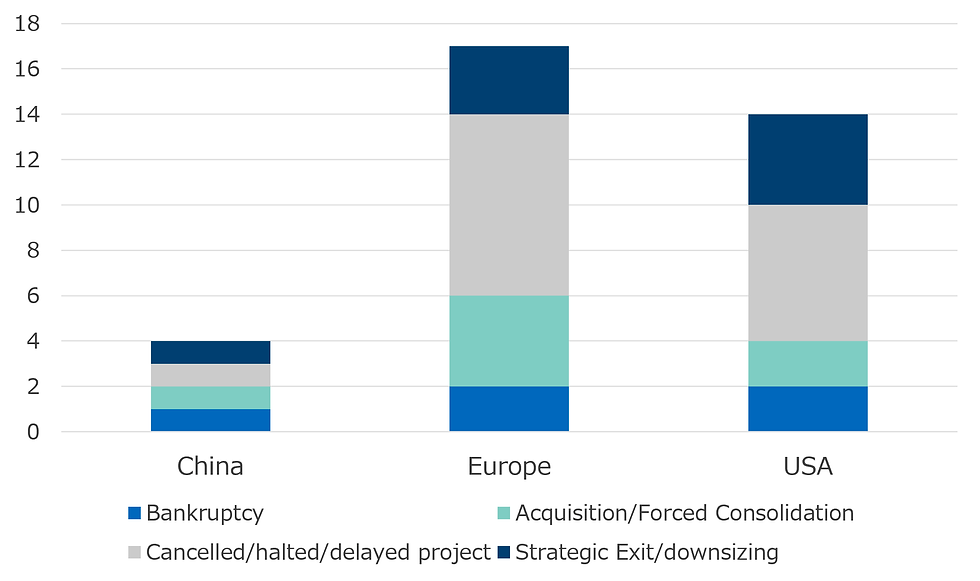
This trend reinforces the Chinese dominance on both EV battery manufacturing and recycling industries. But it also halts or at least slows down the collective attempt by stakeholders in both the other regions to gradually localize the industries creating a sustainable closed-loop supply chain.
While noteworthy innovation and research are going on in all regions, the current scale and domestic capacity are massively skewed toward China. A few major manufacturers, such as CATL, CALB, Svolt, REPT, and EVE Energy, contributed to China reaching 57% of the global battery manufacturing capacity. In a similar way, a few recyclers, including Brunp (CATL subsidiary), GEM, Huayou Cobalt, and more, reached a 67% coverage of the EV battery recycling capacity globally.
In both cases, China’s main players are way beyond the scale of European ones and only a few in America come close, especially on the recycling side with the likes of Redwood Materials. On the battery manufacturing capacity side, the other sizeable share of the market (27%) is currently held by ‘Rest of the World’ companies, here mostly represented by Koreans LG Energy Solution and Sk On.
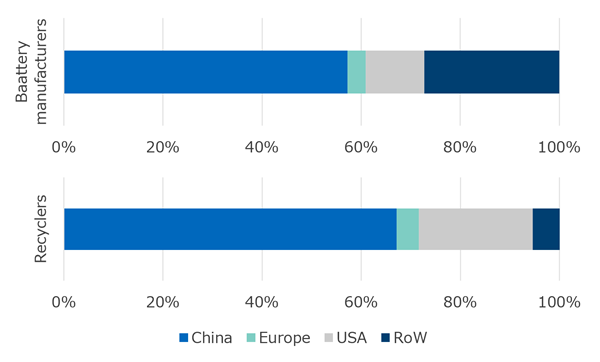
The current trend, if continuing through 2026, would reinforce China’s position in the EV battery market creating a gap that would be extremely difficult for any western stakeholder to fill, especially if not supported by an appropriate regulatory environment.
Highlighting China’s commitment to this supply chain development is the recent Strategic New Materials Innovation and Application Platform. Made of 30 companies among major automotive OEMs and suppliers, the initiative aims at upgrading of the industry through materials innovation by focusing on next-generation battery development, among other technologies, and create a better and more localized supply chain.
The continued support of local and national governments (at both country or state level, as well as federal and union level), in Europe and the USA, with regulations like the battery passport, set to become mandatory in 2027, is crucial. In Europe, the regulation would force specific targets for carbon footprint, supply chain traceability, recycled content requirements, and collection and recycling volumes.
While not necessarily benefitting only the local industry, the regulation would indirectly support demand for recycling and local manufacturing through easier compliance. The USA’s IRA, weakened or challenged by the current administration, tried to achieve similar goals with more incentives and a more direct support to local manufacturers and recyclers.
So, along with these regulations, the best window of opportunity for western manufacturers to balance the supply of the EV battery market lies probably in upcoming battery technologies for different reasons. Research has continued among them and several projects show promise for new batteries, from semi-solid-state, to all-solid-state, to lithium-sulphur and more.
Also, some new battery cells adopt much cheaper and more abundant materials that would drastically reduce the dependence on centralised and scarce resources. Furthermore, for most of these new technologies there is not yet a true scale advantage, although established manufacturers will certainly benefit from their current position.
Ultimately, for Western manufacturers, the opportunity could be beyond simply trying to catch up or to reproduce China’s current battery supply chain at smaller scale, but to compete where the basis of advantage is still being defined. Intellectual property, manufacturing processes, safety validation, and application-specific battery design.
“With such a volatile market, every year, can represent an important turning point for an entire industry, or for a country. The 2026 EV Battery Technology & Ecosystem report provides a structured view of these shifts, covering battery chemistries, manufacturing capacity, recycling, regulation, investments, and the key companies shaping this and the next phase of the EV battery market." Riccardo Del Bello, SBD Automotive Research Analyst |  |
How SBD can help
SBD Automotive can help benchmark your position against the wider industry and identify where action is needed most. To explore how these trends impact your strategy, architecture and supplier roadmap, get in touch with SBD Automotive for a deeper discussion. Email info@sbdautomotive.com |


