
Can legislation help a late adopter become an EV leader?

Nepal's EV journey shows how policy can accelerate adoption and why it offers valuable lessons for OEMs and suppliers.
Identifying the next high-growth EV market is becoming increasingly important. While sales data often shows where markets are today, legislation can provide an early indication of where they are heading.
Nepal offers an interesting example. When discussing electric vehicle (EV) adoption, markets such as Norway, China, and parts of Europe often dominate the conversation. Yet, over the past few years, Nepal has emerged as one of the world's fastest-growing EV markets, supported by a combination of favourable market conditions and government policy.
So, can legislation help a late adopter become an EV leader?
Laying the foundation for EV adoption
Government policies, legislation and long-term mobility strategies often provide some of the earliest indications of where EV markets are heading. Nepal demonstrates how a consistent policy framework, introduced well before widespread adoption, helped establish the conditions for market growth.
Between 2019 and 2020, the Government of Nepal introduced several climate and mobility initiatives that established a clear long-term direction for cleaner transport.
Legislation | Contribution to EV Adoption |
15th Periodic Plan (2019–2024) | Positioned electric mobility as part of Nepal's long-term development strategy by promoting EV adoption, renewable energy and sustainable transport. It also outlined government priorities and investment objectives supporting the transition to cleaner mobility. |
National Climate Change Policy (2019) | Reinforced Nepal's commitment to low-carbon transport by promoting electric mobility, emissions reduction and renewable energy. The policy also encouraged greater coordination and investment to support long-term climate objectives. |
Environment Protection Act 2019 | Established the legal framework for environmental protection through pollution control, environmental impact assessments and emissions management. It strengthened regulatory oversight while supporting more sustainable transport and infrastructure development. |
Environmental Protection Regulations 2020 | Introduced the implementation framework for the Environment Protection Act by defining compliance requirements, enforcement mechanisms and environmental obligations. Together, they strengthened Nepal's regulatory foundation for environmentally sustainable development. |
Collectively, these initiatives did more than establish environmental objectives. They signalled long-term government commitment to electrification, helping build confidence among consumers, businesses, and investors.
Supporting this transition also required a fiscal commitment. By offering tax incentives and lower customs duties, Nepal made EVs more affordable than comparable ICE models. While these measures accelerated adoption, they also reduced revenue from vehicle imports and, over time, fuel tax income as more consumers switched away from petrol and diesel vehicles.
Rather than viewing this as a short-term fiscal loss, the government treated these incentives as an investment in accelerating electrification and achieving its long-term transport, energy security, and climate objectives. As the market matured, however, sustaining this level of fiscal support became increasingly challenging.
Policy decisions can influence market attractiveness, investment priorities, and the pace of EV adoption, making legislative developments a valuable early indicator of future market opportunities.
Why Nepal succeeded where other late adopters have struggled?
Many countries have introduced EV incentives, yet relatively few have achieved Nepal's level of adoption.
Nepal's experience suggests that government policy provided the foundation, but it was the combination of supportive policies and favourable market conditions that accelerated adoption. Competitive EV pricing, rising fuel costs, abundant hydropower resources, expanding charging infrastructure, and the growing availability of affordable EV models together strengthened the value proposition for EV ownership.
Nepal also differs from many established automotive markets in another important way. Passenger vehicle ownership remains relatively low compared with many neighbouring countries, largely due to the high cost of vehicle ownership. While EV adoption in Europe and North America initially concentrated in premium vehicle segments, Nepal's lower customs duties and favourable tax policies made many EVs competitively priced against comparable ICE models. This improved the affordability of EVs within the country's new-car market and strengthened their appeal among consumers considering a vehicle purchase. Whether these policies primarily encouraged existing car buyers to choose EVs or also enabled more households to enter the passenger vehicle market remains an important question, but they clearly improved the competitiveness of EVs within Nepal's automotive market.
Creating the conditions for growth
As awareness and confidence increased, market momentum began to build.
Consumers became more familiar with EV ownership, charging networks expanded across the country, and EVs increasingly moved into the mainstream. Nepal now has more than 1,200 charging points supported by local and international operators, helping address one of the most common barriers to adoption.
At the same time, competitively priced models from Chinese and Indian manufacturers significantly expanded consumer choice. Combined with supportive government policies, these vehicles made EV ownership accessible to a much broader segment of the market.
Recent customs data shows continued growth in EV imports, particularly within the affordable passenger vehicle segments that have driven much of the market's expansion.
What happens after adoption?
Perhaps the most interesting part of Nepal's story is what happens next.
The first phase of legislation focused on encouraging EV adoption through awareness, incentives and market support. The challenge now is managing a market that has already embraced electrification.
This shift is reflected in Nepal's new EV taxation framework, introduced as part of the Government of Nepal's 2026/27 budget.
The reforms replace the previous motor power (kilowatt)-based taxation system with one based on vehicle import value. They also introduce the Clean Infrastructure Investment Levy, significantly increasing the tax burden on higher-value EVs while maintaining lower rates for more affordable models.
The government argues that the reforms are intended to recover declining revenue as EV adoption reduces fuel-related tax income. However, industry stakeholders have raised concerns that the changes could increase costs and create greater uncertainty for importers and consumers.
Below is the tax breakdown between an EV and an ICE (Diesel) vehicle (approx.):
EV Tax structure:
Import Value (USD) | Customs Duty | Clean Infrastructure Levy | VAT | Road Tax | Total Tax (Approx.) |
Under $13,130 | 20% | 2.5% | 13% | 2.5% | ~40% |
$13,130-$19,700 | 20% | 20% | 13% | 5% | ~58% |
$19,700–$26,260 | 20% | 35% | 13% | 5% | ~73% |
$26,260–$32,830 | 20% | 90% | 13% | 5% | ~128% |
Above $32,830 | 20% | 130% | 13% | 5% | ~168% |
ICE (Diesel vehicles) Tax structure:
Engine Capacity | Customs Duty | Excise Duty | VAT | Total Tax (Approx.) |
Up to 1500cc | 50% | 25% | 13% | 90–105% |
1501–2500cc | 70% | 40% | 13% | 120%-140% |
Above 2500cc | 80% | 70% | 13% | 160%-180% |
Whether these reforms achieve their intended objectives remains to be seen. What they do demonstrate, however, is that the policies required to stimulate an emerging EV market are often different from those needed once the market begins to mature.
Looking Towards 2035 and Beyond
Nepal's ambitions remain significant.
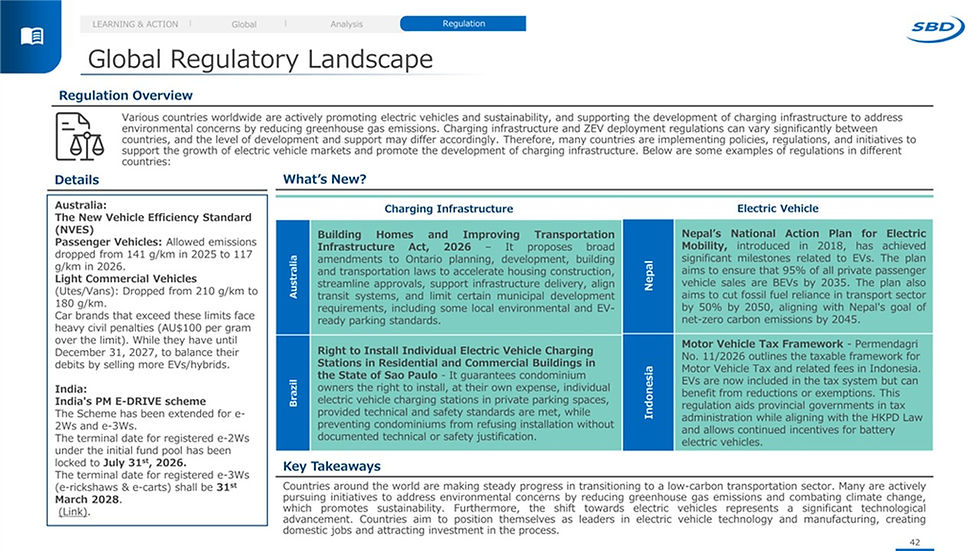
Its National Action Plan for Electric Mobility aims for battery electric vehicles to account for 95% of private passenger vehicle sales by 2035 while reducing fossil fuel dependence in the transport sector by 50% by 2050.
Achieving these targets will require continued investment in charging infrastructure, sustained consumer confidence, and stable long-term policy. As governments refine their electrification strategies, monitoring legislation and incentive programmes provides valuable insight into future market direction and emerging opportunities.
SBD Automotive's 218 – EV & Sustainability Legislation Tracker report covers EV legislation, regulations, policies, standards and best-practice guidelines across Europe, the USA and selected Rest of World markets. Complementing this, the 228 – EV Incentives Tracker report provides in-depth coverage of incentives and government programmes supporting EV adoption. Together, the two trackers provide quarterly updates and detailed Excel databases to help organisations monitor regulatory developments and assess how policy is shaping global electrification.
Takeaways for Automotive Stakeholders
Government policies, legislation and long-term mobility strategies often provide one of the earliest indications of where EV markets are heading. Nepal demonstrates how a consistent policy framework, introduced well before widespread adoption, helped establish the conditions for market growth.
For OEMs and suppliers, Nepal’s experience highlights how changes in incentives, taxation, infrastructure programmes, and electrification targets can provide early signals about future market direction and investment opportunities. In emerging EV markets, policy momentum often appears before large-scale adoption, giving organisations that track these developments a better chance to anticipate where the next phase of growth may occur.
"The next phase of automotive electrification will be driven by a combination of technology innovation and regulatory change. SBD Automotive's 218 - EV & Sustainability Legislation Tracker and 228 – EV Incentives Tracker provides independent coverage of global EV legislation, incentives, standards, and sustainability frameworks." Little Flower - Senior Product Owner at SBD Automotive |  |
How SBD can help
SBD Automotive can help benchmark your position against the wider industry and identify where action is needed most. To explore how these trends impact your strategy, architecture and supplier roadmap, get in touch with SBD Automotive for a deeper discussion. Email info@sbdautomotive.com |


