
The Profitability Path of Automotive AI - Webinar Insights
Artificial intelligence has already reshaped the automotive industry, but one question continues to loom large: can it actually make money?
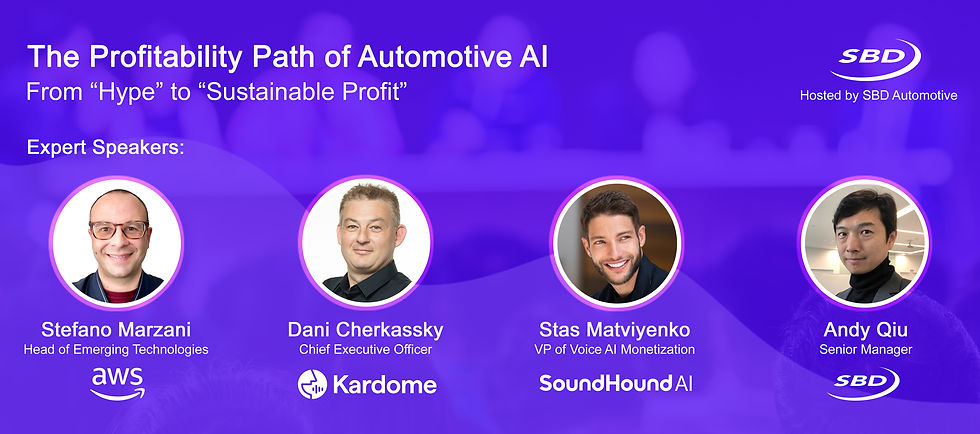
That was the central theme of our recent industry webinar, “The Profitability Path of Automotive AI,” where experts from across the ecosystem such as cloud providers, AI specialists, and automotive strategists, came together to tackle a problem that many OEMs are quietly struggling with: turning AI innovation into sustainable profit.
AI Is Everywhere, But Profit Isn’t
Opening the session, moderator Robert Fisher of SBD Automotive set the tone with a stark reality. AI is no longer experimental. Most OEMs have already deployed AI-powered features, particularly in virtual personal assistants (VPAs), connected services, and advanced driver assistance systems.
Yet despite widespread adoption, profitability remains elusive.
Polling during the session reinforced this: the vast majority of attendees said less than 20% of their AI features are profitable. In other words, the industry has successfully built AI, but hasn’t yet figured out how to monetize it.
“AI in automotive is nothing new,” Robert Fisher noted. “But making AI pay for itself is still very difficult.”
The Economics Shift: From CapEx to Never-Ending Cost
One of the most important insights came from Andy Qiu, Senior Manager at SBD Automotive, who reframed the problem entirely.
“This is not a technology problem,” he argued. “It’s a P&L problem.”
For decades, automotive economics were straightforward: invest upfront (CapEx), ship the car, and lock in costs. But AI, especially cloud-based AI has flipped that model.
“Every time a user interacts with an AI feature, your cloud meter is running,” Andy Qiu explained. “That’s not CapEx anymore. That’s ongoing OpEx every day, forever.”
This creates a dangerous dynamic. The more successful a feature is, the more it costs to operate.
Andy Qiu warned that many OEMs are still flying blind, lacking clear visibility into per-feature costs. The result? A growing portfolio of what he called “zombie features” AI capabilities that look impressive but generate little usage while quietly draining margins.
Tokens, Agents and the “AI Flywheel”

From the cloud perspective, Stefano Marzani of AWS introduced a new way of thinking about AI economics: tokens as the currency of intelligence.
In his view, the future of automotive AI revolves around an “agentic” ecosystem where AI systems don’t just respond, but act.
“The automotive flywheel runs on tokens,” Stefano Marzani explained, describing a loop where:
Tokens power AI interactions
Interactions generate data
Data improves models
Better models drive engagement
Engagement creates revenue
But there’s a catch: integration.
“The business case doesn’t break at the idea layer,” he said. “It breaks at the integration layer.”
Much of the most valuable vehicle data, deep system data, ECU signals and proprietary OEM insights remains locked in silos, making it difficult to monetize. Until those barriers are solved, many AI use cases will struggle to deliver returns.
Fix the Experience, Unlock the Revenue

While cloud economics matter, Dani Cherkassky, CEO of Kardome, argued that profitability ultimately starts with user experience.
“Usefulness and monetization are not separate problems,” he said. “Get the experience right, and revenues will follow.”
He was particularly critical of today’s cloud-dependent voice assistants, describing them as:
Slow
Context-blind
Disconnected from natural conversation
Instead, Dani Cherkassky advocated for a hybrid model inspired by the human brain:
Fast, lightweight AI at the edge for simple tasks
Cloud-based intelligence only for complex reasoning.
This approach reduces cost, improves responsiveness and crucially creates the kind of seamless interaction users are actually willing to pay for. “Customers are willing to pay for things that improve their lives,” he said. “The challenge is getting it right.”
From Assistants to Agents: Where the Money Is
If experience is the foundation, monetization comes from a shift in capability. According to Stas Matviyenko of SoundHound AI, the real breakthrough lies in moving from passive assistants to transactional agents.
“Assistants answer questions,” he said. “Agents complete transactions.”
That distinction is critical. Answering questions consumes resources. Completing transactions generates revenue.
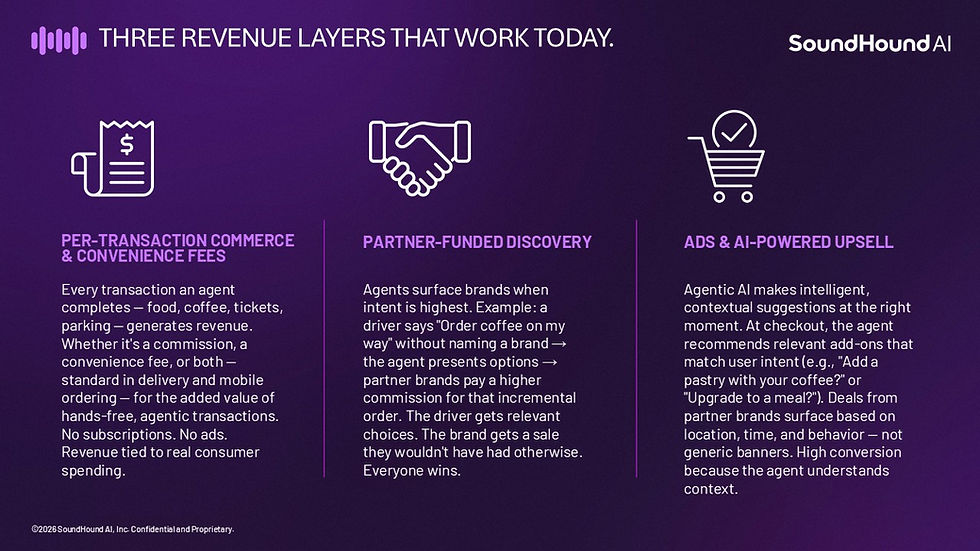
Stas Matviyenko outlined a range of monetization models already emerging:
Convenience fees for services like ordering coffee or booking parking
Commissions from partner businesses
Sponsored discovery, where brands pay to be recommended in context
Upselling, based on user habits and preferences
For example, a car that automatically suggests and orders your usual coffee on your commute doesn’t just enhance convenience, it creates a revenue opportunity. This marks a broader shift away from subscription-only models toward pay-per-use, value-driven monetization.
The Hidden Danger: AI Features That Hurt More Than Help
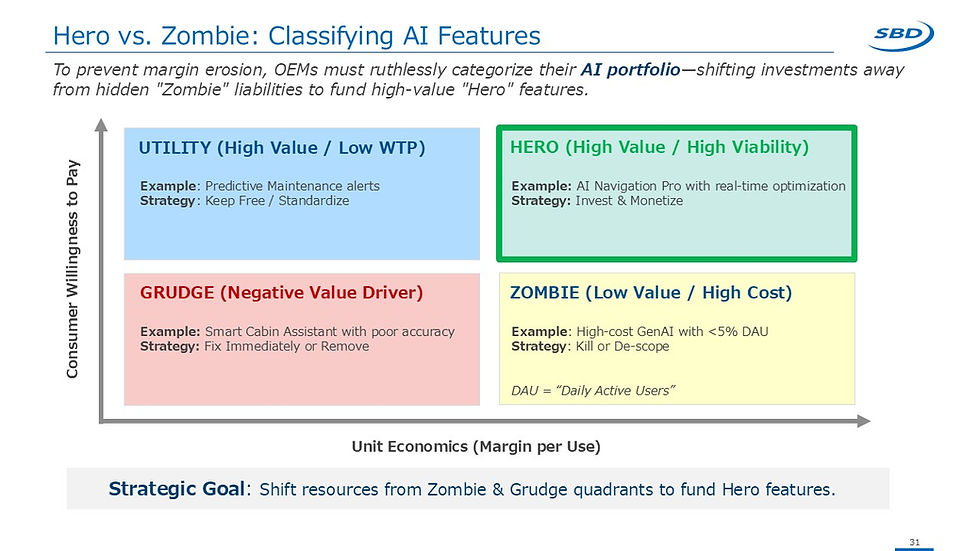
One of the most striking frameworks presented came from Andy Qiu, who categorized AI features into four types:
Heroes – High value, profitable and worth scaling
Utilities – Valuable but expected for free
Zombies – Costly and rarely used
Garages – Poor experiences that actively frustrate users
The uncomfortable reality? Most OEM portfolios are dominated by zombies and garages.
“The biggest opportunity isn’t building more features,” Andy Qiu said. “It’s killing the wrong ones.”
Risk, Regulation, and the Road Ahead
Beyond profitability, the panel also addressed growing concerns around security and regulation.
Agentic AI introduces new risks, from cybersecurity vulnerabilities to unintended actions. As Stefano Marzani noted, AI systems must now be treated not just as tools, but as actors requiring governance, trust frameworks and safeguards.
At the same time, regulation is struggling to keep pace. “AI regulation is behind the development of the industry,” Andy Qiu observed, pointing to global inconsistencies and the added complexity of privacy laws in regions like Europe.
Three Takeaways for the Industry
As the session closed, Robert Fisher outlined the discussion into three key messages:
AI is no longer a one-time investment, it’s an ongoing operational cost.
More features don’t equal more value. Only useful, used features matter.
Revenue won’t come from subscriptions alone, new monetization models are essential.
Meet the Experts

Stefano Marzani – Amazon Web Services - As Worldwide Leader for Emerging Technologies for Automotive and Manufacturing at AWS, Stefano Marzani focuses on solving some of the most complex challenges in safety-regulated industries. With over 20 years of experience spanning IoT, cloud platforms, vehicle architectures, and human-machine interaction, he has played a key role in advancing cloud-to-vehicle “environmental parity” architectures. His work is helping accelerate the shift toward software-defined vehicles, enabling more efficient development of autonomous capabilities and connected services.
Dani Cherkassky – Kardome - Dani Cherkassky, CEO and Co-Founder of Kardome, is a speech-AI expert leading innovation in real-time, edge-based voice technologies for complex environments. With a PhD in speech AI, Dani is focused on solving one of the most persistent challenges in automotive AI: delivering reliable performance in noisy, real-world conditions. His work addresses the gap between technical capability and user experience, ensuring that voice interfaces are not only functional but commercially viable.


Stas Matviyenko – SoundHound AI - As VP of Monetization at SoundHound AI, Stas Matviyenko leads the development of agentic voice commerce platforms that enable seamless transactions through AI-driven interactions. A seasoned entrepreneur and former Founder & CEO of Allset, Stas has a proven track record of building and scaling successful technology platforms. Named to the Forbes 30 Under 30 list, he brings a strong perspective on how voice AI can evolve into a powerful revenue-generating channel within the connected vehicle ecosystem.
Andy Qiu – SBD Automotive - Andy Qiu Senior Manager at SBD Automotive, specializing in AI, cybersecurity, and 5G. With over 15 years of IT experience and a decade in automotive, he has collaborated with more than 30 OEMs on advanced connectivity and security solutions. Andy’s work bridges technical innovation and business strategy, helping organizations navigate the transition to software-defined vehicles while making informed, ROI-driven decisions.

Watch the Full Webinar
For a deeper dive, including detailed examples, live polling insights and the full expert roundtable, you can watch the complete webinar recording here.


